Baba
Gagging kundalinii
Namaskar,
We all know that when doing sadhana, one should sit in the proper position with an erect spine according to the system. If this is not done, sadhana will not be proper.
Ananda Marga Caryacarya, “Padmásana (lotus posture): Place the right foot on the left thigh and the left foot on the right thigh. Clench the jaws and press the tongue against the roof of the mouth. You can maintain this posture as long as you like.” (1)
Senior Acarya Diary guides us that if one’s spine is bent then the kundalini will not be able to rise up. And that is what needs to happen in sadhana. The kundalinii resides in the muladhara cakra at the base of the spine. And when doing mantra japa, then the kundalini awakens. And if mantra japa continues then kundalini rises towards the sahasrara cakra.
http://anandamargauniversal.blogspot.com/
Poor show by two Dadas
But if one's spine is bent or curved, as shown in the below photo, then the pathway of the kundalinii is blocked and sadhana is useless. Sadly, the below two Dadas are setting a very bad example and not even trying to sit properly in sadhana:
(a) In the first photo, Dadaji’s hands are not in the correct position; he is not sitting in padmasana, but rather bhojanasana, i.e. a posture used when eating.
(b) In the second photo, Dadaji is sleeping so his spine is completely bent and his head has fallen to his chest.
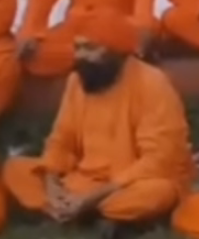
In the above photo, Dadaji’s hands are not in the correct position; he is not sitting in padmasana, but rather bhojanasana, i.e. a posture used when eating.

In the above photo, Dadaji is sleeping so his spine is completely bent and his head has fallen to his chest.
That is why Baba’s directive is to sit with an erect spine preferably in padmasana. Those who want their sadhana to be fruitful should sit properly. Not only that, if someone near you is not sitting properly then their existential vibration will hurt you as well. Sincere sadhakas should watch in dharmacakra and if someone is obviously sleeping or sitting with a bent spine, then that person should be awakened and they should sit erect. Because posture is the most fundamental aspect of doing sadhana properly, as per Caryacarya. The central idea is that first and foremost one should sit in the proper posture for sadhana and then try to do the various steps.
http://anandamargauniversal.blogspot.com/
Dada ji is displaying his dirty laundry
In Human Society book, Baba guides those parents who are smoking or drinking liquor should give them up and be an example to their offspring. And if one cannot give them up then at least do not display these bad habits in front of kids. Similar is the case of some Dadas. These above two Dadajis are sitting in improper posture and then they put the photos on Facebook for the whole world to see. In my unit, avadhutas are revered so many new margiis started emulating Dadaji and they began sitting like this. I noticed this change in their posture and inquired about it. And they all said they learned this bent posture from seeing Dadaji’s photo on Facebook. So watch out, a negative example has far reaching effects.
Importance of keeping spine straight
#1: In the Senior Acarya Diary chapter on Iishvara pranidhana, section - “shuddhis”, Baba is describing that when sitting in meditation (padmasana, siddhasana, viirasana) one must keep the back straight so that the kundalini can the passage to rise upward from muladhara to sahasrara.
http://anandamargauniversal.blogspot.com/
#2: Ananda Marga philosophy states, “Tailless apes can be taught sádhaná after some effort. The tailed bipeds will not be able to do sádhaná like the tailless bipeds because the backbone of the tailed bipeds, containing the controlling points of the five fundamental factors, does not come in one line. The controlling points fall on a curved line, hence they cannot perform sádhaná properly.” (2)
#3: Ananda Marga philosophy states,” Mono-sided, straight or erect beings can perform sádhaná very well because all the five controlling points of the fundamental factors fall on a straight line...You see how fortunate you are to have a human biological structure. You have got a human frame. Humans should be obliged to Supreme Consciousness for this favour.” (3)
#4: Ananda Marga philosophy states, "The one who has followed the straight path of the sus'umna' canal upwards becomes one with Parama Purus'a." (4)
#5: Ananda Marga philosophy states, “Ujure uju cháŕi ná leo re báḿka. The word “uju” in Saḿskrta is derived from the Saḿskrta word “rju”. “Rju” means straight. The meaning of this line is “don’t accept the crooked path rejecting the straight one”. That is, just proceed along the path of “suśumná” not along the path of “id́á” and “piuṋgalá”.” (5)
How padma'sana helps in concentration
Our Ananda Marga system of sadhana adheres to the age-old yogic theorem: As you think so you become. So in order to achieve that high spiritual state one must first withdraw the mind from worldly propensities and goad the mind towards Parama Purusa.
http://anandamargauniversal.blogspot.com/
Hence our first duty in sadhana is not to allow our mind to run towards the external world via the indriyas (organs). Because when the 10 indriyas are sending signals to the brain and the brain engages in processing and receiving those messages, then one's mind becomes extroverted and restless, making sadhana impossible. So first and foremost in meditation is to withdraw the mind from these external stimuli. That means gaining control over the motor and sensory organs. Then one can begin to see within. And for this process, Sadguru Baba directs us that padma'sana is the most effective posture.
How to sit in sadhana
Everyone is aware that the lotus (padma) takes root in the mud and grows up through that murky pond water until it finally blossoms and flowers on the water's surface. Thus despite living in dirty surroundings the lotus flower maintains its pristine purity.
Likewise we human beings live in this busy world where everything is under the bondage of maya, yet we aim to keep the mind above this quinquelemental world - and towards the spiritual Goal. For this endeavour, padma'sana helps a lot.
Here below Baba directs us how to sit in lotus posture and at the same time describes the special import of padma'sana.
Ananda Marga philosophy says, "Padma'sana is the posture of sitting with the right ankle over the lift thigh and the left ankle over the right thigh, the tongue pushing the teeth out. In padma'sana alone, the vision can be fixed on trikuti - the middle point between the eyebrows. Just as the lotus blossoms forth in water, so also in this posture the mind tends to evolve. That is why this posture is termed padma'sana (padma - lotus, a'sana - posture). This is the best a'sana for meditation." (6)
So by sitting in padma'sana the mind naturally gets goaded toward the higher cakras, thereby helping one to succeed in meditation. That is why padma'sana is the top posture for sadhana.
http://anandamargauniversal.blogspot.com/
"Like a lotus transcending all the impurities"
In order to set a proper example for the people, Lord Shiva Himself would always take to this position.
Baba says, "Usually He [Lord Shiva] would sit in a posture called padma'sana . It is called padma'sana because it is just like a lotus in full bloom. Just as the roots and stems of the lotus remain under the water and only the leaves and flowers float above it -- and although it is born in the mud it sustains its love for the stars -- in the same way, people sitting in this lotus posture and remaining in the world, can keep their minds above their mundane environment. That is why on the path of sa'dhana' this posture has tremendous importance. Even though He took upon Himself all the physical and psychic responsibilities of the entire world, Shiva, when seated in this posture, was just like a lotus in full bloom, transcending all the impurities and dirt of the mind." (7)
So in the above quote Baba tells how this was the special posture used by Lord Shiva and then Baba again explains the special inner significance of sitting in padmasana and how it relates with the lotus flower.
Conclusion
Yet progressing in sadhana is not easy - it demands a strong commitment and a determined effort. Our each and every aspect of meditation should be proper and pointed. So if when doing meditation one just lazily sits in bhojana'sana (eating posture in cross-legged position) and one's sadhana is hazy and loose because the mind is not concentrated, then surely success remains a distant dream.
http://anandamargauniversal.blogspot.com/
Because to do anything great, it demands taking a strong vow and commitment. Only then can one reach the Goal.
For this reason, all great yogis take that special effort to sit for meditation in padmas'ana since it helps the mind rise up above the all worldly propensities and temptations, and enables one to move towards that spiritual stance.
Baba has given a step-by-step procedure for doing sadhana - everything from half-bath, to padmasana, to shuddhis all the way up to Guru puja and sastaunga pranam. If any of these steps - including padmasana are missing - then that qualifies as lazy sadhana.
Namaskar,
in Him,
Devadatta Pandey
For reasons of privacy we are not mentioning this Dada’s name. The above scene is from a sadhana program; if anyone is interested then we can show you the larger image.
http://anandamargauniversal.blogspot.com/
Ananda Marga Caryacarya says, "When children are five years old and attain some awareness, the parents, brothers, sisters or any guardian may initiate them in Na'ma Mantra [the preliminary process of meditation]. They should be taught to sit in padma'sana [lotus posture], but instead of interlocking the fingers, they may rest one palm upon the other; and keep the spine erect." (8)
Ananda Marga Caryacarya says, “After this, at the age of twelve, the child should take initiation from an ácárya/á in Sádhárańa Yoga, and at sixteen or afterwards, they should take initiation in Sahaja Yoga from the ácárya/á. If considered essential, ásanas may be taught before the age of sixteen.” (9)
Ananda Marga ideology guides us, “Proper attention should be paid to the physical, psychic and spiritual development of small boys and girls. Just as they sit and study to develop their intellectual capabilities, they should also sit to do their spiritual practices with their parents. That is the way they will develop their spiritual practices. They should take diikśá [spiritual initiation] from an ácárya(á) [spiritual teacher] when they grow up. They should practice the lessons of sádhaná – japa, dhyána, ásana, práńáyáma, etc. – along with their regular academic lessons. All that is necessary for their trifarious development, and it must be perfectly balanced. One should remember that the absence of a proper balance will harm not only the individuals, but also the society as a whole.” (10)
References
1. Caryacarya - 3, Asanas
2. Yoga Psychology, The Human Body Is a Biological Machine
3. Yoga Psychology, The Human Body Is a Biological Machine
4. Namami Krsnasundaram, Párthasárathi Krśńa and Vishiśt́ádvaetaváda (Discourse 16)
5. Ananda Marga Karma Yoga in a Nutshell, “Kurvanneveha Karmmáńi”
6. Táttvika Diipiká (Paiṋcama Parva)
7. Namaj Shivaya Shantaya, Discourse 20
8. Caryacarya - 1, chapter 2
9. Caryacarya 1- The Process of Initiation
10. The Awakening of Women, Táńd́ava and Kaośikii
Other topics of interest
#5: Ananda Marga philosophy states, “Ujure uju cháŕi ná leo re báḿka. The word “uju” in Saḿskrta is derived from the Saḿskrta word “rju”. “Rju” means straight. The meaning of this line is “don’t accept the crooked path rejecting the straight one”. That is, just proceed along the path of “suśumná” not along the path of “id́á” and “piuṋgalá”.” (5)
How padma'sana helps in concentration
Our Ananda Marga system of sadhana adheres to the age-old yogic theorem: As you think so you become. So in order to achieve that high spiritual state one must first withdraw the mind from worldly propensities and goad the mind towards Parama Purusa.
http://anandamargauniversal.blogspot.com/
Hence our first duty in sadhana is not to allow our mind to run towards the external world via the indriyas (organs). Because when the 10 indriyas are sending signals to the brain and the brain engages in processing and receiving those messages, then one's mind becomes extroverted and restless, making sadhana impossible. So first and foremost in meditation is to withdraw the mind from these external stimuli. That means gaining control over the motor and sensory organs. Then one can begin to see within. And for this process, Sadguru Baba directs us that padma'sana is the most effective posture.
How to sit in sadhana
Everyone is aware that the lotus (padma) takes root in the mud and grows up through that murky pond water until it finally blossoms and flowers on the water's surface. Thus despite living in dirty surroundings the lotus flower maintains its pristine purity.
Likewise we human beings live in this busy world where everything is under the bondage of maya, yet we aim to keep the mind above this quinquelemental world - and towards the spiritual Goal. For this endeavour, padma'sana helps a lot.
Here below Baba directs us how to sit in lotus posture and at the same time describes the special import of padma'sana.
Ananda Marga philosophy says, "Padma'sana is the posture of sitting with the right ankle over the lift thigh and the left ankle over the right thigh, the tongue pushing the teeth out. In padma'sana alone, the vision can be fixed on trikuti - the middle point between the eyebrows. Just as the lotus blossoms forth in water, so also in this posture the mind tends to evolve. That is why this posture is termed padma'sana (padma - lotus, a'sana - posture). This is the best a'sana for meditation." (6)
So by sitting in padma'sana the mind naturally gets goaded toward the higher cakras, thereby helping one to succeed in meditation. That is why padma'sana is the top posture for sadhana.
http://anandamargauniversal.blogspot.com/
"Like a lotus transcending all the impurities"
In order to set a proper example for the people, Lord Shiva Himself would always take to this position.
Baba says, "Usually He [Lord Shiva] would sit in a posture called padma'sana . It is called padma'sana because it is just like a lotus in full bloom. Just as the roots and stems of the lotus remain under the water and only the leaves and flowers float above it -- and although it is born in the mud it sustains its love for the stars -- in the same way, people sitting in this lotus posture and remaining in the world, can keep their minds above their mundane environment. That is why on the path of sa'dhana' this posture has tremendous importance. Even though He took upon Himself all the physical and psychic responsibilities of the entire world, Shiva, when seated in this posture, was just like a lotus in full bloom, transcending all the impurities and dirt of the mind." (7)
So in the above quote Baba tells how this was the special posture used by Lord Shiva and then Baba again explains the special inner significance of sitting in padmasana and how it relates with the lotus flower.
Conclusion
Yet progressing in sadhana is not easy - it demands a strong commitment and a determined effort. Our each and every aspect of meditation should be proper and pointed. So if when doing meditation one just lazily sits in bhojana'sana (eating posture in cross-legged position) and one's sadhana is hazy and loose because the mind is not concentrated, then surely success remains a distant dream.
http://anandamargauniversal.blogspot.com/
Because to do anything great, it demands taking a strong vow and commitment. Only then can one reach the Goal.
For this reason, all great yogis take that special effort to sit for meditation in padmas'ana since it helps the mind rise up above the all worldly propensities and temptations, and enables one to move towards that spiritual stance.
Baba has given a step-by-step procedure for doing sadhana - everything from half-bath, to padmasana, to shuddhis all the way up to Guru puja and sastaunga pranam. If any of these steps - including padmasana are missing - then that qualifies as lazy sadhana.
Namaskar,
in Him,
Devadatta Pandey
For reasons of privacy we are not mentioning this Dada’s name. The above scene is from a sadhana program; if anyone is interested then we can show you the larger image.
http://anandamargauniversal.blogspot.com/
Ananda Marga Caryacarya says, "When children are five years old and attain some awareness, the parents, brothers, sisters or any guardian may initiate them in Na'ma Mantra [the preliminary process of meditation]. They should be taught to sit in padma'sana [lotus posture], but instead of interlocking the fingers, they may rest one palm upon the other; and keep the spine erect." (8)
Ananda Marga Caryacarya says, “After this, at the age of twelve, the child should take initiation from an ácárya/á in Sádhárańa Yoga, and at sixteen or afterwards, they should take initiation in Sahaja Yoga from the ácárya/á. If considered essential, ásanas may be taught before the age of sixteen.” (9)
Ananda Marga ideology guides us, “Proper attention should be paid to the physical, psychic and spiritual development of small boys and girls. Just as they sit and study to develop their intellectual capabilities, they should also sit to do their spiritual practices with their parents. That is the way they will develop their spiritual practices. They should take diikśá [spiritual initiation] from an ácárya(á) [spiritual teacher] when they grow up. They should practice the lessons of sádhaná – japa, dhyána, ásana, práńáyáma, etc. – along with their regular academic lessons. All that is necessary for their trifarious development, and it must be perfectly balanced. One should remember that the absence of a proper balance will harm not only the individuals, but also the society as a whole.” (10)
References
1. Caryacarya - 3, Asanas
2. Yoga Psychology, The Human Body Is a Biological Machine
3. Yoga Psychology, The Human Body Is a Biological Machine
4. Namami Krsnasundaram, Párthasárathi Krśńa and Vishiśt́ádvaetaváda (Discourse 16)
5. Ananda Marga Karma Yoga in a Nutshell, “Kurvanneveha Karmmáńi”
6. Táttvika Diipiká (Paiṋcama Parva)
7. Namaj Shivaya Shantaya, Discourse 20
8. Caryacarya - 1, chapter 2
9. Caryacarya 1- The Process of Initiation
10. The Awakening of Women, Táńd́ava and Kaośikii
== Section 2: Links ==
Recent postingsOther topics of interest