Search This Blog

Showing posts with label unity. Show all posts

Wednesday, April 9, 2025

When to capitulate + 5 more

Baba
When to capitulate 

Namaskar,

Here is an example for us all to consider. In 1970, when the defectors like Madhavananda, Vishokananda, and Prakashananda went against Ista - betrayed Guru, then some simple people, who had sentimental friendships with those defectors, wanted to keep everyone together. Those simple sadhakas requested Baba to allow those defectors to remain in the organisation even though they blatantly contravened the very foundational tenets of Ananda Marga ideology. In their naïveté, those simple people wanted to overlook the ideological blunders of those defectors - and have everyone coexist once again. This is what they asked from Baba.
https://anandamargauniversal.blogspot.com/


Never compromise with those against dharma

However, Baba took a very firm stand - an ideological stand - on this issue, and the rest is history. Baba did not wish to send messengers to those defectors and compromise with their adharmic demands and console them. Instead, on their own accord, those defectors strayed far, far away and never returned. And our AM rose to the height of glory. There were some simple people who were duped and tricked by such defectors. Those naive people joined them initially; and, Baba openly welcomed them back. While those who deliberately joined those defectors had to face punishment before being allowed back into AM.

By this incident, Baba demonstrates through His own Personal example that when it comes to ideology, there must not be any compromise. Rather one is to stand tall on all ideological matters. Scanning the present day situation, how can we forgive those who have altered Baba's teachings, and done so many heinous crimes which go against Ananda Marga ideology. How can we simply forgive and excuse such people. In so many teachings Baba has guided us to never compromise on ideological matters - never.
https://anandamargauniversal.blogspot.com/

Ananda Vanii says, "Fight for your Ideology. Be one with your Ideology. Live for your Ideology. Die for your Ideology." (1)

Ananda Marga philosophy guides us, "Where the question of benevolence and malevolence is concerned we will not deviate an inch from our ideology." (2)

Ananda Vanii states, "Life represents Ideology. Life should be sacrificed for Ideology." (3)


Blunder to have a pact with wrongdoers


By His own example and in His teachings, Baba guides us to always live by the high ideals of Ananda Marga - never compromise. This following passage from Guru’s discourse leads in this same direction. This below paragraph has been paraphrased from AV-26 (H) pg 34. It is based on the original Hindi and if anyone has this book and can post the original Hindi section, then that will be very helpful.

Here then is the essence of Baba's message from that portion of His discourse where Baba is pointedly explaining that there must not be any pact made with those who are opposed to our principles.
https://anandamargauniversal.blogspot.com/

Remember one can have a temporary ceasefire with the black forces, but there cannot be a pact...do you know what a cease-fire is? For example, two battling parties may decide that there will not be any fighting at night, and that the fighting will resume in the morning. So in a temporary cease-fire the fight has not been stopped permanently; it will continue after a short period of pause by paying their ransom. So this is what is known as a temporary ceasefire. In contrast, what is a pact? When a pact is made then a compromise of values is done and each side accepts certain conditions and sacrifices their own ideological platform...Remember, at any cost there will never be a pact with the black forces, i.e. the negative forces. And that cease-fire will be done with the sole intention to increase your own strength. For example, suppose you are alone and the dark forces surrounding you are ten in number. Then for the time being one can make a ceasefire with those black forces by paying their ransom; but, then tomorrow you will have to collect 20 fighters to join your cause and then start your offensive against those black forces. That is the use of a temporary ceasefire. Virtuous people must remember that one can never make a pact with the sinful forces. (English summary of original Hindi Ananda Vacanamrtam, Part 26, page 34)


Conclusion


In unambiguous language in His above teaching, Baba directs us that we must never sacrifice our ideals by making a pact with sinful agents - i.e. those who go against the welfare of humanity. On this point, Baba maintains that we must live by and fight for our ideals, i.e. Ananda Marga ideology.
 
Namaskar,
Sastaunga Pranam to Baba,
Rakesh Ranjan

Here are some very unique precedents from Sadguru Baba's own actions and dealing where He refused to compromise on points of ideology. We are to apply these same measures in our organizational / ideological life.


~ In-depth study ~

What genuine bhaktas do

In the practical sphere, our Ananda Marga has never made a pact with or bowed down to communists, capitalists, or any type of anti-social leaders etc. No matter what the circumstances, always we are to abide by our Ananda Marga ideals. That is Baba's directive, and that is what sincere margiis do.
https://anandamargauniversal.blogspot.com/

Ananda Marga ideology guides us, "The person will welcome that death rather than compromise with sin and vice. Therefore keep in mind that those who are genuine devotees, sádhakas of high order, loved by Parama Puruśa and closely bound to Parama Puruśa in love and affection, will never compromise with sin and vice. They will cling to their ideal totally, throughout their lives." (4)


Stick to AM ideals irrespective of praise or abuse


Ananda Marga ideology states, "Humans should never allow themselves to descend to paradharma, the dharma of birds and beasts, of trees and plants. On no account should animal dharma be encouraged. The flag of mánava dharma must always be held high under all circumstances...upholding the ideal of humanity; one should never allow oneself to fall back into a state of animality." (5)

Ananda Marga ideology states, "The shástras say that a person must stick to his ideals irrespective of whether he receives praise or abuse, whether wealth comes or wealth goes, whether he lives a thousand years or suffers death the next moment. Such a person is called “dhiira”. My direction to you is to be Dhiira. You must stick to your ideals in spite of everything. In this lies your spiritual growth." (6)

References
1. A'nanda Va'nii #14
2. Namah Shiváya Shántáya, Disc: 14
3. A'nanda Va'nii #15
4. Discourses on Krsna and the Giita, Svadharma and Paradharma – 3
5. Discourses on Krsna & The Giita, “Better to Die . . .” – 2
6. Ananda Vacanamrtam - part 1, What Do You Want?


*        *        *

The below sections are entirely different topics, unrelated to the above material.
They stand on their own as points of interest.

*        *        *

== Section 2: Important Teaching ==

Perfecting the kośas
  
Ananda Marga ideology guides us, "The paincakośas shall have to be perfected, but how is it possible? They can be consummated only through the practice of yama and niyama [and the various lessons of sadhana]. The annamaya kośa is perfected through asanas (physical postures). Yama and niyama sádhana perfect the kámamaya kośa. The manomaya Kośa is perfected through pránáyáma. Through pratyáhára the atimánasa kośa is perfected. The vijinánmaya kośa is perfected through dhárańá and the hirańmaya kośa through dhyána. Only dhyána samádhi gives access to the soul. Pious persons are those who are earnest in their efforts to perfect the paincakośa. Human existence consists of the five kośas and spiritual practice is eightfold. This spiritual practice is Dharma. That which does not provide for the explanation of the paincakośa is not Dharma, but sectism." (1)

Ananda Marga ideology says, "The loka above this where the hiran'maya kos'a (subtle causal mind) is established is what we call devarloka (satya loka). When sa'dhakas merge their petty I-feeling from the realm of the devarloka (where this I-feeling is not very much evident) -- into the bearing of the Great, they establish themselves fully in Sagun'a Brahma (Qualified Consciousness -- the collectivity of Parama'tman, Macrocosm and Microcosm). In this loka, if the whole of the I-feeling (asmita) is shattered and merged in Purus'a, the unit attains total identification with Nirgun'a Brahma (Unqualified or Objectless Consciousness). This loka is the satyaloka -- this indeed is the Brahmaloka. The one who is established in this loka is alone the Brahman'a (Bra'hmin')." (2)

Reference
1. Subhasita Samgraha - 1, Invocation of the Supreme
2. Ananda Marga Ideology & Way of Life - 5, This World and the Next


== Section: Important Teaching ==

Psychology behind animal slaughter

Ananda Marga philosophy says, "When people sacrifice a goat or buffalo in a religious festival while chanting “Divine goddess, divine goddess!” before a deity, they know that the animal is an irreplaceable part of creation, but still they slaughter it. This is hypocrites' dogma. If a man kills his brother before his mother, will it please his mother? No, it cannot. The difference between these two examples is that the deity is unable to do anything to stop the slaughter, while the mother is quite capable of taking the necessary action. Otherwise, the deity would certainly interfere and stop the cruel, useless sacrifice." (1)

Reference
1. Prout in A Nutshell - 16, Religious Dogma – Excerpt B


== Section: Important Teaching ==

Contrasting morality: cities vs villages


Prout philosophy states, “Today there are too many obstacles on the path of morality. Urban civilization is one of the chief reasons of moral degeneration because many people are compelled to live undesirably in small, congested places. This is inimical to morality in individual life. Solitary living for some time is essential for the cultivation and development of morality.”

“Where the population is very dense, milk and vegetables are in short supply, and these are indispensable for healthy survival. When the demand is more than the supply, adulteration goes unchecked. To meet the deficit in the supply of milk, people mix water with it. To meet the demand for diamonds, imitation diamonds are produced, because the demand is more than the supply. Cities become dens of corruption because of antisocial elements, but generally such things are not noticeable in villages.” (1)

There are many swindlers lurking in their midst


Prout philosophy states, “In villages, everybody knows everyone else. Everybody knows the livelihood of their neighbours. But even after twenty years of living in a city people seldom get acquainted with their neighbours. They don’t even know that there are many swindlers lurking in their midst.”

“However, the slogan, “Go back to the village” alone will not suffice. City life has a great attraction for people generally so they run to cities for their livelihood. To stop this trend intellectuals and others will have to look for their livelihood in villages. The supply of cheap electricity and the expansion of cottage industries in villages are of paramount necessity today. By cottage industries I do not mean outdated, primitive handicrafts. Cottage industries must be efficient, modern mechanized units.”

“From the economic viewpoint decentralization is an absolute necessity. With the exception of heavy industries and essential government offices, all industry should be shifted to the villages. To stop overcrowding in the cities this is the only feasible approach.”

“Villages are not congested, so antisocial people will not be able to hide themselves there. If they try, the police can easily detect them.” (2)

References
1. Prout in a Nutshell - 6, Dialectical Materialism and Democracy
2. Prout in a Nutshell - 6, Dialectical Materialism and Democracy


== Section: Important Teaching ==

All languages should have their rightful due place

Prout philosophy states, “India is a multi-lingual and multi-religious country. If a particular regional language is declared the national language, it would be very detrimental to the overall welfare of the country. Rather, all the languages spoken in India should be recognized and encouraged. In this regard, India should follow the example of some other countries. In Switzerland, for instance, four languages are recognized as state languages – German, Italian, French and Romansch – although more than twice as many people speak German than the total speaking the other three languages. This is the correct approach, as it does not go against the collective psychology of the people.”

Prout philosophy states, “”For the all-round welfare and development of human beings, society needs to follow some fundamental socio-political principles. Without the firm foundation of such principles, disunity, injustice and exploitation will flourish. To avoid this and to safeguard the interests of all people, the leaders of society must ensure that cardinal socio-political principles are strictly followed. Otherwise, individual and collective progress can never be achieved.”

"There are three cardinal socio-political principles which should never be violated…..Thirdly, no mother tongue should be suppressed." (1)

 Reference
1. Prout in a Nutshell-16, Three Cardinal Socio-Political Principles


== Section: Hindi Teaching ==

यन्त्रवत बन जाएँगे

“अब देखा जाए, कर्म---the philosophy of action, the actional approach | कोई एक कर्मवीर हैं, ख़ूब कर्म करते हैं, स्वार्थ-विहीन कर्म करते हैं---मगर तो भी उनसे कुछ काम नहीं होगा, अगर उनमें भक्ति की कमी हो | शुरुआत में अगर उनकी कर्म-प्रचेष्टा में थोड़ा-सा भी अन्तर्मुखीन भाव हो, तो भी आख़िर तक, अर्थात्‌ दूसरे चरण में होगा क्या ? भक्ति नहीं रहने के कारण उसकी गति बहिर्मुखीन हो जाएगी---और, कर्म उनको जड़ से जड़ बना देगा | आख़िर तक वे  यन्त्रवत बन जाएँगे, मानवता से बहुत दूर हट जाएँगे | इसलिए भक्ति-विहीन कर्म में परमार्थ नहीं है; है अनर्थ |”

[यह प्रवचन-अंश, बाबा के कैसेट से सीधे लिखा गया है । बाबा का यह असली प्रवचन, अमृतोपदेश है। आनन्दमार्ग हिन्दी पुस्तकों में छपे प्रवचन तो नक़ली प्रवचन हैं, असली नहीं हैं -- बंगालीकरण (बँगलाइजेसन) के तहत उनकी बर्बादी की गई] (1)

Reference
1. GD 13 September 1978 Patna


== Section: Important Teaching ==

All this led to mutual animosity in the world of religion

Ananda Marga philosophy states, "In the absence of knowledge of common psychology, people of different religions try to destroy other religions. This has resulted in the spilling of rivers of blood. In ancient India the Aryans tried to impose their own Vedic religion on the Austric community. In the Buddhist era, particularly during the reign of King Bimbisára, Buddhism was imposed on other religions. Later, the followers of the Sanátana Hindus forcibly converted the Buddhist and Jains into Hinduism. During Moslem rule Islam was imposed on India, Persia and Egypt. Similarly, countless Jews were converted into Christianity. During the British period attempts were made by Christian missionaries to subvert Hinduism and impose Christianity on the indigenous population. All this led to mutual animosity in the world of religion." (1)

Reference
1. AFPS-2, Human Society Is One and Indivisible – 2


Baba gave me proof
Rule for donating money + Show of pracara

Bathing: dharmic system

AM's practical foundation


Tuesday, August 6, 2024

Human culture: singular + 4 more

Baba
Human culture: singular

Namaskar,

Commonly people think there are so many cultures: African, European, Native American, Chinese, Russian, Indian etc. Indeed, various terms like multi-cultural, plurality of cultures, bicultural, cultural pluralism etc are very commonly used. People think humans differ according to their own "separate culture". It is often thought that there are many different cultures on this planet.
https://anandamargauniversal.blogspot.com/

In that case, people look upon others as being different. They aim to tolerate differences, yet ultimately feel that "such persons are not like me - they are foreign - we can live together by tolerating differences - but their culture is different from my culture."

According to Baba's teachings, this is neither correct nor should this be our outlook. We must embrace one and all as our own and cultivate feelings of love and cordiality - not tolerance. Human culture is one - not many. As Ananda Margiis, we must fully understand Baba's sublime teachings on culture, and gain clarity on how human culture is one.


What is culture

First and foremost, according to Baba Shrii Shrii Anandamurti ji, culture is the collective name of various human expressions: approach to education, eating and food, way of salutation and greetings, types of songs, ways to dance, raising children, social interactions, responsibility toward others, values and social norms, style of dress, friendships etc. Every human group has these kinds of expressions. Some of which have been addressed below. The sum total of all these expressions is known as culture.
https://anandamargauniversal.blogspot.com/

Baba says, "Culture…is the collective name of different expressions of human life." (1)


Human culture is one: greetings


Let's examine a few practical examples to better understand what is culture.

As we know, when people meet, they greet each other. This practice of humans greeting each other when they meet is pervasive. It happens everywhere. A person in the hills of North Korea greets their friend; and, a person from a valley in California greets their friend. In both cases, in some way, they greet their relations. This is a common practice. This is culture. And because it is everywhere, culture is one.

Certainly, people from different lands may express their greetings differently, but those different ways of greeting do not stand as different cultures, but rather as cultural expressions.
https://anandamargauniversal.blogspot.com/

For instance, in Ananda Marga we do namaskar or pranam; in some lands, people bow to one another; in other countries people wave their hand and say hello; in some places people say shalom; in other lands people embrace one another or kiss; and many resort to handshaking also. Thus there are many ways that people greet each other. But these various types of greetings do not represent different cultures. The act of greeting is itself human culture and singular; and, the various ways that greetings are done are various cultural expressions.


Human culture is singular


So culture is the act of greeting, irrespective of how it is done. On this point, all human beings share a common thread; they all greet one another. The practice of greeting a friend or neighbor etc is shared by all peoples in all lands. The very act of greeting another person is itself our human culture. Thus, human culture is singular - not many.

Some may try and bifurcate the society by dividing people into this culture or that culture. But, in truth, there is a common thread that is shared among all. The act of greeting a fellow human being is one such common point. Again, there may be various ways of greeting a friend, but, in reality, people from all various places are all doing the same thing, i.e. performing greetings.

It should be very clear that the greeting itself is culture, while the way people greet one another is a cultural expression, which may be innumerable but culture itself is one. That is how human culture is one - not many.
https://anandamargauniversal.blogspot.com/

Here we have to remember that internally humans are one, and human culture is singular in number; only externally there are a multitude of cultural expressions and variations.


Human culture is one: expressing one's happiness


Let's take another example: All over the world people express their joy or happiness. This expression of happiness is common to all. This is culture. If someone is happy in Thailand then they express their happiness, and if someone is happy in Alaska or Siberia then they too express their happiness. Expressing happiness is the culture of human beings: When they are happy then they express themselves in some way.

It may be through art, dance, laughter, drama, music and so many ways. But human happiness itself is a common point everywhere. So human beings are one, irrespective of their geographical area. Because their culture is one, i.e. when they are happy they express their joy.
https://anandamargauniversal.blogspot.com/

And they may do this in various ways: some may laugh loudly; others might just smile; some might dance half naked in the street; while still others might decorate their dress with flowers. Around the globe, people express their happiness differently.

Cultural expression is different in various lands


People of Thailand may dance in a way different from residents of Alaska or Siberia. But that difference in style is the cultural expression of that area. Human culture is one: To express happiness.

One should not confuse culture and cultural expression. Culture is the trunk of the tree and the cultural expression refers to all those branches, and limbs that stem off of the main tree trunk. So human culture is one, i.e. expressing happiness when they are happy.

In other words, in different lands, people express their joy or happiness in various ways. Some sing, some dance, some clap, some whistle, some smile, some laugh, some slap hands, and others hug. There are so many ways people express their happiness. These variations are not culture, but rather local cultural expressions which are different in various lands. The main theme is that when they are happy, they express their happiness. That is common everywhere. That is culture and that is one.
https://anandamargauniversal.blogspot.com/

All human beings are one and human culture is one: (a) everyone greets, (b) everyone expresses happiness, and (c) many practices can be included in this list such as feeding their loved ones, working, bathing and more.

Irrespective of their so-called caste, language, so-called race or geographical areas, literate or educated, all are part of the same human culture. Everyone greets, everyone expresses happiness, and everyone feeds their loved ones etc. Thus, inherently, human culture is one. By superficial review, it may seem like people live in different cultures and express themselves according to different cultural tenets, but these are just local variations of our singular human culture. And we call these local variations as cultural expressions.


Conclusion

The conclusion is that fundamentally human culture is one and there are various local differences and those differences are not cultural distinctions but rather cultural expressions. Internally human culture is one, and on the external plane we see a range of cultural expressions. But all those expressions are rooted in one human culture.

Namaskar,
In Him,
Harahar vyomvyom

~ In-depth study ~

Unfortunately, nowadays, some people attempt to divide humanity by highlighting differences in expressions and using those differences as proof that people are intrinsically different and that human culture is many. They think others are alien and "not like me." But this is not the right approach. We must adhere to Baba's below guideline and eradicate such feelings of difference and encourage feelings of unity through social mixing and revolutionary marriages.
https://anandamargauniversal.blogspot.com/

Ananda Marga philosophy says, "Culture is an ambiguous term. It is a collective expression of social life and is of composite structure. The Sanskrit words for culture are samskrti and krśt́i. Samskrti is used in a good sense and krśt́i in a general sense. There are certain prima facie local variations, but there is no difference in the subterranean cultural flow of the human society. The difference is external and not internal. Culture is one for the entire world. Common factors for the entire humanity (that is, culture in the true sense of the term) should always be encouraged, but prima facie differences should never be encouraged. Those who encourage these differences help the fissiparous tendencies which endanger human progress. To establish a cosmopolitan cultural outlook, we have to wipe out prima facie differences through matrimony and other socio-economic blendings." (2)

Ananda Marga philosophy states, “Although according to perfect logic the culture of all humanity is one and indivisible, the exponents of isms do not understand this. They prefer to assert that the different sets of script and language, behaviour and habit, and local variations in expression, are actually the constituents of human culture.” (3)


Ananda Marga propagates culture as one

Ananda Marga wants to unite all and form one human society. This is one of our main themes: to unite all human beings.

Human culture is, by definition, one. It is singular. As Ananda Margiis, we propagate this truth - i.e. that human culture is one - to bring about one human society. Side by side we are to introduce people to more refined and sentient cultural expressions.

When people start thinking human culture to be one it will be very easy to unite all humans. Then peace can be brought on this earth. Disunity invites violence. People divide humanity on the basis of various platforms including culture. By that way so many problems surface. Propagating the truth that human culture is one is how we can unite humanity and bring peace.

Human society is one and culture is one: If we forget this fact and instead think, "I am different, or that person is different" etc, then we will never be able to live together. We should always remember that human culture is one.

Ananda Marga ideology states, "The more human beings live in unity, shoulder to shoulder, the greater the welfare of the human race will be." (4)

One should not confuse culture and cultural expressions. Culture is the trunk of the tree and the cultural expressions refer to all those branches, and limbs that stem off of the main tree trunk. Internally human culture is one, and on the external plane we see a range of cultural expressions. But all those expressions are rooted in one human culture.
https://anandamargauniversal.blogspot.com/

References
1. Prout in a Nutshell - 15, Talks on Prout
2. Prout in a Nutshell - 5, Discourses on Prout
3. Prout in a Nutshell - 4, Ism and Human Progress
4. A Few Problems Solved Part 3 - Human Society Is One and Indivisible – 3


== Section 2: Prabhat Samgiita ==

Streams of divine refulgence


"Tumi ele cári dik raunge bhare ut́halo, taruń tapan miśt́i hási hásalo..." (Prabhat Samgiita #0316)

Purport:

Parama Purusa, with Your arrival and advent, everything - all the directions - became inundated with resplendent colours of bhagavata dharma. The morning sun smiled sweetly; due to its beaming joy the world forgot all its agony. Because of Your coming as Mahasambhuti the whole universe is charged with spiritual vibrations.

Baba, in jubilation and delight, all became very close as everyone pulled together. It is Your grace. Today, after forgetting all sorrows, now in an exalted state bhaktas no longer feel suffering as suffering, or problems as a problem. Everything has become blissful due to Your august presence. In one tempo of spirituality, in a singular pull of the Cosmic Entity, in one song of His glory, the entire cosmos is ecstatically dancing in exultation.

My Cosmic Boatman, with a smile, receive the mind which is floating in the streams of divine refulgence; please bring that to the shore. With the attraction of the golden flash, today all are dancing rhythmically with exuberance, in euphoric ecstasy, in Your cadence & divine tempo.

Baba, in the past, people were drowned in misery - now with Your auspicious arrival everything has changed - only there is bliss...


== Section: Important Teaching ==

How to handle prostitution

Prout philosophy states, "Those who shudder at the sight of various social vices and lament, “Everything is lost; righteousness is gone; morality has vanished…” should realize that among all the causes behind this so-called all-round degeneration, social injustice is the principal one."

"Because of injustices against women with respect to their social rights and because women are economically crippled, a section of women is compelled to take to prostitution. Although there are many causes of this profession, these are the main two."

"Ananda Marga recognizes that women are as dignified human beings as men. Ananda Marga, in addition, wants to encourage women to be economically independent of men. The system in which characterless men swagger about in society while fallen women are denied proper opportunities despite their sincere desire to lead an honest life, can never be supported by justice. Women who desire to lead an honest life must be given a respectable place in society." (1)

Reference
1. Problems of the Day, Point #13

== Section: News (Feb 21, 2019) ==

News: Rudrananda is ready to devour AM / Sweden property

Namaskar,

Rudrananda needs money so he has put the AMPS bakery business in Sweden up for sale. in the next phase, he will sell the entire Wt Training Centre in Sweden. Watch for more news reports about this.

in Him,
Jiivesh
(Johann Svenson)


== Section: News (July 25, 2018)==

Re: For better care: Shyamananda wants to shift to Durg


Namaskar,

Due to neglect and deficient care, Shyamananda ji is interested in changing his residence at Ananda Nagar and instead staying with Mantracetanananda. At the same time Shyamananda harbours some concerns of facing backlash by H group. But by Shyamananda ji's statement it is clear he wants to leave Ananda Nagar. He has spoken with Manatracetanananda and expressed his desire to seek care in Durg. This demonstrates that Shyamananda is not fully satisfied with present situation at the SDM building at AN. That is why he is strongly considering leaving. Kindly wait for more info on this developing story.

in Him,
Keshava

Note: Here is a link to the news posted in Hindi - click & scroll down to section three.

- Here is link to the original report in English - Murder case history & Shyamananda health status


== Section: Important Teaching ==

Root query of spirituality

Ananda Marga ideology guides, "Those who have fallen today may become evolved people, great personalities in the future – mahápuruśas. This is why no one should ever be disappointed in life. Parama Puruśa is calling everyone and He will continue to call everyone: all shall find a safe shelter on His loving lap. He does not hate or neglect anyone. Hence the only answer to the question, “kasya tvam” – “Whom do you belong to?” – is: “I belong to Parama Puruśa, to Him and Him alone, because I have come from Him and I am in Him, and finally I will return to Him.” And the only answer to the question, “Kuta áyátah” – “From where have you come?” – is: “I have come from Parama Puruśa and I will go back to Him. He is my permanent abode.”" (1)

Reference
1. Subhasita Samgraha - 12, To Whom Do You Belong? Where Do You Come From?


== Section 4: Links ==


Sunday, March 10, 2024

Saḿskrta & human unity + 4 more

Baba
Saḿskrta & human unity

Namaskar,

Those familiar with Baba's pravacans know that the explanation of Saḿskrta / Sanskrit words is a key element of His discourses. Most every discourse is centered around either a Saḿskrta word or a Saḿskrta shloka. One can pick up any Ananda Marga book and randomly open to any discourse and corroborate this idea. Baba has given example after example how old Saḿskrta / Vedic is the mother of all Indo-European languages, as well as Southeast Asian languages, and related to most spoken tongues of the world. This fact He has emphasized and reiterated throughout His teachings.


Ananda Marga philosophy says, "If Saḿskrta is used human unity will be encouraged and human beings will move closer together. See how sweet the link is between Vedic, Saḿskrta and the other classical languages of the world? So you should encourage the study of Saḿskrta." (1)


Here the chief point is that if people from various language backgrounds come to know that their mother tongue is related with old Saḿskrta, then they will embrace this and forget all external differences. Saḿskrta is a unifying force because of its universal quality. Baba has given a special place to Saḿskrta, as it will help heal the wounds of humanity and bring about a brighter human society.

https://anandamargauniversal.blogspot.com/
 

Concrete proof of Saḿskrta’s link

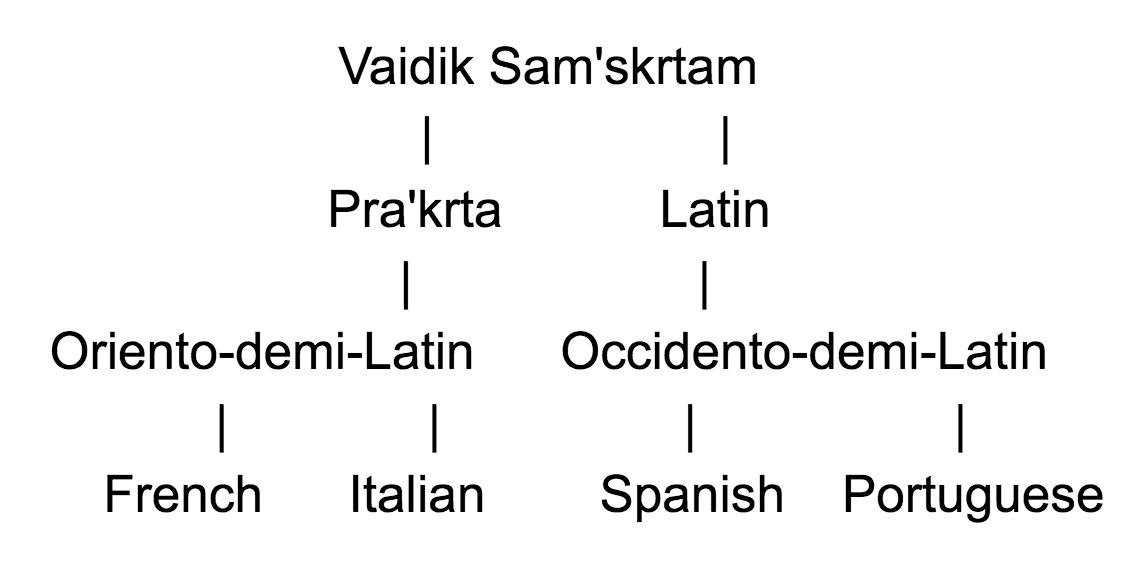
Next, the below teaching stands as concrete and irrefutable proof of the deep and dynamic link Saḿskrta has with so many languages. Basically, Baba is telling that Vedic Saḿskrta is the starting point or the top of the pyramid. And from that came two languages: (1) Prakrta & (2) Latin. And from Prakrta came about 98% of the languages of India. So Prakrta, which is a descendent of Vedic Saḿskrta, has many, many daughters and granddaughters such as Magahii, Bhojpuri, Oriya, Bengali, Gujurati, Hindi etc. And from Latin there came two distinct groups (a) Oriento-demi & (b) Occidental demi. The former led to the formation of French and Italian and the latter resulted in Spanish and Portuguese. Thus Vedic Saḿskrta is the starting point of so many of the world's languages.


Baba spoke about this while in Valencia, Spain on 30 May '79 because He wanted Spanish and overseas margiis to know that Vedic Saḿskrta is the grandmother of their native language(s).


Ananda Marga ideology says, "The Saḿskrta language was spoken by the Aryan people from 15,000 years [ago] to last 5,000 years [ago], for a long range of 10,000 years, and Pra'krta from 5,000 years [ago] to 2,000 years [ago], that is, for a period of about 3,000 years. During Lord Buddha’s period, distorted Pra'krta was the common mass language, that is, the people’s language. In the later Saḿskrta, you may say hemi-Saḿskrta – it’s another sister, that is a daughter of Vedic Saḿskrta, old Saḿskrta, was Latin. And Latin has got two offshoots: one is Oriento-demi-Latin, and the other Occidento-demi-Latin. Oriento-demi-Latin languages are French and Italian, and Occidento-demi-Latin are Spanish and Portuguese. Latin was the source. Similarly in Lord Buddha’s time the language was hemi-Prakrta." (2)


Old Saḿskrta is the mother of all...

Next Baba clearly tells how Saḿskrta is the mother of most Asian languages as well.


Ananda Marga philosophy says, "Saḿskrta is a classical subject as well as an ancient language. It is the mother of all the mother languages of South Asia and Southeast Asia." (3)


Saḿskrta is one very special unifying language that is related with so many major and minor language groups of the world. So it is an essential element for creating human unity and indeed it is for this very reason that Baba has given us all Sanskrit names.


Ananda Marga Caryacarya says, "At the time of initiation or shortly afterwards, those who do not have a Sanskrit name should be given one by the a'ca'rya/a'." (4)


Saḿskrta holds a tremendous place in both our AM and global societies. It is the linking point among all.


Conclusion

Baba has focused on Sanskrit grammar and erudition in so many books starting with “Shrii Prabhat Ranjain's Sarkar's Grammar Book” (parts 1-3). This is an edition that totals thousands of pages. Thereafter, Baba gave His books: Varna Vijiana, Varna Vicitra, and Shabda Cayanika-- in that order. All these publications focus on Saḿskrta and its relation with the various languages of the globe. Through it all, Baba is explaining Saḿskrta grammar, relating it with other languages, and creating new vocabulary so that Sanskrit can be used everywhere around the globe. And verily this is already happening as words like Guru, dharma, mantra,  karma, and so many others have been incorporated into languages all over the globe. The greater use of the Saḿskrta language, the better it will be for the flowering of our universal human family.


Ananda Marga philosophy says, "If Saḿskrta is used human unity will be encouraged and human beings will move closer together. See how sweet the link is between Vedic, Saḿskrta and the other classical languages of the world? So you should encourage the study of Saḿskrta." (5)


Ananda Marga philosophy says, "A perfect state of balance will be established between individuals and the collectivity, and between the collectivity and the Cosmos." (6)


In Him, 
Ramanuj 

~ In-depth study ~

Here below is the correct version of the para from the discourse "Lord Buddha's Cardinal Principles". May 30 1979. In this below para, Baba explains that Latin is the daughter of Saḿskrta:


Ananda Marga ideology states, "The Saḿskrta language was spoken by the Aryan people from 15,000 years [ago] to last 5,000 years [ago], for a long range of 10,000 years, and Pra'krta from 5,000 years [ago] to 2,000 years [ago], that is, for a period of about 3,000 years. During Lord Buddha’s period, distorted Pra'krta was the common mass language, that is, the people’s language. In the later Saḿskrta, you may say hemi-Saḿskrta – it’s another sister, that is a daughter of Vedic Saḿskrta, old Saḿskrta, was Latin. And Latin has got two offshoots: one is Oriento-demi-Latin, and the other Occidento-demi-Latin. Oriento-demi-Latin languages are French and Italian, and Occidento-demi-Latin are Spanish and Portuguese. Latin was the source. Similarly in Lord Buddha’s time the language was hemi-Prakrta." (7) 


Here is a graph of the language tree given by Baba to make the matter very clear:


Screen Shot 2017-09-05 at 10.40.26 PM.png


Seen from another view:

Vaidik Saḿskrtam -> two daughters (Pra'krta & Latin).

Latin -> two daughters (Oriento-demi-Latin & Occidento-demi-Latin).

Oriento-demi-Latin -> two daughters (French & Italian).
Occidento-demi-Latin -> two daughters (Spanish & Portuguese).


Saḿskrta is the root of so many Arabic & Middle-Eastern words.


Ananda Marga philosophy says, "Silik in Arabic means 'fine fibre'. The fine fibres that came to Bengal from China were given the Sanskrit name ciina'm'shuka. This cinna'm'shuka was given the Farsi name resham and the Arabic name silk. Arab merchants used to export this cinna'm'shuka to the markets of Europe. When they were heard saying the Arabic word in Europe, cinna'm'shuka became 'silk' with the help of a little fault pronunciation." (8)


References
1. Prout in a Nutshell - 17, The Significance of Language
2. Valencia, V12-28, Spain 30 May '79 EGD
3. Prout in Nutshell-17, The Evolution of Indian Languages
4. Varńa Vijiṋána, Phonetics, Prefixes and Suffixes (Discourse 5)
5. Caryacarya - 1
6. Prout in a Nutshell - 17, The Significance of Language
7. A Few Problems Solved  - 8, Pramá – 1 / Dynamic Equilibrium and Equipoise
8. Valencia, V12-28, Spain 30 May '79 EGD


== Section 2: Prabhat Samgiita ==

I felt utterly powerless & called You

Prabhat Samgiita Intro: This below song describes the scene just prior to and during the divine advent of Parama Purusa. Those days the whole humanity was being exploited, tortured, and choked. In response, right-thinking people tried to solve the problems; but, they could not get victory over those wicked, demonic forces. That is why they began desperately calling for that Divine Entity - Parama Purusa - to come immediately and rescue them from those demons and establish dharma. This song is the expression of the heart of those bhaktas when they were desperately crying for His help. Upon hearing their call, Parama Purusa Baba takes advent as the Taraka Brahma; He then creates a tremendous psycho-spiritual vibration whereby all the problems are resolved. In the very near future, in the coming hours and days, we will see this manifest in the physical sphere.

"Duhkhe kleshe kátar hoye, d́eke chilum báre báre..." (Prabhat Samgiita #3290)

Purport:

O’ my Parama Purusa, due to extreme suffering and misery, helplessly I cried out for You again and again in desperation. But You did not give any response, as if You were deaf. Why did You ignore my call. By seeing the plight of suffering humanity, I felt utterly powerless and called You to come and re-establish dharma in its proper place, my Prabhu.

O’ Divine Entity, due to injustice, oppression, and torture, their golden dreams withered away; everyone crying loudly. They wanted to remove the dogma of caste, creed, and racial differences, and establish one human society. But those demons in human form were creating havoc all around. The righteous people were harassed  and beleaguered so they were wailing with loud lamentations. The situation was bleak. 

O’ my Parama Purusa, Baba, in the end, You came in the form of Rudra. You burned the devilness with intense fire and the thundering sound of Your viśáńa. You instilled bhagavad dharma on this earth. All the sinners were destroyed. You saved humanity from the vileness of those demons and spread Your brilliant refulgence of bhakti. You inundated this whole creation with Your love. People realised the importance of human life; they understood it is not for carnal satisfaction, but for supreme fulfillment. Everybody’s eyes were opened. You are so gracious, You are the Saviour...

Notes for Prabhat Samgiita #3290:

[1] Rudra: Parama Purusa has many forms - one of which is rudra, meaning horrible or terrible. This is when He punishes wrongdoers of their sins and forces them to mend their ways. That is one key aspect of rudra and that is how the role of Parama Purusa is depicted in this song. Another meaning of Rudra is when He blesses someone with overwhelming joy and in that blissful state they cry. So one of the countless names of Parama Purusa is Rudra wherein He makes others weep. The demonic forces get annihilated and cry out while the good people shed tears of joy - divinely intoxicated in His bliss. Here below it is explained furthermore.

  Ananda Marga ideology says, "Why call the Supreme Being 'Rudra'? The word Rudra in Sanskrit means 'weeping'. But the Supreme Being not only makes all weep, He also makes them laugh! In both the circumstances, that is, of extreme pain and pleasure, there are tears in the eyes. In pain the tears come from the middle of the eyes, in pleasure they come from the corners of the eyes. A mother weeps when her daughter goes to her in-laws' house. She also weeps when her daughter returns from the house of her in-laws. In one case she weeps for pain, in another she weeps for joy."
  "If living beings were to live in one state always, there would be extreme monotony and no one would want to continue life. If in a drama we know the end in the very beginning, there would be no interest in the play. We need suspense, ups-and-downs and eleventh-hour surprises to keep life interesting. God, that is, Rudra, is a first-class dramatist. He keeps life floating within the two extremes of joy and pain; hence His liila', His play, goes on." (1)


[2] Viśáńa: The literal meaning is horn - such as when a bugle is blown to call and inspire the masses. In the case of Ananda Marga, the viśáńa symbolises our tri-shastra the social, philosophical, and spiritual scriptures containing the teachings of Prout, neo-humanism, and all spiritual guidelines. By coming in contact with Ananda Marga philosophy, people awaken, rise up, fight against dogma, and establish dharma, by His grace.

Reference
1. Subhasita Samgraha - 25, Rudra


== Section: Important Teaching ==

Is this a lady?

Ananda Marga philosophy states, “Parama Puruśa is the only real entity, the only absolute entity. The further the jiivas move towards Parama Puruśa, the more elevated their minds become. When they reach a very subtle stage of elevation, their concentrated mind-stuff speeds towards Him with the one-pointedness of an arrow. Such a mentality is called Rádhá....What is Rádhá bháva? When devotees feel in their heart of hearts that their existence is meaningless without attaining Lord, that they cannot survive a single moment without feeling His blissful presence, they have attained the stage called Rádhá. Such devotees know nothing other than árádhaná [total mental absorption”]. (1)

Note: Some ignorant people think that Radha is a female of Vrindaban. But that is not true. 'A-grade' bhaktas are Radha, whether they are male or female or anyone.

Reference
1. Namami Krsnasundaram, Vraja Krśńa and Sáḿkhya Philosophy (Discourse 7)


== Section: Important Teaching ==

Before attending MPD read this

Ananda Marga ideology states, “In each and every action you will have to try to realize the Supreme Entity; then and only then will those actions not be binding. When you think He is here, He is nearer than here. He is so near that it is difficult to measure the distance. You search Him in the caves of the Himalayas and wander here and there and He is nowhere. But when you attain awareness of Him, you know that He was along with you in your search and that He was seated in your heart. He shares your joys and pains, as He is with you through thick and thin. He never leaves you even when all others have abandoned you.” (1)

Note: When the mind is influenced by avidya maya, a sadhaka may start thinking that, “Parama Purusa is not along with me.” In that depraved state, the mahaprayan dogma sprouts in the mind. Just as night and day cannot co-exist, similarly the mahaprayan dogma (i.e. “Parama Purusa is no more”) and the above the cited idea - that “Parama Purusa is always with me” - cannot co-exist. When a person keeps their mind pure with Brahmabhava then the mahaprayan dogma will not brood in their mind. To understand fully, please read the above quote again.

Reference
1. Ananda Vacanamrtam - 23, God Is With You


== Section: Important Teaching ==

Human animal & dirty life style

Everywhere in the west the gay movement is gaining traction. That is why this following teaching is very important. There is no room for confusion about the stand of Ananda Marga.

Ananda Marga ideology states, "Love and passion are mutually antagonistic tendencies. The attachment for a finite thing is an expression of extroverted energy, whereas the attraction for the Infinite is an expression of the introverted energy. That is why these two can never co-exist. Therefore the aspirant has to skillfully to transform passion into love." (1)

Ananda Marga is the path of introversial movement towards the Supreme Entity; it is not the path of sensuality and lust. These two opposites cannot co-exist. They are mutually exclusive. Either one may goad their mind towards Parama Purusa, or they may indulge in animal propensities. There is no scope to do both.

That is why there is no option for leading a gay / homosexual lifestyle in Ananda Marga. Because a gay lifestyle is based on the baser propensities - sex for sex sake. Every dedicated Ananda Margii will easily grasp this point - it is just a matter of simple mathematics. Whereas, it is far more difficult for those goaded by those lower propensities to understand.  That is why it is said that until the mind reaches a particular level, one cannot assimilate the teachings of Ananda Marga ideology. Ananda Marga is for standard human beings not those with animal mind and human body.

Reference
1. Subhasita Samgraha - 1, Bhaktitattva


== Section 4: Links ==


SUBJECTS TOPICS