Search This Blog

Showing posts with label vrttis. Show all posts

Tuesday, September 15, 2026

How to manage vrttis + 4 more

Baba
How to manage vrttis

Namaskar,

Sadguru Baba has given that at present human beings have 50 vrttis, or 50 propensities of mind. And the sadhaka is to goad all those vrttis to that one singular point of spiritual attainment. This is done through regular sadhana, kiirtana, asanas, fasting, sentient diet, and following Sixteen Points etc.
https://anandamargauniversal.blogspot.com/

In contrast, those not on the spiritual path generally succumb to one vrtti or another. And, in certain instances, people become fully consumed and dominated by one particular vrtti. It might be greed, fear, sex, jealousy etc. And when that happens, i.e. when one single vrtti captures their whole existence, their rational mind ceases to function. No amount of logic will be able to convince that person as they are under the spell of that vrtti.

Infatuated with sex instinct


For instance, suppose Mr Tim is infatuated with a member of the opposite sex. That means whenever Tim is around Sally or not around Sally, either way he is only thinking of Sally, Sally, and Sally. Tim’s mind is wholly consumed with the thought of going close to Sally. In that psychic condition, Tim’s rational mind will not work. He will not be able to think and evaluate the situation in a balanced manner. Why? Because he is completely infatuated with Sally. In that case, even if Sally is an HIV patient and mistreats, cheats, and abuses Tim, still Tim will be keen to go close and give his whole life's savings to Sally because he is infatuated with her. No amount of logic or reasoning will be able to sway Tim in another direction. The reason is that he is intoxicated by that vrtti, and he is unable to clearly evaluate the situation for what it is.
https://anandamargauniversal.blogspot.com/

Here is a second example. Same is the case if one is consumed by greed. If Shyam is very greedy then if his house is on fire he will remain inside trying to collect all the money he has hidden in various parts of the house. Until finally, Shyam dies in the fire. Under normal circumstances, the rational mind says to run for safety outside the house, but Shyam was completely consumed by greed so his rational mind was not working. That is what happens when a person is completely captured by a particular vrtti.


Conclusion

When people are captured by a particular vrtti then their rational mind stops working. So in one’s individual life, if ever someone becomes struck by a given vrtti and gets infatuated on that point, they should not make any major life decisions in that frame of mind. They should delay, seek help, and get counsel etc. Here the key point is not to decide anything so long as the mind has been kidnapped and overpowered by that vrtti. Only when the pull of that vrtti weakens and one’s rational mind is again functioning should that individual make important life decisions etc.
https://anandamargauniversal.blogspot.com/

Namaskar,
In Him,
Liila
Leslie Gerraro


~ In-depth study ~

Premature death: nothing can save human beings

Ananda Marga philosophy states, “So whether in the material world or in the intellectual world, the predominant tendency that makes today’s people, both individually and collectively, rush headlong without control, is the instinct of greed. The propensity of greed, if not controlled by rationality, or benevolent intellect, or spiritual practices, will lead to premature death. Nothing can save human beings from this. This instinct of greed has brought the present humanity to such a state that people no longer consider anything as sinful. Rather, they consider the “sin psychology” as a mental weakness, and the worst of sins are being glorified as the height of intellect, not only indirectly but also openly.” (1)

People will develop different types of cunningness


Ananda Marga ideology states, “Human beings have fifty vrttis (psychic urges), and those fifty vrttis are also complex in their functioning. As the vrttis become more complex, so do their functions.” (2)

Ananda Marga ideology states, “The number of vrttis may further increase. The more complicated social life, family life, the realm of thought and the realm of intellect become, the more vrttis will develop. For example, the vrtti, cunningness, may be expressed in many more ways. To fulfil their desires, people will develop different types of cunningness which may become different vrttis in future. For example, the cunningness required to procure an object by devious means, the cunningness needed to give a promise knowing full well that one will never keep it, and the cunningness required to trick someone into believing that one did not tell a lie when in fact one did tell a lie, may all become separate vrttis in future.” (3)

Sahasrára cakra controls 1000 propensities


Ananda Marga philosophy guides us, “The number of vrttis varies according to the complexity of the physical structure. The more complex the structure, the greater shall be the number of vrttis. The more-developed animals, therefore, possess more vrttis than the less-developed ones. Generally there are one thousand vrttis in the human structure. In their development and expression on the ordinary crude level they are fifty in number. The collective number being one thousand, the seeds of all those thousand vrttis are present in the brain. Because of the existence of these seeds of one thousand vrttis in the pineal gland, the yogins have named it sahasrára cakra [sahasra means “thousand”]. The subsidiary glands control forty-eight vrttis and the pituitary controls two – saḿkalpátmaka, or one leading to parávidyá (knowledge of the Great) and vikalpátmaka, relating to aparávidyá (knowledge of the mundane). The pineal as a structure controls all these fifty vrttis taken internally and externally by all ten indriyas. 50 x 2 x 10 = 1000. Yogis having control over the sahasrára cakra attain nirvikalpa samádhi, a state where they are beyond the approach of all the vrttis. Within the scope of these vrttis lies the seed of saḿskára – good or bad. So the attainment of such a state means the end of all the saḿskáras, exhaustion of all the previous momentum accumulated by the mind due to its previous journeys in Brahma Cakra. This is what is called mokśa – union with the Transcendentality.” (4)

Alliances with antisocial elements for sake of party

   Ananda Marga philosophy states, “The vanity of lineage is associated with the cultural superiority complex also. That is, the supremacy of any particular culture is dependent on an ism. Although according to perfect logic the culture of all humanity is one and indivisible, the exponents of isms do not understand this. They prefer to assert that the different sets of script and language, behaviour and habit, and local variations in expression, are actually the constituents of human culture.”
   “The supporters of political isms do not even hesitate to commit heinous acts for the sake of their ism. In the medieval period communalism dragged humanity to the nadir of degradation. Incredibly, a few people in the twentieth century still try to revive medieval communal feelings. Today people who make a habit of delivering high-sounding lectures do not hesitate to form unholy alliances with antisocial elements for the sake of their ism. We can therefore say without any doubt that they are under the evil influence of the static force.” (5)

How to utilize the vrttis


Ananda Marga ideology states, “In this introversial phase, all fifty vrttis should be directed towards the Supreme Goal. The mind which was swayed away by the fifty vrttis should now be redirected. How? The activities of the ten organs should first be withdrawn and suspended in the mind, and the suspended mind should be directed towards Parama Puruśa. In the process of withdrawal or pratyáhára, all the organs should be channelized towards the subtle mind. What is dhyána? To suspend all the vrttis and then to direct them towards the Supreme One is dhyána.”(6)

References
1. Namah Shivaya Shantaya, Shiva’s Teachings – 1 (continued) (Discourse 10)
2. Ananda Vacanamrtam - 8, Sádhaná, Abhidhyána and Kiirtana
3. Ananda Vacanamrtam - 8, Sádhaná, Abhidhyána and Kiirtana
4. Idea & Ideology, Mind, Práńendriya and Vrtti
5. Prout in a Nutshell - 4, Ism and Human Progress
6. Ananda Vacanamrtam - 8, Sádhaná, Abhidhyána and Kiirtana


*        *        *

The below sections are entirely different topics, unrelated to the above material.
They stand on their own as points of interest.

*        *        *

== Section 2: Important Teaching ==

How to put it to memory

Namaskar, 

Baba's below teaching discloses the reason why our scripture has been composed in the genre of poetry: Because poetry is easy to memorise. For this reason, Baba has composed our scripture - i.e. Ananda Sutram and Prabhat Samgiita - in poetic verse.
 
Ananda Marga philosophy states, "In the absence of rhythm it is difficult to memorize. That is why since ancient times, for 15,000 years, the common practice has been to bring every valuable branch of knowledge within the scope of rhythm. Human beings do not easily forget rhythm. One may forget the contents of knowledge, but not the rhythm. That is why all Vedic Rks were composed in 7 meters. All literary compositions were brought within the gamut of the seven Vedic metres...as they are valuable for the memory." (1)

Set to rhythm

 
If you want to learn or memorize anything, the easiest way is to set it to rhythm. One paragraph of prose is very difficult to memorise, but one stanza of a poem, shloka, or song is comparatively easy to memorise. Rhythm helps in memorising anything. That is why in their infancy, children are introduced to language via rhythm in nursery rhymes and songs etc. By this way, they can quickly learn and advance.
 
In the distant past, before the invention of any script and before paper came into vogue, people used to keep everything in their mind. There were no books or other media as we see nowadays: audio, video, writings, etc. There was nothing.


What yogis did in the past
 
So when there was no way to store ideas or teachings on paper or cassette, the only option was to store it all in their memory. The best technique for doing that was to create rhythmic poetry. So all those past yogis, rishis, sages, thinkers, and munis put their realizations into shloka, poem, or any kind of rhythmic expression like the vedas, purana etc. Even when script was first invented, most people did not know how to read or write, so those thinkers continued to put their teachings into poetic verse. This happened all across the globe.
 
This is not only for those of the past. Today also if you want to memorise anything then put it in rhythmic form. Cunning advertisers create jingles or rhymes to influence consumers, and film-makers do the same.
 
So to keep something readily in the mind then take help from a rhythmic flow, otherwise it will be very difficult to store that in your memory. For this reason Baba has given the key of Ananda Marga teachings - i.e. Ananda Sutram - in poetic form, and Prabhat Samgiita as well. And in virtually every discourse He has included a shloka. By that way - by memorizing one rhythmic shloka - one can get the seed idea of the entire discourse. That is how to memorize that entire discourse in key form.
 
In His series of discourses on the Faculty of Knowledge, Baba has given so many points about memory and rhythm.

In Him, 
Viniit
 
Reference
1. Ananda Marga Philosophy in a Nutshell - 5, The Faculty of Knowledge – 4


== Section: Important Teaching ==

Posture for elimination


Ananda Marga health guideline: “Straining at stool often aggravates the disease. Remember that without constipation and defective functioning of the liver one can never suffer from piles.” (1)
 
Ananda Marga health guideline: “A hernia patient should also remember to maintain a slight but continuous feeling of hunger. Hernia patients should get out of the habit of straining while defecating.” (2)

Ananda Marga health guideline: “Cancer is a disease of the whole body as well as a tridośaja disease [involving disturbances of váyu, pitta and kapha]. This disease is a combined effect of many different factors. It is ordinarily observed that persons who suffer from constipation as a result of violating the health rules, and who likewise are lazy, lack self-restraint, sleep during the day and keep late nights, are most likely to be attacked by cancer.” (3)

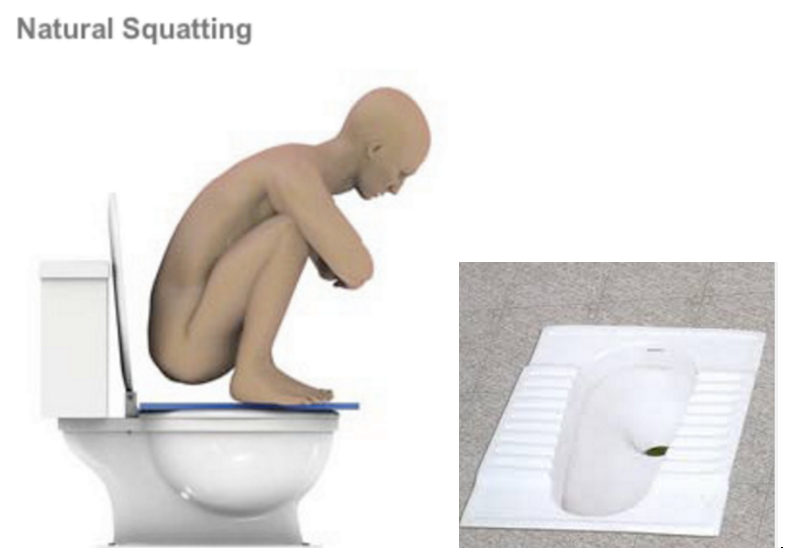
In most western countries a toilet seat is widely used where one sits on it like a chair at the desk, but that causes constipation and related diseases. If you see animals, you will notice that they defecate in a half-seated / squatting posture. The best natural and anatomical position for humans is to defecate in a squatting posture. That is the natural position for elimination and will ward off constipation.

Those using an Indian sanitary pan - as displayed below on the right are already defecating from a squatting position. And on the left is how to properly use a western style toilet. 


References
1. Yogic Treatments, Haemorrhoids
2. Yogic Treatments, Hernia
3. Yogic Treatments, Cancer


== Section: Important Teaching ==

No words for exploitative vaeshyas

Prout philosophy states, “If, in the history of human struggle, the role of the vipras [intellectual exploiters] is one of parasitic dependence on others, I cannot find words to describe the role of the vaeshyas [wealthy exploiters]. Both the vipras [religious exploiters] and the vaeshyas exploit society, but the vipra exploiters are not as terrible as the vaeshya exploiters. The vaeshyas are like a deadly parasite on the tree of society which tries to kill the tree by sucking dry all its vital sap. But if the tree dies, the parasite will also die. The vaeshya parasites understand this and therefore try to ensure the survival of society by making some donations; they build temples, mosques, churches and pilgrims’ inns, give little bonuses, feed the poor; etc. Calamity only comes when they lose their common sense out of excessive greed and try to suck society completely dry. Once the social body falls unconscious, the vaeshyas will die along with the rest of the body. Otherwise, before allowing themselves to die, the exploited shúdras [toiling mass], kśatriyas [warriors] and vipras [intellectuals] can unite to destroy the vaeshyas [wealthy exploiters]. This is the rule.” (1)

Reference
1. Human Society - 2, The Vaeshya Age


== Section: Important Teaching ==

Key point before sadhana

Here is the English summary of Baba’s Hindi teaching of Átmatiirtha, V24 25(H), 22 Nov 71 Purnea, Bihar AV 24-25.

After involving in mundane works one is generally plunged in worldly thoughts. So then if one sits in sadhana, in the mind you will think that 'Tomorrow I will go to Arariya town. Indeed I have to go in the morning. I will have to catch the first bus'. You will sit in sadhana and go on thinking like this. In this situation what should you do? Before sitting for sadhana you should do kiirtan-- either 2 min, or 5 min, or 10 min. So first one should do kiirtan. Because by doing kiirtan the mind will get elevated. After that immediately one should sit in sadhana. Then you will see that there will not be any worldly thoughts. Then sadhana will be proper...Do not worry; you have learned sadhana and I am always ready to help and serve you. 

Note: Every sincere Ananda Margii wants to do sadhana. Yet most of the time this aforesaid problem occurs. And our Guru understands this. That is why He has graciously given such a beautiful solution-- as mentioned above. I think many may be following His divine guideline; and for those who are not, they should do so from now onwards, i.e. sing kiirtan before doing sadhana.


== Section: Important Teaching ==

No charge for diiksa

Ananda Marga Caryacarya states, “To ensure the subsistence of ácáryas (spiritual teachers), all kinds of sacrifice should be accepted.” (1)

Note: Sadguru Baba has given the rule that acaryas are not to charge or accept remuneration for giving sadhana lessons, initiations, or presiding over any social ceremony like baby naming, marriages, death, or house entrance etc. So the question arises how will they survive? The answer is that it is the duty of family margiis to provide Wts with their basic requirements. By this system, Wts can perform their duties per Baba’s guideline. Unfortunately we see that some fake Wts like Dada N* etc are charging money for the aforesaid duties. Teaching sadhana has become his business. It is disgraceful. 

Baba made initiation without charge because in the society some are economically poor and some are economically healthy. So Baba made Ananda Marga sadhana and social ceremonies equal for all. That is why there should not be any charge. In a mundane manner, just think what would happen if firefighters started asking for money and charging before putting out the fire. In that circumstance, the whole society would collapse and crumble.

* The Dada N in the above note is Nabhanillananda.

Reference
1. Caryacarya, part 2, Society, point #11


== Section: Important Teaching ==

How not to digress from the ideal of the Great


Ananda Marga ideology states, "You exist in a vast, limitless ocean of rasa or essences. A never-ending, radiant wave of manifestations is surging within and without you and radiating through all the ten directions – the indescribable vibrational expressions of small and great, accented and unaccented, eternally flowing thought-waves. Behave properly and reasonably with every expression, with every manifestation of the Cosmic mind. But always remember the One, Who is the essence of all these diverse vibrational manifestations. Train yourselves in the ideal of the lily, which blossoms in the mud and has to keep itself engaged in the struggle for existence day in and day out, parrying, bracing and fighting the shocks of muddy water and the force of storms and squalls and various other vicissitudes of fortune; and yet it does not forget the moon above. It keeps its love for the moon constantly alive. It seems but a most ordinary flower: there is nothing extraordinary about it. Yet, this most ordinary little flower has a romantic tie with the great moon. It has focused all its desires on the moon. Similarly, perhaps you are an ordinary creature – perhaps you have to pass your days in the ups and downs of worldly existence – yet do not forget that Supreme One. Keep all your desires inclined towards Him. Always keep yourself merged in His thought. Go deep into the mood of that Infinite Love. By this your worldly activities will not be hampered in any way."

Kumud candramá dúrete rahiyá yemati rákhaye priiti,
Temati Shrii Rádhá kánu páne cáhi grha káj kare niti.

Ananda Marga ideology states, "No matter what circumstances you are in, never lose sight of the Infinite One. Degradation is impossible for those who have accepted the Supreme Being as the Ideal of their lives. Indulging in mean thoughts only engenders crude vibrations in the Citta, as the result of which you will have to take rebirth in lower species in order to suffer the lowly Saḿskáras created by those crude vibrations. Thus you must arouse higher vibrations in your Citta. Even a man of King Bharata's calibre had to take rebirth as a deer because at the time of his death he was deeply anxious about a fawn. Thus regardless of what you are at present or what you may possibly become in the future, do not digress from the ideal of the Great in any circumstances: do not stray even a step away from the path of realization of Absolute Bliss. Ananda Marga or the path to eternal bliss is the only path for you." (1)

Reference
1. Subhasita Samgraha - 3, Vibration, Form and Colour


== Section: Prabhat Samgiita ==


बाबा, सुख भरे अच्छे दिनों में, मैं तुम्हें भूला रहा

"प्रभात सङ्गीत 966 आलोकेर एइ झरना धाराय, स्नान करे तुमि एशेछो …"

भावार्थ

हे परमपुरुष ! तुम आध्यात्मिक दिव्य रौशनी  के झरने में स्नान करके आए हो। तुम परमसत्ता हो। हे प्रभु ! मैं गन्दगी में डूबा हुआ था।  माया में पूरी तरह जकडा हुआ था। बाबा, तुमने मेरे हाथ पकड़कर माया के कीचड़ से बाहर निकालने की कृपा की। कीचड़ को साफकर तुमने कृपाकर मुझे अपनी दिव्य गोद में  स्थान दिया।


हे मेरे प्रभो ! मेरे सुख और  प्रसन्नता  भरे अच्छे दिनों में, मैं तुम्हें भूला रहा। मैंने साधना नहीं की और न ही सोलह विधियों का पालन किया । मैंने तुम्हें तभी पुकारा जब कष्टों ने आ घेरा और खतरे में पड़ गया। अपने सुख के दिनों को मैंने अकेले ही भोगा। अपने पापों का पहाड़ बन जाने के बाद ही मैंने बचाने के लिए  तुम्हें पुकारा। मैं सभी से कहता फिरता था कि मैंने कठिन परिश्रम से सफलता, प्रसन्नता और योग्यता पाई है।  सबको अपने पराक्रम का गर्व से बखान किया करता था। घमण्ड में डूबकर यह भी कहा करता था कि इसमें परमपुरुष ने कुछ नहीं किया है। परन्तु  जब कुकर्मो में फंसकर पाप करने लगा तो तुम्हें दोष देना लगा। इतना ही नहीं यह भी आरोप करने लगा कि तुमने मेरे मन को गलत दिशा में मोड़ दिया। अपने पहाड़ जैसे पापों का दोष तुम्हारे ऊपर मढ़ने लगा। मैं सदा ही घमण्ड में डूबा रहा।  तुम्हारे चरण कमलों में कभी समर्पण नहीं किया। इसके बाद भी तुमने मेरी ओर कितने प्रेम और आकर्षण से निहारा। सचमुच तुम मुझे बहुत चाहते हो।

हे परमपुरुष बाबा ! मैं तो केवल अपनी महानता का ही गुणगान करता रहा। पूरे समय अपने आपको शाबाशी देने में  ही व्यस्त बनाए  रहा। तुम्हारे बारे में तो कभी सोचा भी नहीं, बिलकुल नहीं ।  मैं सदा स्वार्थ के  कीचड़  में ही फँसता चला  गया। सही और धार्मिक कार्य तो मैंने किए  ही नहीं। केवल दूसरों के लिए  इनकी शिक्षा अवश्य देता रहा और खुद इनसे दूर बना रहा । अपनी महानता बताने को  मैं  दिखावे के लिए  महान भक्त होने का नाटक करता रहा। इतना सब होते हुए भी  हे बाबा ! तुमने मेरे सभी गलत कामों  को माफ़  कर दिया तथा  मुझे धर्म और नीति के सच्चे रास्ते पर ले आए ।  तुम कितने कृपालु हो !

About spiritual effulgence: Parama Purusa has no shape but in the language of philosophy it is expressed that He is the embodiment of spiritual effulgence. From time to time for the welfare of humanity and His creation He descends on this earth in human form as Mahasambhuti. So in the language of poetry, it is expressed that, O’ Mahasambhuti You have come after bathing in spiritual effulgence. You are blemishless, without any samskara. However You take Your samkalpa in that way You manifest Your liila in day to day life. Alternately, human beings are bound by their samskara, i.e. stains.

References
1. Sadguru Baba says (in GD, Delhi, 26 Feb 1984) that when writing a Prabhat Samgiita purport then very simple words should be used so that the common mass may understand. The above Hindu purport has been written according to that guideline.


== Section: Important Teaching ==

Why sadhakas undergo more bad samskaras

   Ananda Marga ideology states, “Reactions in requital to past actions normally occur more in a spiritual aspirant’s life than in an ordinary person’s life. The reason is that when all original actions are surrendered to Brahma, there remain only the reactive actions. The reactions may be good or bad [according to whether they are resultants of good or bad original actions]. But think about how many of the deeds you performed before coming to the path of sádhaná were good and how many were bad. To tell the unpleasant truth, ninety-nine percent of your deeds were bad. Hence it is often the case that sádhakas have to suffer much more from bad reactive momenta than get to enjoy good ones. It can even be said that the more one suffers from reactions, the more one is progressing along the path of sádhaná.”
   “Of course, the requital of the reactive momenta may possibly be pleasurable instead of painful; it all depends upon the nature of one’s actions. In either case, the more one surrenders one’s actions to Brahma, the shorter will be the period of requital caused by the reactions. In this case the intensity of the requital will be greater than normal; but this is a good sign, because intense requital means the exhaustion of the requital within a short period.” (1)

Reference
1. Ananda Marga Ideology in a Nutshell - 8, Sádhaná

== Section 3: Links ==
Prabhat Samgiita Day - 14 Sep
Sharing heartfelt feeling: role of PS
Starting point of Prabhat Samgiita 

Postings to Read

Best use of time
Spirituality: essential aspect of nitya karma
Golden rule: inherent flaws
Link between sadhana lessons
Story: how Baba made me victorious
Ananda Marga vs dogmas of epic


Sunday, July 12, 2026

The body: our alarm clock + 3 more

Baba
The body: our alarm clock

Namaskar,

Imagine a situation in which someone is doing something important in their office and they are severely pressed for time. If they suddenly feel hungry or need to go to the  restroom then a question arises: Should they stop working and tend to one’s bodily needs or suppress the urge until the work is completed.
https://anandamargauniversal.blogspot.com/

The human body is a biological machine


Sadguru Baba says that the human body is a sophisticated and complex machine. Many processes are happening simultaneously inside the human body. It is very difficult to comprehend the exact working of the human body due to its sheer complexity. For proper functioning, the human body should get adequate support, such as air to breathe, water to drink, and provision to defecate toxic substances, to name a few.

Body's warnings: keep an eye


The chemistry of the body needs to be maintained, and so one must pay heed to the the demands of the body. Take the analogy of an indicator light on a car which is displaying the warning that the engine has become overheated. If the warning is ignored for a long time and one continues driving the car, then the engine may fail permanently.
https://anandamargauniversal.blogspot.com/

Ignoring signals can cause disease

The human mind is very powerful. Those who are mostly engaged in intellectual work often ignore their bodily needs, unlike the ones who are mostly involved in physical work. By ignoring the basic needs one puts their body under undue stress. Maybe occasionally ignoring one’s bodily needs may not be so dangerous, but such an approach continued over a duration can lead to serious diseases. Just as a machine becomes dysfunctional if its warning signals are continuously ignored, the human body can also succumb to disease if one does not pay heed to one’s basic physical needs.

The basic rule of yoga is to perform all one’s daily bodily duties like eating, sleeping, bathing, and defecating at the right time. One should never force oneself to change the schedule for the above daily activities as that can adversely affect their health.

Risk of long-term damage

If one’s body is strong then one may not immediately feel the adverse effects, but, internally, the body as well as the mind get affected. For example, if one is trying to ignore the pressure to urinate then one part of the mind gets distracted and one’s concentration gets divided. It is better to relieve such pressure. If one is hungry then, as an effect, one may get a headache or burning sensation in the stomach which again may affect the proper functioning of one’s mind.
https://anandamargauniversal.blogspot.com/

Recipe for happy life

If one listens to one’s body’s signals then one will be able to live a long and healthy life. Rather than holding normal bodily functions, one should make a proper timetable and follow that. A train that can run smoothly on rails but if it is not maintained properly then it can derail. On derailment, the train can get stuck in a field or a ditch. In that case, a powerful crane has to be brought to put the train back on the track.

Thus, for one’s physical health and overall well-being, one should make a routine and follow it strictly. One should not do anything at arbitrary times. The body has its own biological clock, and by duly following it one can live a healthy life and can make progress. Not following a routine is an invitation for trouble.

The body is the framework for carrying out spiritual sadhana, but to do sadhana a healthy body is needed. If the body is healthy then only is spiritual progress possible. After death, the brain disintegrates but the mind remains. An Alzheimer patient’s brain begins degenerating during their lifetime but the mind is still fully functional. For such patients, the mind wants to work but the brain is not capable of helping. So there is a deep connection between body and mind. 
https://anandamargauniversal.blogspot.com/

Conclusion


So in order to maintain a healthy body, one must be vigilant about listening to the signals of one’s body. If one ignores those signals, then serious diseases can develop which will disturb the mind so that one’s sadhana will be adversely affected. 

In Him,
Bhakti

False alarms / wrong justifications

Note: In the context of not ignoring one’s bodily needs, there should not be any misunderstanding about following negative bodily or mental tendencies.

1. Some have malevolent vrttis, e.g. the urge to cause harm to someone. This can be misinterpreted by the person to be an urgent call from within. But malevolence does not qualify as among the natural signals of the body, and must not be heeded.

2. Those who suffer from lust and feel an urgent demand to satisfy that desire should understand that this is not fundamental in the same way as the need for food, water, and sleep. It is not to be included among the natural signals to which one should respond. The reason being that responding to it degenerates the mind and arouses and multiplies animalistic tendencies.

3. Physical addictions such as to cigarettes, alcohol, and other drugs are just that, physical addictions. They must give in to such addiction, rather such vices are to be shunned by goading the mind toward positive activities.
https://anandamargauniversal.blogspot.com/

Biological machine


   Sadguru Baba says, “Let me explain why the human body is a biological machine and goaded by propensities….There are ten indriyas [organs] – five jiṋánendriyas [sensory organs] and five karmendriyas [motor organs] – and one antahkarańa [internal faculty]. The sensory and motor organs are bahihkarańa [external organs]. Antahkarańa is directly associated with the body. It is one intrinsic portion of the mind itself. It is by dint of this portion that the mind feels the emptiness of the stomach, and thereby hunger. Once the stomach becomes empty, the mind starts searching for food, and this is expressed through the physical actions of the body. So there are two portions – antahkarańa and bahihkarańa. One consists of an intrinsic portion of the mind itself, and the other of the ten organs – five sensory organs and five motor organs.”
   “The propensive propulsion comes from antahkarańa. The origin or source of the propulsion is antahkarańa. Antahkarańa is made of the conscious and subconscious portions of the mind – thinking, memory, etc., all belong to antahkarańa. Antahkarańa is doing these things. Now, whenever antahkarańa does something, the physical body is activated accordingly. The body is also transformed accordingly. Thus, this biological machine is goaded by propensive propulsion.” (1)

Reference
1. Yoga Psychology, The Human Body Is a Biological Machine


*        *        *

The below sections are entirely different topics, unrelated to the above material.
They stand on their own as points of interest.

*        *        *


== Section 2: Prabhat Samgiita ==

If I had known

PS Intro: The relationship between the bhakta and Parama Purusa is eternal - it has been going on since the very dawn of creation. However, the bhakta was not always aware of this truth. Ages and ages passed when the sadhaka did not realise his unique and intimate connection with Parama Purusa. So when any sadhaka does get initiated and starts doing strong sadhana and becomes linked with Parama Purusa and feels His divine love and becomes drenched in His bliss, then that sadhaka feels repentant for not developing his relationship with Parama Purusa sooner. This song expresses this very notion of repentance and wishful thinking. Because in this song the sadhaka is expressing the following directly to Parama Purusa:

'In the past I was not aware about my relation with You. So now, when I have been blessed to come in Your contact and feel in my heart that You are my nearest and dearest One, then I feel sad that why did I not call You before, in the past - long, long back. Because even when I was a non-margii then at that very time You were also with me. But I never looked towards You those days; I never called You back then. Why did I not do so? Why did I not recognise You back then? It would have been so blissful to have had Your proximity all these years, but instead so much time passed in vain.'

So this song expresses the feeling of repentance of each and every devotee who has become linked with Parama Purusa as they reflect back on their life before becoming a margii. They wonder, 'Why did I remain oblivious of You - it would have been blissful if I had deep intimacy with You sooner'.

“Tumi a'ma'r kata a'pan a'ge bujhi ni…” (Prabhat Samgiita #0241)

Purport:
 
Parama Purusa, You are very close to me; You are my Dearest One. Before, in the past, I was oblivious to this sacred truth: That You are my eternal Companion. All along, You were side by side with me - near me always and with me wherever I was, in all endeavours. But it was so unfortunate that I remained unaware of Your divine presence. I never thought that You loved me so much. My Dearmost, why did I not talk to You and have Your intimate closeness.

Baba, since time immemorial You have been with me in all my works - small or big, meaningful and meaningless. But unfortunately that time I did not look towards You. Baba, You were with me in my song, rhythm, and tune. There was never any occasion when You were not there right by my side. And the string of that viina was vibrating then and resonates even today. And now I can hear it. But it is so sad and painful how that time in the past I remained oblivious of You. I did not pay heed to the call of Your viina, so I did not hear it. My Dearmost, alas, it would have been so blissful if I had known that You love me so much, and You are with me always.

Divine Entity, You were with me on this journey of life, even when I was submerged in the deep Cimmerian darkness. And now that very memory remains awake in my mind always. It comes again and again in my mind that You are my close One, and You are always by my side, in my heart. But alas, for so long I remained oblivious and did not call You. I remained distant; on the point of bhakti I could not come close, although You were always accompanying me. Only now do I realize You are present and I can call and talk to You. Today I understand this truth; but, in the past I did not know. O’ Supreme One, why did my spiritual life not start at the very outset. I feel so repentant that I did not beckon You in those early days. Due to neglect, You went away, leaving me alone in isolation in an unknown place and distant land. That time, why did I not keep You in my heart and hold Your feet. How come I did not wipe away all my dilemmas and hold You in dhyana and make You mine. To this day I still wonder about this. It is so sad that time passed, and You remained distant. No doubt today we are close, yet I repent how my life would have been so blissful having Your proximity earlier. This pain I carry in my heart, O' my Dearmost…


== Section 3: Important Teaching ==

Spirituality & suicide prevention


Due to lack of a higher goal, if even a small problem arises, people get frustrated and lose interest in life. Those without a spiritual goal lack higher values, and therefore get overwhelmed when they face any of life’s difficulties. For human welfare, the propagation of spirituality is extremely important. If one has a higher goal then they will never commit suicide, no matter the circumstances.

Baba's original guideline


Baba discusses this topic in His Hindi discourse: Kya' Dharma Vaeyas't'ika Jiivana ka' U'rdhva-Sam'vega Hae, athava' Sa'magrika Vishva ka' Tristariiya Mukti Sopa'na Hae? Subhasita Samgraha, Part 15, Chapter 02 (H) DMC 29 July 1980 Ranchi

Here is the English summary of Baba's original Hindi teaching:

Life becomes monotonous if one is merely engrossed in mundane thinking and worldly works all day long. When non-sadhakas, i.e. those not doing sadhana - reach old age, they say, "Now it is better to die." Even youths who do not do spiritual practices commit suicide when they suffer from feelings of despair etc. Why is this the case? According to applied psychology, I would say it is because they don't have any higher pursuits; hence, the lonely and desperate feelings of sheer monotony consume their mind.

Now, what is the way to prevent such monotony? The objective counterpart of the mind should have such an object which is infinite. Indeed, by coming in contact with such an infinite object of ideation, people will never harbour feelings of monotony - not in any case. That object [Parama Purusa] is ever new, newer, and newest. Parama Purusa is that Entity who is ever new, always new. Therefore, it is the duty of every person to do spiritual practices and prevent any feelings of monotony in life. For spiritual progress, certainly it is everyone’s bounden duty to do sadhana. Verily, by your sadhana you will be able to protect yourself from falling prey to any type of melancholia or depression. (English summary)


== Section 4: Links ==


Saturday, March 28, 2026

Hurtful humour & pranks + 5 more

Baba
Hurtful humour & pranks

Note: In many western countries, the pseudo-culture event known as April Fools' Day occurs annually on 01 April.

Namaskar,

There are numerous occasions and dealings in materialistic communities that are founded upon degrading tendencies of mind. For instance, Halloween is based on injecting a fear complex wherein little children may even suffer their whole life - scared to death of imaginary ghosts. And the daily grind of capitalism itself encourages greed, sensuality, and selfishness. Likewise, on April Fools’ Day, the aim is to trick or deceive someone so they feel embarrassed, nervous, or ridiculed etc.
https://anandamargauniversal.blogspot.com/

The end result is the loss of trust in society whereby people harbor tremendous suspicions towards one another - even between best friends, or husband and wife. This casts a long shadow on humanity because distrust, doubt, fear, and anxiety become dominant. And verily that is why we see so many psychic diseases wherever materialism thrives. In the end, people feel stressed, depressed, lonesome, and helpless.

In materialism: negative propensities flourish


That is why we can say that materialism is the polar opposite of tantra. Materialism stands for the injection of degrading propensities. Sadly, when the mind is overrun by degenerating thoughts then sadhana is not possible, as one will just dwell on those dark thoughts and degrade themselves further. Whereas tantra wholly encourages higher propensities and goads the mind towards Parama Purusa. In tantra, negative propensities do not get scope to grow as each and every engagement and practice in tantra aims at elevating the mind. By this way the mind is well-prepared to do sadhana and reach the Supreme rank.

As far as possible, as Ananda Margiis, we must always follow Sadguru Baba’s divine teachings and goad the mind towards higher pursuits - and never give way to materialistic traditions and daily rituals which erode the human psyche - both individually and collectively. What may seem like harmless and innocuous pranks and expressions etc often serve to undermine one’s well-being. Not only that, such types of pranks are against our sadhana oaths.
https://anandamargauniversal.blogspot.com/

As materialism takes root around us, we should be even more vigilant to hold firm to the traditions of tantra and only encourage those elevating qualities of mind. By this way we will reach the Goal and help others progress as well.

Seeing John’s face sunk in woe


“Hey John, I need to talk to you about something personal. As you know your marriage with Carol has been rocky of late, and our wives are best friends. Well, last night Betsy and Carol had a sit-down chat, and Betsy tells me that Carol is thinking of leaving you and ending the marriage - she will probably pack-up and leave by the end of the month. As a friend, I just felt I needed to tell you this.”

Hearing this, John becomes quite shocked and devastated. Seeing John’s face sunk in woe, an instant later Gary cries out, “April Fools!! I was just kidding - not to worry - Carol still loves you - she tells Betsy that the marriage has gotten much better - but you sure did get fooled!! I had you believing it all - you should have seen the look on your face!!”
https://anandamargauniversal.blogspot.com/

Distrust, doubt, fear, & anxiety is outcome


So the above is yet another example of how the traditions and norms in a materialistic society degrade the mind. The entire premise of the pranks and practical jokes made on April Fools’ Day stem from a sadistic mentality (pishunatá) where one derives pleasure by seeing others suffer - even if it is their good friend.

Of course, those submerged in materialism will justify that, “It was all done in good fun” and “everyone got a good laugh out of it” etc, but the underlying tendency of mind is sadistic and cruel (kruratá).

Conclusion


Ananda Marga philosophy teaches us that our life is dear to us; similarly, the next person’s life is also dear to them. So, as far as possible we should help others, and not create problems in anyone else’s life. But unfortunately pranksters do the exact opposite of the aforesaid idea. Yet they themselves do not like to have pranks played on them; but, still they enjoy playing pranks and putting others in trouble. Those who have such a mentality cannot do sadhana. Human beings should realize their potentiality to provide relief to suffering people. That’s why they never play pranks on others.
https://anandamargauniversal.blogspot.com/

Namaskar,
In Him,
Satya

~ In-depth study ~

Ananda Marga philosophy states, “When human beings do sádhaná, the kulakuńd́alinii, an ideative entity, rises upward through the spine. It pierces through cakras one after the other, and simultaneously the thoughts or propensities controlled by their respective cakras are brought under control. As soon as the kulakuńd́alinii pierces the múládhára, svádhiśt́hána and mańipura cakras, it brings under control all the propensities up to and including those of the mańipura cakra. The mańipura is the controlling cakra of ten propensities – shyness, sadistic tendency, envy, staticity, melancholia, peevishness, yearning for acquisition, infatuation, hatred, fear. When after rising and rising the kulakuńd́alinii reaches the sahasrára, it becomes one with Paramashiva. This is the state of liberation.” (1)

We must discourage depraving ones


Ananda Marga philosophy states, “Tendencies are of either a degenerating or an exalting nature, that is, they are either of a depraving or an elevating nature. We should encourage the elevating tendencies and discourage the depraving ones. In certain parts of this world, depraving tendencies such as pornography exist. Simply protesting will not stop these things: we will have to do something positive to check it. Such positive action will create a new stir in the human mind. Pornography and other depraving tendencies will be completely discouraged and checked. That will be our course of action. We have to create new literature, new books, new music, new songs… We have to chalk out a programme and act accordingly.” (2)

Ananda Marga ideology states, “In Ananda Marga Sadhana, the method of withdrawing the mind from degrading tendencies, and absorbing oneself in the colour of the Great, is called Pratyáhára Yoga (the yoga of withdrawal) or Varńárghyadána (the offering of colours). All people have a particular attraction for one or another object or activity and as soon as they become attracted to an object, then their minds become coloured with the colour of that object. You can withdraw your mind from the colour of that object and dye yourself in His colour by offering Him the captivating colour of the object that has attracted you: this is the real Pratyáhára Yoga.” (3)

References
1. Discourses on Krsna and the Giita, The Meaning of “Krśńa” in Rája Yoga
2. A Few Problems Solved - 8, The Rule of Rationality
3. Subhasita Samgraha - 3, Vibration, Form and Colour


*        *        *

The below sections are entirely different topics, unrelated to the above material.
They stand on their own as points of interest.

*        *        *

== Section 2: Prabhat Samgiita ==

For You only

"Prabhu a'ma'ra priya a'ma'ra, toma'ra tarei a'ma'ra jiivana..." (Prabhat Samgiita #1439)

Purport: 

O’ my Parama Purusa, the Dearest One of my heart, my life is only for You. I live only in the hope of getting You. That is my dream. 

Baba, in the stream of  Your causeless karuńá, each day I am floating closer toward You with rhythm and songs. You alone are the one who fulfils everyone’s desire. 

Your wish is why I exist. I have forgotten all my shyness, hatred, and fear. Baba, O’ my Eternal Shelter, come close into the core of my heart…


== Section 3: Important Teaching ==

He does not have occult powers

Ananda Marga ideology says, "For living beings, omniscience (evedaḿ) is certainly a recognized occult power. That is right. But for the Supreme Entity it is not a recognized occult power; He does not get it as a result of cult…To know everything is His nature. That is why He is omniscient." (1) 

Note: The entire creation lies within the mind of Parama Purusa so Parama Purusa sees everything because it is all within His own psychic arena. Whereas human beings acquire knowledge from outside themselves. For humans, knowing something entails the psychic assimilation of external objectivity. According to the definition of the faculty of knowledge, for a person to know something then they must look outside the scope or periphery of their own mind. But with Parama Purusa nothing is outside His mind. That means that He does not 'know' anything per se; rather, He intrinsically sees everything as it is all going on within His own mind.

Reference
1. Ananda Vacanamrtam - 5, The Omniscience of the Causal Matrix


== Section: Important Teaching ==

Consequences of sleep & flatulence

Ananda Marga ideology states, “In sleep if the flatulent gas moves upwards on account of stomach trouble or if there is some nervous disturbance, the brain and the sub-conscious mind will become agitated. Our previously imagined or felt objects reappear in our subconscious mind in a disjointed form. This we call a dream. Obviously such a dream is of no consequence. Not only that, the story formed therein will not be well-knit as it consists of merely the re-appearance of the objects, stored in the different parts of the brain. There is yet another type of dream. The Atimánas kośa (supramental mind) is the store-house of all knowledge. At times a premonition of a coming be great happiness or sorrow, which only the omniscient causal frame can visualize, is created during deep slumber in the subconscious mind of an individual, who is deeply concerned with that particular happiness or sorrow. Such dreams do not take place very often. Nevertheless such a dream does carry the prognosis of a true event.” (1)

Reference
1. Subhasita Samgraha - 2, The Intuitional Science of the Vedas – 4


== Section: Important Teaching ==
About the ball

In the following quote Baba reveals the history of the "ball" which is nowadays commonly used in innumerable games and sports. The ball is originally invented in India. The following Baba's teaching reveals this fact.

Ananda Marga philosophy states, "The meaning of the root verb kand is 'to wallow'. We get the word kanduka (ball) by adding 'uk' to 'kand' or adding 'u' + 'ka' to kand. Its etymological meaning is 'that which rolls'; colloquially it refers to 'ball'-- a ball rolls. It should be remembered that the kanduka (ball) originated in this country. Originally, balls used to be made from cloth, but since cloth balls did not last very long people in ancient Bengal started making balls from the shoots of young bamboo." (1)

Reference
1. Shabda Cayanika - 3, Kakubh to Kavaśńa (Discourse 17)

== Section: Prabhat Samgiita ==

बाबा! तुम मेरे जीवन में तुम दिव्य प्रेम की फल्गु-धारा बहाते रहते हो

प्रभात संगीत 327 सौम्य शान्त  चेतनानन्द, चरण... दाओ गो आमाय...

भावार्थ

हे परमपुरुष बाबा! तुम सदा शान्त और आनन्द हो ! तुम  शुद्धचेतन , प्रेमस्वरूप! हो, तुम कृपा कर अपने चरण कमलों में मेरा समर्पण स्वीकार करो और मुझे आशीष  दो ।  हे मेरे प्रभु! तुम हतास की आशा  हो, व्यथित हृदय के लिये प्रेम हो, आश्रयविहीन भटकने वालों के तुम्हीं अंतिम आश्रय हो।

बाबा! तुम सभी लोकों  में प्रारंभ से अंत तक रहते हो, और मेरे जीवन में तुम दिव्य प्रेम की फल्गु-धारा बहाते रहते हो । तुम्हारी असीम करुणा लगातार सभी दिशाओं में बहती जा रही है। तुम सबके अति  प्रिय हो, और सबके सर्वाधिक पूज्य हो। तुम मनुष्यों की विद्या और बुद्धि से परे हो। हे मेरे प्रभु! तुम अपने चरण कमलों में मेरा समर्पण स्वीकार करो.

हे मेरे प्रभु, बाबा! मेरी पैदाइस इस सीमित जगत में, तथा मैं हूँ भी  इस सीमित जगत में, परन्तु तुम तो सीमा से परे हो, और मैं सीमा से परे अनंत सत्ता को सोच भी नहीं सकता। जब मैं तुम्हारा चिंतन करता हॅूं तो मेरा मन तुम्हीं में मिलने लगता है, खो जाता है । हे मेरे प्रभु! तुम अपने चरण कमलों में मेरा समर्पण स्वीकार करो.

हे मेरे प्रभु, बाबा! मेरे मन की मंजूषा , मधुर केवड़े के पराग के सामान है। मेरा मन सबकुछ मधुरता लेकर, तुम्हारी ओर दौड़ रहा है। बाबा!  हे मेरे प्रभु! तुम अपने चरण कमलों में मेरा समर्पण स्वीकार करो, और मुझे आश्रय दो। 


== Section 4: Links ==


SUBJECTS TOPICS