Baba
Namaskar,
In Ananda Marga, we are essentially taught not to pray to God, so no one asks Parama Purusa for anything. We can say that there are two types of ways people interact with the Supreme: prayer and sadhana. And it is the latter that enables us to reach that divine stance, His lotus feet. As Ananda Margiis, we should clearly understand the difference between prayer and sadhana, and utilise sadhana to progress in our spiritual lives.
https://anandamargauniversal.blogspot.com/
The main teaching: do not pray to God
Since first coming in contact with the path of Ananda Marga, one of the main teachings everyone receives is: Do not ask Parama Purusa for anything, i.e. do not pray to God. Each and every Ananda Margii understands this fact and in our philosophical treatise - Ananda Sutram - Baba makes it quite clear.
Pra'rthana'rcana' ma'traeva bhramamu'lam.
"Purport: It is useless to pray to God for something for He is sure to give what is necessary. Solicitation or importunity in the name of worship is nothing but toadyism and flattery." (1)
By this way, we can clearly know that we are not to ask Him for anything. We never ask Parama Purusa for wealth, or a new job, or a baby boy, or more money, or a glamorous, or a new car, or for anything mundane etc. And this is one of the basic differences between the dharma of Ananda Marga and the various religions. We live by the tenet that He provides us with what is needed, and, therefore, we do not ask for anything. So there is a vast difference: They ask and we don't.
https://anandamargauniversal.blogspot.com/
Importance of requesting something from Him
Even then, we should as Parama Purusa for something. We should ask Him for something. And what is that something? What is it that we should ask from Parama Purusa?
Ananda Marga ideology says, "You yourself should say...'O Parama Purus'a, give me para'bhakti.” Or you should say, “O Parama Purus'a, give me shuddha' buddhi'." (2)
As Ananda Margiis, we should ask Parama Purusa for His grace to bring us closer to Him. We should request, “O Parama Purusa, please be gracious; make my meditation proper; please appear in my dhyana; You are mine, please grant me bhakti; please give me parabhakti so I may love You in sadhana.”
These are the sentient ways in which we should ask Baba. This does not go against sutra 3-11 from Ananda Sutram. The two are not contradictory. Because by seeking His grace is related with asking to be closer to Him, whereas sutra 3-11 warns us about asking Him for material objects.
According to Ananda Marga philosophy, we should not ask for something mundane but that does not forbids us from asking Baba for more bhakti to get His closeness. Verily, this type of request should be done otherwise it will not be possible to get Him.
Ultimately this type of sentient request in sadhana needs to be done. It fulfills a particular need of our human psyche. It is basic human psychology to ask for favours from those whom we feel close to. And this type of asking builds trust and makes friendships flourish. So requesting or asking creates a special intimacy or closeness in a relation.
https://anandamargauniversal.blogspot.com/
Why we Ananda Margiis should make requests
As Ananda Margiis we do not fall into the category of religious dogma, as we never ask for mundane things from the Lord. Yet at the same time, we must ask ourselves, “How do I ask Baba for help in sadhana? How do I ask Baba for bhakti? How do I ask to get Him.” These are also important questions because by making such requests of the Lord, we automatically increase our closeness and intimacy with Him.
That is why asking Him for bhakti is a needed element in the life of any sadhaka. By this way (a) sadhana improves, (b) we feel closer to Him, (c) we come under His shelter, and (d) ultimately one day we become one with Him.
Verily, requesting His grace in dhyana is an integral aspect of the term yojanat, or achieving unicity with Him. Just doing the lessons of Ananda Marga sadhana practice without requesting Him for bhakti, makes sadhana just a technical exercise that can easily become dry and boring.
Whereas if we bring Baba into the picture, if day and night we are asking Him for help and His blessing in sadhana, then the whole experience becomes an intimate affair where we know He is always with us and listening to our every request. And, He fulfills those requests and sadhana becomes a blissful event where we get Him, by His grace.
That is how we become close, and ultimately one, with Him. That is why requesting Him for His grace is a healthy and needed ingredient in our sadhana practice and the life of a bhakta.
https://anandamargauniversal.blogspot.com/
Conclusion
Baba's has shown us the exact way in which we should make a request of Him.
Ananda Marga philosophy says, "O Parama Purus'a, grant me devotion – that devotion which will enable me to love you every moment in newer and still newer ways. For you are endless and your expressions are also endless. If I learn how to love You, I will be able to love You in endless ways. My life will become effervescent with the sweet rhythms of the infinite. My life will attain its highest fulfillment.” (3)
Best is to simply sing His name, do kiirtan, repeat one's ista mantra, and do sadhana without requesting anything of Parama Purusa - just let His wish be fulfilled. But often people want to request something in which case they should follow the guidelines outlined in this letter.
Namaskar,
In Him
Chandramohan
~ In-depth study ~
Story of boatman's wife & Ra'ma
Here is one of the more famous stories which Baba tells again and again in order to show us that we should never ask anything mundane from the Lord, only we should ask for Parama Purusa Himself.
Ananda Marga ideology says, "To return to the original story. Vishvamitra was going to Mithila with Ra'ma and Laks'man'a... When they reached the other bank of the river they saw to their amazement that, at the touch of the holy feet of Ra'ma, their boat had been transformed into gold. The astonished boatman exclaimed, “Good heavens, what an amazing thing. He must be an extraordinary person.” He ran home and narrated the astonishing incident to his wife who immediately grabbed as many things as she could carry – kitchen utensils and the like – and rushed to where Ra'ma was standing. She placed all the objects at his feet to convert them into gold. To carry all the wooden furniture to the boat, get it converted into gold and then carry it all back again was a Herculean task. Things become a lot heavier when they are converted into gold!"
"So, the boatman’s wife had aches all over her body and pains in her back and hands, and soon the poor wife was no longer able to carry the load. But under the spell of greed she wanted to acquire more and more gold. People do their utmost to bind themselves with the worldly bondages and often fall prey to this greed instinct. So even though her back was badly aching she was unwilling to stop carrying the wooden furniture to get it converted into gold. This is just like the condition of gluttons at a feast who, even after eating so much that they are completely full, still manage to stuff one or two more pieces of rasagolla (Indian sweet) into their mouths. If ever such people get a chance to eat at others expense, they are ready to eat for days together. The boatman’s wife was suffering from a similar psychic ailment. Even though she was no longer able to carry the load, she was helplessly goaded on by greed…”
"Then the boatman said to his wife, “Stop this folly! How much longer will you be able to carry the load! You’ll get deeper and deeper into difficulty. Your greed for gold will never end and you’ll probably die under its weight. You’ll never be able to satisfy your greed so stop this folly, stupid woman!” “Yes, may be I am stupid,” she replied, “but now I am helpless. There’s nothing I can do about it.” The boatman advised, “Instead of carrying all the loads of wood and gold, why don’t you simply carry those two feet which have such extraordinary qualities and at the touch of which everything gets converted into gold?” So she went up to Ra'ma and said, “Well, you’ll just have to come along with me.” At first, Ra'ma was unwilling to go, but due to her insistence, he finally agreed and sat down in the boat. Then, strangely enough, the boatman’s wife forgot her desire to get everything converted into gold and became totally absorbed in the thought of those two feet. Having attained the ultimate thing, why should she bother about the gold?" (4)
References
1. Ananda Sutram, 3-11
2. Subhasita Samgraha - 24, Bhakti, Mukti and Parama Puruśa
3. Namami Krsnasundaram, Disc: 26
4. Ananda Vacanamrtam - 6, The Four Vargas and Devotion
Recent postings
Other topics of interest
What to ask, what not
Namaskar,
In Ananda Marga, we are essentially taught not to pray to God, so no one asks Parama Purusa for anything. We can say that there are two types of ways people interact with the Supreme: prayer and sadhana. And it is the latter that enables us to reach that divine stance, His lotus feet. As Ananda Margiis, we should clearly understand the difference between prayer and sadhana, and utilise sadhana to progress in our spiritual lives.
https://anandamargauniversal.blogspot.com/
The main teaching: do not pray to God
Since first coming in contact with the path of Ananda Marga, one of the main teachings everyone receives is: Do not ask Parama Purusa for anything, i.e. do not pray to God. Each and every Ananda Margii understands this fact and in our philosophical treatise - Ananda Sutram - Baba makes it quite clear.
Pra'rthana'rcana' ma'traeva bhramamu'lam.
"Purport: It is useless to pray to God for something for He is sure to give what is necessary. Solicitation or importunity in the name of worship is nothing but toadyism and flattery." (1)
By this way, we can clearly know that we are not to ask Him for anything. We never ask Parama Purusa for wealth, or a new job, or a baby boy, or more money, or a glamorous, or a new car, or for anything mundane etc. And this is one of the basic differences between the dharma of Ananda Marga and the various religions. We live by the tenet that He provides us with what is needed, and, therefore, we do not ask for anything. So there is a vast difference: They ask and we don't.
https://anandamargauniversal.blogspot.com/
Importance of requesting something from Him
Even then, we should as Parama Purusa for something. We should ask Him for something. And what is that something? What is it that we should ask from Parama Purusa?
Ananda Marga ideology says, "You yourself should say...'O Parama Purus'a, give me para'bhakti.” Or you should say, “O Parama Purus'a, give me shuddha' buddhi'." (2)
As Ananda Margiis, we should ask Parama Purusa for His grace to bring us closer to Him. We should request, “O Parama Purusa, please be gracious; make my meditation proper; please appear in my dhyana; You are mine, please grant me bhakti; please give me parabhakti so I may love You in sadhana.”
These are the sentient ways in which we should ask Baba. This does not go against sutra 3-11 from Ananda Sutram. The two are not contradictory. Because by seeking His grace is related with asking to be closer to Him, whereas sutra 3-11 warns us about asking Him for material objects.
According to Ananda Marga philosophy, we should not ask for something mundane but that does not forbids us from asking Baba for more bhakti to get His closeness. Verily, this type of request should be done otherwise it will not be possible to get Him.
Ultimately this type of sentient request in sadhana needs to be done. It fulfills a particular need of our human psyche. It is basic human psychology to ask for favours from those whom we feel close to. And this type of asking builds trust and makes friendships flourish. So requesting or asking creates a special intimacy or closeness in a relation.
https://anandamargauniversal.blogspot.com/
Why we Ananda Margiis should make requests
As Ananda Margiis we do not fall into the category of religious dogma, as we never ask for mundane things from the Lord. Yet at the same time, we must ask ourselves, “How do I ask Baba for help in sadhana? How do I ask Baba for bhakti? How do I ask to get Him.” These are also important questions because by making such requests of the Lord, we automatically increase our closeness and intimacy with Him.
That is why asking Him for bhakti is a needed element in the life of any sadhaka. By this way (a) sadhana improves, (b) we feel closer to Him, (c) we come under His shelter, and (d) ultimately one day we become one with Him.
Verily, requesting His grace in dhyana is an integral aspect of the term yojanat, or achieving unicity with Him. Just doing the lessons of Ananda Marga sadhana practice without requesting Him for bhakti, makes sadhana just a technical exercise that can easily become dry and boring.
Whereas if we bring Baba into the picture, if day and night we are asking Him for help and His blessing in sadhana, then the whole experience becomes an intimate affair where we know He is always with us and listening to our every request. And, He fulfills those requests and sadhana becomes a blissful event where we get Him, by His grace.
That is how we become close, and ultimately one, with Him. That is why requesting Him for His grace is a healthy and needed ingredient in our sadhana practice and the life of a bhakta.
https://anandamargauniversal.blogspot.com/
Conclusion
Baba's has shown us the exact way in which we should make a request of Him.
Ananda Marga philosophy says, "O Parama Purus'a, grant me devotion – that devotion which will enable me to love you every moment in newer and still newer ways. For you are endless and your expressions are also endless. If I learn how to love You, I will be able to love You in endless ways. My life will become effervescent with the sweet rhythms of the infinite. My life will attain its highest fulfillment.” (3)
Best is to simply sing His name, do kiirtan, repeat one's ista mantra, and do sadhana without requesting anything of Parama Purusa - just let His wish be fulfilled. But often people want to request something in which case they should follow the guidelines outlined in this letter.
Namaskar,
In Him
Chandramohan
~ In-depth study ~
Story of boatman's wife & Ra'ma
Here is one of the more famous stories which Baba tells again and again in order to show us that we should never ask anything mundane from the Lord, only we should ask for Parama Purusa Himself.
Ananda Marga ideology says, "To return to the original story. Vishvamitra was going to Mithila with Ra'ma and Laks'man'a... When they reached the other bank of the river they saw to their amazement that, at the touch of the holy feet of Ra'ma, their boat had been transformed into gold. The astonished boatman exclaimed, “Good heavens, what an amazing thing. He must be an extraordinary person.” He ran home and narrated the astonishing incident to his wife who immediately grabbed as many things as she could carry – kitchen utensils and the like – and rushed to where Ra'ma was standing. She placed all the objects at his feet to convert them into gold. To carry all the wooden furniture to the boat, get it converted into gold and then carry it all back again was a Herculean task. Things become a lot heavier when they are converted into gold!"
"So, the boatman’s wife had aches all over her body and pains in her back and hands, and soon the poor wife was no longer able to carry the load. But under the spell of greed she wanted to acquire more and more gold. People do their utmost to bind themselves with the worldly bondages and often fall prey to this greed instinct. So even though her back was badly aching she was unwilling to stop carrying the wooden furniture to get it converted into gold. This is just like the condition of gluttons at a feast who, even after eating so much that they are completely full, still manage to stuff one or two more pieces of rasagolla (Indian sweet) into their mouths. If ever such people get a chance to eat at others expense, they are ready to eat for days together. The boatman’s wife was suffering from a similar psychic ailment. Even though she was no longer able to carry the load, she was helplessly goaded on by greed…”
"Then the boatman said to his wife, “Stop this folly! How much longer will you be able to carry the load! You’ll get deeper and deeper into difficulty. Your greed for gold will never end and you’ll probably die under its weight. You’ll never be able to satisfy your greed so stop this folly, stupid woman!” “Yes, may be I am stupid,” she replied, “but now I am helpless. There’s nothing I can do about it.” The boatman advised, “Instead of carrying all the loads of wood and gold, why don’t you simply carry those two feet which have such extraordinary qualities and at the touch of which everything gets converted into gold?” So she went up to Ra'ma and said, “Well, you’ll just have to come along with me.” At first, Ra'ma was unwilling to go, but due to her insistence, he finally agreed and sat down in the boat. Then, strangely enough, the boatman’s wife forgot her desire to get everything converted into gold and became totally absorbed in the thought of those two feet. Having attained the ultimate thing, why should she bother about the gold?" (4)
References
1. Ananda Sutram, 3-11
2. Subhasita Samgraha - 24, Bhakti, Mukti and Parama Puruśa
3. Namami Krsnasundaram, Disc: 26
4. Ananda Vacanamrtam - 6, The Four Vargas and Devotion
* * *
The below sections are entirely different topics, unrelated to the above material.
They stands on their own as points of interest.
* * *
== Section 2: Prabhat Samgiita ==
The below sections are entirely different topics, unrelated to the above material.
They stands on their own as points of interest.
* * *
== Section 2: Prabhat Samgiita ==
You go on helping all, day and night
Note: If you are at the dinner table talking to your close companion you need not address them by saying “O”. Because your companion is seated next to you and looking directly at you. Already you have their full attention. In that case So there is no need to say “O”, rather it would be irritating.
Similarly, prefacing an appellation for God with “O’”, such as in O’ Lord, is not appropriate in our Ananda Marga. Saying “O’ Lord” signifies that that Divine Entity is far away - i.e. in the 7th sky or heaven - and that one must cry out to reach them. But this goes against the spirit of bhakti.
In our Ananda Marga, we know that Parama Purusa is looking at us always. He is never far - always He resides in the heart, witnessing all we think, do, and say. Hence there is no need to call out to Him using the phrases, “O’ God”, “ O’ Lord etc.” One may simply address Him in a natural manner without the “O” preface, and He certainly listens to you.
“Tumi, sudhá taraunge khelicho raunge, sabár saunge niyata…” (Prabhat Samgiita #0700)
Purport:
My Parama Purusa, You are playing with waves of colours of nectar with all and are engaged with everyone through Your ota and prota yoga. You care for them. Baba, You never get tired and never stop; You go on helping all, day and night, always. Your prema is endless.
By the strength of Your own centrifugal force, in a dancing manner You rush forward in saincara, from the nucleus to far, far away. Afterward, with Your centripetal force and the liila of pratisaincara, You pull Your entire creation unto Yourself, even those entities that are very far. This dual process of saincara and pratisaincara goes on by Your sweet will. You never deviate due to any obstruction or impediment.
Baba, even when there was no creation - no planets, no stars, and no galaxies swaying in the vast sky, even when there was absolutely nothing, in that great historyless past, You were present. That period was beyond the time factor. Mayatiita, even prior to the beginning of creation, You were completely busy remaining in the nucleus.
Baba, Your liila cannot be expressed in words and language. Since eternity You have been present and You will remain forever. You are the Supreme Nucleus of this whole cosmic cycle…
Note: If you are at the dinner table talking to your close companion you need not address them by saying “O”. Because your companion is seated next to you and looking directly at you. Already you have their full attention. In that case So there is no need to say “O”, rather it would be irritating.
Similarly, prefacing an appellation for God with “O’”, such as in O’ Lord, is not appropriate in our Ananda Marga. Saying “O’ Lord” signifies that that Divine Entity is far away - i.e. in the 7th sky or heaven - and that one must cry out to reach them. But this goes against the spirit of bhakti.
In our Ananda Marga, we know that Parama Purusa is looking at us always. He is never far - always He resides in the heart, witnessing all we think, do, and say. Hence there is no need to call out to Him using the phrases, “O’ God”, “ O’ Lord etc.” One may simply address Him in a natural manner without the “O” preface, and He certainly listens to you.
“Tumi, sudhá taraunge khelicho raunge, sabár saunge niyata…” (Prabhat Samgiita #0700)
Purport:
My Parama Purusa, You are playing with waves of colours of nectar with all and are engaged with everyone through Your ota and prota yoga. You care for them. Baba, You never get tired and never stop; You go on helping all, day and night, always. Your prema is endless.
By the strength of Your own centrifugal force, in a dancing manner You rush forward in saincara, from the nucleus to far, far away. Afterward, with Your centripetal force and the liila of pratisaincara, You pull Your entire creation unto Yourself, even those entities that are very far. This dual process of saincara and pratisaincara goes on by Your sweet will. You never deviate due to any obstruction or impediment.
Baba, even when there was no creation - no planets, no stars, and no galaxies swaying in the vast sky, even when there was absolutely nothing, in that great historyless past, You were present. That period was beyond the time factor. Mayatiita, even prior to the beginning of creation, You were completely busy remaining in the nucleus.
Baba, Your liila cannot be expressed in words and language. Since eternity You have been present and You will remain forever. You are the Supreme Nucleus of this whole cosmic cycle…
== Section: Important Teaching ==
Wrong message on tandava
Namaskar,
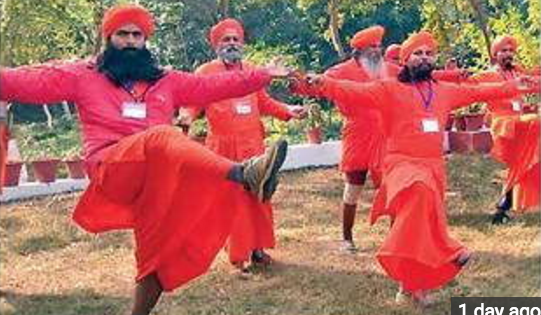
The below display of Tandava dance gives the wrong message that one can practice tandava while wearing shoes.
The above display of Tandava dance gives the wrong message that one can practice tandava while wearing shoes.
In Him,
Pankaj
== Section
3: Links ==
Recent postings
Other topics of interest

