Search This Blog

Wednesday, June 27, 2018

Dogma about “Guru’s words”


Baba

Dogma about “Guru’s words”

Namaskar,

If you have read Baba’s books, attended dharmacakra regularly, or been around senior margiis and Wts etc, then you have probably heard the following shloka:
Mantramúlaḿ Gururvákyam
Meaning: Guru’s word is mantra
The question then arises what does this really mean and how, as sadhakas, do we apply this in our own lives. Here following are some points to consider.

Will not produce the desired effect, if….


#1: The basic sense is that Guru’s teachings are like a mantra. If anyone follows the spirit of His spiritual teachings then they will attain mukti / moksa, by His grace.

#2: Baba has presented His teachings in the form of His numerous discourses. To follow those teachings, a sadhaka should know the underlying spirit. Merely memorizing the words in a literal manner will not produce the desired effect. If one embraces the inner spirit of what Baba wishes to convey then that is everything.

#3: As Mahasambhuti, Sadguru Baba’s overall presentation was very dynamic. Sometimes Baba would joke, play dramas, scold, and deliver discourses etc. Through each of those avenues Baba would speak in a unique manner based on the circumstances. So following the literal word is not helpful. The key element is to understand the overarching idea Baba was expressing in every situation.

#4: Suppose Baba delivered an 30 minute discourse. Then the need of the day was to record it and transcribe it to know what Baba actually spoke. Using that as a platform, it is our duty as His disciples to garner the spirit of His teachings from that discourse by understanding it within the greater context of His teachings. Once that is achieved one will have mastery of that discourse and be able to explain and expound upon those teachings in numerous ways using a wide-ranging vocabulary. So the spirit more so than the literal word is what is important. Yet knowing the literal words at the outset is integral for comprehending the overall meaning and guideline.
https://anandamargauniversal.blogspot.com/


Spirit of Guru’s teaching is the main thing

#5: Baba has given His teachings in multiple languages. And then we translate those teachings - using our own chosen words - into other languages. By this way, sadhakas from other linguistic backgrounds are able to understand that discourse. This furthermore shows that the overall spirit is the key aspect. Even if Baba spoke the entire discourse in Hindi, a sincere sadhaka who does not know any Hindi can understand exactly what Baba is conveying in that discourse, while a native Hindi speaker may not really understand that discourse even though they know every word. Again and again, it comes back to fact the spirit or essence of His message is what is most important. Mere literal understanding will not get you far.

#6: Baba’s teachings are not limited by a particular language or set of words. Actually, the inner meaning of His guidelines fail to be conveyed by words alone. Such is the limitation of language. A professor with a Ph.D. in philosophy may not be able to understand one of Baba discourses even though that discourse was given in his mother tongue because he lacked the mental capacity to embrace the underlying spirit of Baba’s teachings. Words are mere symbols and inadequate - in and of themselves - to convey all the subtleties of Baba’s eternal guidelines. Both sadhana and philosophical understanding are needed.
https://anandamargauniversal.blogspot.com/


Conclusion

#7: If anyone follows the spirit - not the letter - of Sadguru Baba’s blessed teachings then they are assured of attaining mukti / moksa. That is what is meant by the sholka, Mantramúlaḿ Gururvákyam.

In Him,
Dharmamitra

*        *        *

The below sections are entirely different topics, unrelated to the above material.
They stands on their own as points of interest.

*        *        *

== Section 2: Important Teaching ==

Still suffering from 7000-year-old problem


Ananda Marga philosophy states, “The Sanskrit equivalent for marriage is viváha (vi – vah + ghaiṋ): it means, after the ceremony, the man and woman can no longer live as libertines or as irresponsible so-called family people. They have to discharge their full obligations as bharttá and kalatra, responsible husband and responsible wife.”

“Another Sanskrit equivalent for “woman” is nárii, which is feminine gender. But Shiva used the term kalatra, in the neuter; for to her husband a woman is a wife, but to her children and other members of the society, she is as dignified as her male counterpart. So by declaring a married lady to be kalatra, Shiva gave her special status, and addressed her in neuter terms.”

“The liberal meaning of the term viváha is “live one’s life in a new way with a special type of responsibility”. This is the underlying significance of the Shaeva system of marriage.”

Ananda Marga philosophy states, “In His life, Shiva Himself married with this commitment. We can say without the least hesitation that Shiva was the first person in this world to marry in the proper sense of the term..” (1)

Note: That which was common 7000 years ago has now again come into vogue: That same disease has become prevalent today. A huge percentage of people around the globe are leading libertine life - especially in the materialistic areas. They produce children and neglect to take any responsibility. They do not like to be bound in conjugal relations and shoulder the responsibility of helping the child. The ones who suffer the most are the children and the mother. Often such children wind up in foster care - mentally and physically scarred. It is a serious crisis - watch out. Where capitalism is growing that disease will spread. Our duty is to propagate this teaching - if we bring even one libertine onto the path of responsibility then at least to some small degree the problem is solved.

Reference
1. Namah Shivaya Shantaya, Disc: 9


== Section 3: Links ==

Recent postings
Other topics of interest


Legal Notice: ©2018 Ananda Marga Universal Forum. All rights reserved. Ananda Marga Universal Forum content is the intellectual property of Ananda Marga Universal Forum or its third party content providers. Ananda Marga Universal Forum shall not be liable for any errors or delays in content, or for any actions taken in reliance thereon. Any copying, republication or redistribution, part or full, of Ananda Marga Universal Forum content, including by framing or similar means, is against the court of law and expressly prohibited without the prior written consent of Ananda Marga Universal Forum.


This email contains three sections:
1. Posting: Dogma about “Guru’s words” + 2 more
2. IT: Still suffering from 7000-year-old problem
3. Links

Example of abominable justice system in US + news


Baba


This email contains three sections:
1. News: Caricature of AMPS
2. Posting: Example of abominable justice system in US
3. Links


________________________________________________


== Section 1: News ==


Caricature of AMPS


Namaskar,

In this photo, all are smiling at Dada ji' hypocrisy - they know Satyashrayananda does not follow the avadhuta rules. Indeed, the person on the far right and the person on the far left think Satyashrayananda is worthless. They know Satyashrayananda's only quality is that he is a bootlicker of Rudrananda and for that reason he got the post not because of his own good conduct.  That is why they are smiling at this hypocrisy. And the Wt on the right has a lower post and he is smiling because he knows he has to garland this chameleon Satyashrayananda. The guy in the red shirt is wonderstruck how this degenerated Dada is getting respect - he cannot understand that others are smiling at Satyashrayananda's hypocrisy. An entertaining caricature of AMPS is going on. And all along Satyashrayananda was thinking, "Please don’t laugh at me - understand my weakness that for the fascination of post I became a sycophant of Rudrananda."


in Him,
Rasadeva


== Section 2: Main Topic ==


Example of abominable justice system in US


Namaskar,

Ananda Marga philosophy states, "In the past, many [so-called]f races and sub-races have been suppressed and exploited by powerful or dominant races. Racism has been propagated by those with evil designs in order to divide society and establish their own pre-eminence. Society must guard against such narrow and dangerous sentiments. This can be done only if every ethnic group has adequate scope for its expression and development. The multi-coloured garland of humanity will be enriched to the extent diverse human groups blend together from a position of strength and independence out of a genuine love for each other, and are not forced together through fear or compulsion." (1)


Two case studies: justice system

Here are excerpts from two news articles related to two different cases of court trials of two teenagers.
1) "A judge on Thursday sentenced an Alabama teenager to 65 years in prison for a series of crimes, including murder, even though a police officer was the one who actually killed the victim. Lakeith Smith, now 18, was convicted under the state’s accomplice liability law in March. Based on that law, a person can be convicted of felony murder if they were committing a crime with the deceased that led to the other person’s death, according to the Montgomery Advertiser. Most U.S. states have similar laws." (Courtesy of Huffinton Post)

2) "Ethan Couch, whose trial for killing four people while driving drunk sparked widespread conversations about the privilege of being raised wealthy, was released from a Texas jail on Monday after nearly two years. Mr. Couch, 20, became known as the “affluenza teen” after a psychologist suggested during his trial that growing up with money might have left him with psychological afflictions, too rich to tell right from wrong." (Courtesy of The New York Times)
In the first case, the convict who was a 15-year-old child at the time the crime was committed, was given a harsh sentence of 65 years in prison for abetting a burglary during which his accomplice was shot and killed by the police officer. It is to be noted that the convict did not kill his accomplice. The convict is now an 18-year-old is an African American teenager. Although he was not involved in the crime of killing his accomplice, he has been charged with murder. The cop responsible for shooting and killing the accomplice has been acquitted of all crimes.
https://anandamargauniversal.blogspot.com/

In the second case, the convict who was 16 years of age when the crime was committed, was responsible for the murder of four people. He was driving in an inebriated state, struck four pedestrians and killed them. He is a white American from a wealthy family who was tried as a juvenile in the court of law and given only probation with no jail time which is nothing but a "slap on the wrist" for a very heinous crime. This case sparked a debate of how affluent teens are afflicted with a psychological disorder that prevents them from distinguishing 'right' from 'wrong' and this affliction is the basis for only getting probation. See more about affluenza in the in-depth study section below. 


Comparison
  • In the first case the defendant was poor and black; and, in the second case the defendant was rich and white;
  • In the first case the black defendant did not kill anyone but was punished with a 65-year prison sentence. 
  • In the second case, the white defendant killed four people and was only put on probation, i.e. no jail time. (Note: It was only when he violated his probation the he was arrested in put in jail temporarily.)

Racism

By just briefly analyzing both these cases, one can conclude how the privilege of so-called race and wealth created a situation where a harsher crime was served with a just probation and no jail time. While action must be taken against both the boys involved in the crime, there is a glaring difference in the way both these individual cases were handled by the justice system. In the first case involving an African American teenager, who was just an innocent child at the time of the crime, probably influenced by his older accomplices, he was held responsible for a murder committed by a cop who came to respond to the situation. In the second case involving a wealthy teenager, he was directly responsible for killing four people. He was tried as a juvenile and released in a very short period of time owing to the influence of his parent's wealth. This situation explains the stronghold of racism and capitalism in our society which has penetrated deeply into the judicial system. The only panacea for this disease and many others is Baba's teachings.
https://anandamargauniversal.blogspot.com/

Ananda Marga philosophy states, "The famous American poet Carl Sandburg proclaimed –
There is only one man in the world
and his name is All Men.
There is only one woman in the world
and her name is All Women.
There is only one child in the world
and the child’s name is All Children." (2)
In the spirit of the above teaching, when humans view their fellow-humans as equals, as the progeny of Parama Purusa, as a manifestation of the Supreme just like one's own self and recognize everyone's right to live and develop physically, mentally and spiritually, then justice will be delivered to everyone in a fair manner irrespective of one's race, religion, caste, creed or social and financial status.

Social Justice 

Now let us examine the idea of social justice in light of Ananda Marga teachings.

Ananda Marga Philosophy states, "If and when somebody, whether a judge or an ordinary person, takes any type of action against another, it should be corrective, not punitive. If a system of corrective measures is introduced, criminals, whether they were deeply involved in the crime or not, will have no reason to complain against anyone. Although there may be flaws in the judgment, it will not harm them in any way. A person who is definitely guilty will benefit from a system of corrective measures, and even a person who is not guilty will benefit from such a system." (3)

In both the cases involving teenage convicts, irrespective of their race or social status, both were involved in crimes and it is the duty of the judicial system to take actions against them. Ananda Marga teachings shed light on the nature of the action to be taken against the culprit involved in a crime. In both the cases, the boys were given a prison sentence for a particular number of years. It has to be carefully examined if their time in the prison has a transformative effect on their personalities. At a tender impressionable age, when one is confined to the walls of the prison, there must be enough and more opportunities for the convict to develop his physical, mental or spiritual potentialities. The sentence should not be imposed as a punishment but should be rendered with a view to correcting flaws in the convict's character due to which the crime was committed. That way, when he steps out of the prison, the convict integrates back into the society as a productive member who can contribute to the society.


Conclusion

This is deplorable and abominable situation in the US where the justice system is blatantly biased and issues harsher sentences based on the color of one's skin and ethnicity etc.

Ananda Marga philosophy states, "While presiding over a trial a judge should not be prejudiced against the accused, but should consider whether he or she has committed a crime or not; and if so, under what circumstances, and whether the crime was committed voluntarily or at the instigation of others. This is the main point for consideration during a trial. The person on whom society has bestowed the solemn office of judge has therefore to be of a higher standard than an ordinary person." (4)

Ananda Marga philosophy states, "My opinion is that no innocent person should have the opportunity to think or say, “Although I am innocent, I am being punished because I couldn’t afford a good lawyer” due to flaws in the judicial system. No doubt society will be adversely affected if an offender evades the law and is not arrested by the police due to their incompetence, but far greater damage will be done if an innocent person is penalized because of a defective judicial system." (5)

in Him,
Praka'sha


~ In-depth study ~ 

About affluenza

 ~ Courtesy of Wikipedia ~
"Affluenza, a portmanteau of affluence and influenza, is a term used by critics of consumerism. It is thought to have been first used in 1954, but it gained legs as a concept with a 1997 PBS documentary of the same name and the subsequent book Affluenza: The All-Consuming Epidemic (2001, revised in 2005, 2014). These works define affluenza as "a painful, contagious, socially transmitted condition of overload, debt, anxiety, and waste resulting from the dogged pursuit of more". The term "affluenza" has also been used to refer to an inability to understand the consequences of one's actions because of financial privilege, such as in the case of Ethan Couch." (Courtesy of Wikipedia)

"In December 2013, State District Judge Jean Boyd sentenced a North Texas teenager, Ethan Couch, to 10 years' probation for driving under the influence and killing four pedestrians and injuring 11 after his attorneys successfully argued that the teen suffered from affluenza and needed rehabilitation, and not prison. The lawyers had argued that Couch was unable to understand the consequences of his actions because of his financial privilege. The defendant had been witnessed on surveillance video stealing beer from a store, driving with seven passengers in a Ford F-350 "stolen" from his father, and speeding at 70 miles per hour (110 km/h) in a 40 miles per hour (64 km/h) zone. Couch was also driving while under the influence of alcohol (with a blood alcohol content of 0.24%, three times the legal limit for an adult in Texas) and the tranquilizer Valium. At a February 5, 2014, hearing, Eric Boyles—whose wife and daughter were killed in the crash—said, "Had he not had money to have the defense there, to also have the experts testify, and also offer to pay for the treatment, I think the results would have been different." (Courtesy of Wikipedia)

References
1. A Few Problems Solved Part 9, Socio-Economic Groupifications
2. A Few Problems Solved Part 6, Universality in Race, Language, Religion, and Culture
3. Human Society Part 1, Justice
4. Human Society part 1, Justice
5. Human Society part 1, Justice


== Section 3: Links ==

Recent postings


Other topics of interest


Legal Notice: ©2018 Ananda Marga Universal Forum. All rights reserved. Ananda Marga Universal Forum content is the intellectual property of Ananda Marga Universal Forum or its third party content providers. Ananda Marga Universal Forum shall not be liable for any errors or delays in content, or for any actions taken in reliance thereon. Any copying, republication or redistribution, part or full, of Ananda Marga Universal Forum content, including by framing or similar means, is against the court of law and expressly prohibited without the prior written consent of Ananda Marga Universal Forum.

Friday, June 22, 2018

Mahaprayan of Dada Sambhutyananda

Baba


Mahaprayan of Dada Sambhutyananda

Namaskar,

It is with much sadness that we share the news of the mahaprayan of Acarya Sambhutyananda Avt. Dada ji underwent his mahaprayan today 22 June 2018 in the evening at 8:50pm IST. Sadly, Dadaji was seriously ill for at least the past one month. The cremation ceremony will be on 23 June 2018 at 1pm at Ananda Nagar.

For some time Dada ji was living alone near "Pindra Jora", approximately 10km from Bokaro.

With his mahaprayan, Acarya Sambhuytnanda Avt will be greatly missed by so many. May we all take solace in the fact that our dear Dada ji was a disciple of Sadguru Baba. Certainly he will attain mukti or moksa, accordingly. Baba will lovingly bestow His infinite grace.

at His lotus feet,
Prabhudeva Mahato


~ In-depth study ~

We have seen that when somebody dies then in offering their condolences people say now Mr So-and-so is sitting on Baba's lap. On other occasions when telling a Baba story people also say, "Such and such person sat on Baba's lap." But these days the trend is that "sitting on Baba's lap" is used more in connection with death. And that causes some confusion in reader's mind. To unknot the situation please read below.

Dogma: if "on Baba's lap" only used for death

Here are quoted lines from recently posted emails on various forums, wherein the writer uses the phrase - "in Baba's lap" - with the occasion of death:
- "May Parama Purusa Baba accept her in HIS divine lap"

- "May his soul rest in the lap of our beloved BABA"

- "Now she is taking rest in Baba's Lap."

- "May Baba accept him in HIS divine lap....."

- "May he rest in HIS loving lap of eternity."

- "We are sure that Baba has taken him in His loving lap."

- "May his soul rest in Baba's lap forever."

- "Let her rest peacefully in Baba's Lap - which she always desired."

- "now he is in beloved Baba's lap"

- "May his soul get peaceful place in His lap"

- "He is now in Bábá's loving lap"

- "May Baba bless him with a seat in His lap."

- "May BABA accept him in HIS divine lap!"

- "May Baba take him in his eternal loving lap."

- "May his soul rest in peace taking shelter in Baba's lap."

- "Please keep him on Your lap forever."

- "We all collectively pray to Baba to take him on Baba's divine lap forever.”
All of the above lines are commonly written in eulogizing the deceased. These days mostly it is used in a eulogy and rarely used to recount one's intimate spiritual experiences - unfortunately. By this way, the phrase "in Baba's lap" is being misused and step by step the real meaning is being forgotten as now people more commonly use the phrase to eulogize those who have died, and much less so to express their inner feelings of bhakti. Unfortunately, the meaning and inner spirit of the phrase is getting lost.


Baba story: "sitting on Baba's lap"

Some time ago after dharmacakra, a senior margii was recounting his experiences of having dharma samiiksa with Baba. He said, "After being lovingly scolded by Baba for my wrongdoings, then He called me close and placed me on His lap - I remained there for some time soaking up His love - and He blessed me."

We all enjoyed hearing about his personal account with Baba during dharma samiiksa. When he finished telling his factual and historical event, there was a call for questions. Various people posed their queries. Towards the end, one new margii raised his hand and asked, "How did Baba bring you back to life?"

Everyone stared at the new margii in amazement. There was a look of astonishment all around - people were really shocked to hear him say this. The new sadhaka sensed that something was wrong He said very matter-of-factly, "I thought that sitting on Baba's Lap means that he (the margii) died - that is why I asked that question."

This was quite eye-opening for those of us in the room: Through our language and expression we had unknowingly taught someone to think that being on Baba's lap is the equivalent of death. Because it seems that nowadays people only use the phrase "Baba's lap" when a person has died, such as "Let him rest peacefully in Baba's lap", as if in order to sit on Baba’s lap one has to die. But that is false. Sincere sadhakas regularly sit on Baba’s lap in their meditation. It is His grace. It is just like a child need not die in order to sit on his father’s lap.

The idea is that this phrase - Baba's lap - has been linked with death due to extreme overuse. So for some time if sadhakas use this phrase exclusively for spiritual purposes, that will be best. The phrase, "sitting on Baba's lap", should not meet a similar fate. It should not lose its pure spiritual quality and just refer to one's death. That will be very negative.

Baba would bless bhaktas and place them on His lap

There are tens of thousands of recorded stories by sadhakas where they use the phrase, "on Baba's lap", when describing their experiences of being with Baba: He used to bless them and bring them on His lap. People should understand the deeply mystical value of this expression, and not just think that Baba's lap means death, i.e. that you can only sit on His lap at the time of death. Still today there are thousands of margiis walking this earth who sat in Baba's lap. And not only that, there are countless more sadhakas who were blessed by Baba in dreams and sadhana wherein they sat in His lap. And still today this deeply intimate experience is attainable by sadhakas, by His grace.

There are so many ways an aspirant can reach unto Baba's lap including in sadhana. That is the main idea that should be preserved. Sadhana is a spiritual practice and one can sit on Baba's lap in sadhana. We should make it cent-per-cent clear to one and all that the phrase, "sitting on Baba's lap", does not mean death.

"Mahaprayan" means death of mortals - confirm for yourself
from the Samsad Bengali-English Dictionary

Mahaprayan (Death): Many are aware that mahaprayan (death) is the common term used in India and especially in our Bengal to describe the death of any human being, even ordinary people. In that way, the obituary columns of the newspapers of Bengal regularly cite the mahaprayan (death) of various persons of society who died or passed away.

Some may get confused and wrongly think that the word 'mahaprayan' (death) is one extraordinarily term of bhakti to be used in association with Parama Purusa. But that is not at all the case. Rather to do so is only to undermine the eternal presence of Parama Purusa. That is why no bhaktas ever use the word 'mahaprayan' in reference to Lord Shiva or Lord Krsna. Because Lord Shiva and Lord Krsna exist eternally. Then there is no question of Their mahaprayan (death).

Baba is Parama Purusa so He is eternal and there is no question of His mahaprayan.

Here it should be known that the convention of an annual death day ceremony (i.e. shraddhainjali or mahaprayan) is a foundation of the Islamic tradition. Muslims are well known for this, and their approach of an annual death day ceremony was adopted by the leader of a particular group in AMPS. So no one should think that mahaprayan is some type of sacred event. It is done on the death day anniversary of Muslims.

And for those who need still more technical proof then all this can be clarified quite readily by referencing the dictionary. Specifically in the Samsad Bengali-English             dictionary 3rd edition on page 848. Checking there it will be confirmed that the word 'mahaprayan' means death. Which is why it is used to refer to the passing away of even common citizens. And that is the case in this letter also. The term mahaprayan means death and this is the ideal term for this purpose.

Mahaprayan is only for humans not for Sadguru

Here it should be qualified that there is both real mahaprayan and fake mahaprayan. Real mahaprayan marks the death of any ordinary human being, just like the aforesaid news. This is the proper use of the term: To note a person's departure from this earth. That is the meaning of the mahaprayan term and that is the standard way the term is used in Indian languages.

Then there is the fake, or so-called, or dogmatic mahaprayan. That is when certain vested interests try to apply the mahaprayan term to Parama Purusa. This is grossly inappropriate because when Parama Purusa Sadguru Baba is that Divine Entity who is beginningless and endless and resides always in our heart, then it is entirely wrong to proclaim that He is gone.

That is why rational margiis are protesting; because the Oct 21st program is so-called mahaprayan. So-called means that something is fake. Parama Purusa is eternal, thus for some vested interests to declare "mahaprayan of Parama Purusa" is nothing but so-called mahaprayan.

Mahaprayan only really happens in the case of human beings, not Parama Purusa. Those doing mahaprayan for Sadguru are hypocrites. On the one side in meditation they ask His grace thinking that He is ever-present, and on the other side they think that Baba has passed way. That is their hypocrisy.


== Section 2: Links ==

Recent postings


Other topics of interest


Thursday, June 21, 2018

Girl donation + 3 more

Baba

Girl donation

Are women like cattle, or sacks of cloth that people give as gifts at the time of marriage?

Note: This letter is only for those who have reverence for Sadguru Baba Shrii Shrii Anandamurti ji and try to follow His Ananda Marga ideology.

Namaskar,

Here is one important topic that every Ananda Margii must know about.

Sadguru Baba has given the guideline that males and females have equal status. But in old Indian traditions that is not the case. Especially, marriage ceremonies are done in a very lopsided way. This letter talks about the kanyadan (girl donation) Hindu marriage system. These days even highly educated boys and girls marry according to the old ritual of kanyadan or girl donation - whereby girls are donated to boys and treated as slaves. Those getting married do not think about what they are doing - nor do the participants / witnesses. They are so indoctrinated that they do not consider or question how abominable this kanyadan (girl donation) ritual is. To understand please continue reading.

Sadguru Baba says, “Renaissance people will have to start a movement for social equality and fight against such inequality based on sexual difference. Are women like cattle, or sacks of cloth that people give as gifts at the time of marriage? Are they slaves to be sold to others? As long as women lacked courage or intellect, they tolerated these things – but what a great humiliation! To submit them to such indignities is far worse than to whip them publicly on the road. Are women simply like bundles of cloth to be sent to the washerman’s house?” (1)

Girls objectified & given away as mere objects


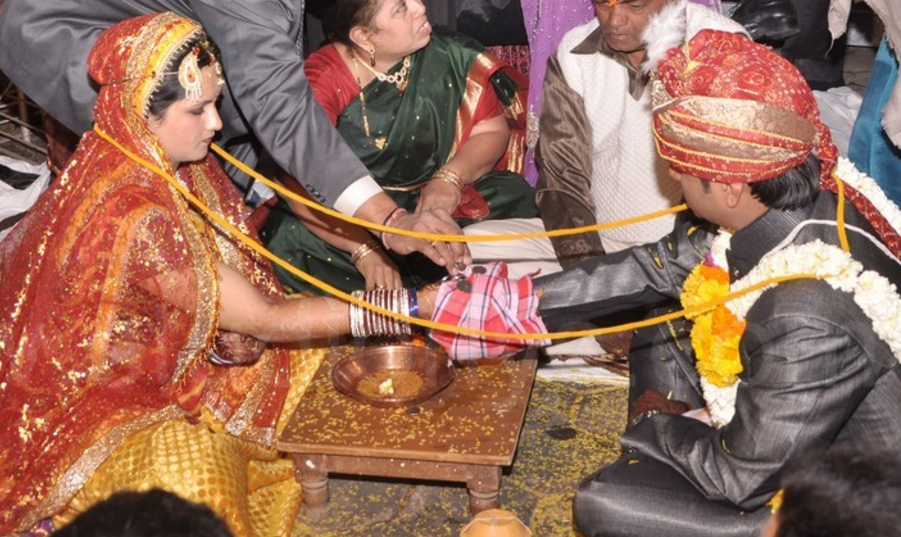
In the below photo, the prevailing Hindu marriage dogma is on full display. Women are treated as mere objects to be donated to the husband and his family - just as one would donate a sheep, cow, or a table cloth etc. These girls are viewed as physical property to be bartered and traded etc. Verily, females in the Hindu marriage system are not treated as human beings, but rather as mere possessions - i.e. articles to be given away etc.
https://anandamargauniversal.blogspot.com/

It is akin to the era of slavery where slaves were taken to the market to be bought, sold, and traded like mundane possessions etc. Similarly, these girls are decorated in order to be given away. This is the case with typical Hindu marriage ceremonies. The Muslim marriage ceremonies are even worse as they proclaim that three females are equal to one male. That is why sincere Ananda Margiis do not participate in these types of dogmatic ceremonies - even if non-margiis are hosting the event. Participating means degrading the status of women. Indeed, this type of marriage ritual is abhorrent.

The below is the scene at a Hindu marriage / kanyadan (girl donation) ceremony where girls are objectified and bartered as property - just as one has a house, a car, a bicycle, horses, or animals etc.


~ Dogmatic Hindu marriage ceremony where females treated as commodities ~

Dogma: girls are treated as property

Pictured above is the girl donation ceremony. In the above photo, the guardians of the girl are leaning over her head and offering her to the boy who is sitting across from her. The golden thread or cord that is looped about the girl and boy demonstrates that she now belongs to him. In India, girls are treated as property - just as one has a house, a car, a bicycle, horses, or animals etc. Boys are not treated as property, but girls are. This is pervasive in throughout the Indian subcontinent, the Muslim world, and many other regions as well. In the west, females were formerly treated this way but things have changed drastically in the last half-century whereby women have gained both legal and social rights. But in India - such as in the Hindu wedding scene picture above, girls are mere objects to be traded.

Because this dogma is so ingrained, some may feel frustrated reading this. They have been so indoctrinated into this defective mentality that they think the donation of their girls is something holy or virtuous. 
https://anandamargauniversal.blogspot.com/

Quite humiliating and denigrating for the girl


The name of this social ritual is kanya’da’n (girl donation). Kanya’ means girl, and da’n means gift or donation. Thus when they donate their girls it is called kanya’da’n (girl donation). They think of this as being something virtuous. But in reality, we know that nothing can be donated unless it is something you own. Thus girls are mere commodities or property.

As Sadguru Baba points out, this whole scene is quite humiliating and denigrating for those girls but due to their ignorance they feel ecstatic and glorified during this ceremony. When that girl was small she was taught that a one fine day she will become the property of another family. So they believe that this is a respectful and dignified outcome - i.e. to live as the property of someone else.

Ananda Marga philosophy states, "The bride wearing ornaments would remain seated in a squatting fashion on a low wooden seat; the guardian of the bride would pick her up along with the wooden seat and give her away to the bridegroom, who would receive her as a gift. The person presenting the gift was called kukuda, that is, one who gives away [the bride after picking her up]. The one who received the gift was called koka, that is, the one who accepts the offered bride as a gift. This marriage custom where the daughter is ceremonially given away is still prevalent among high-caste people. This custom is humiliating for women. Is a woman a commodity like rice, pulse, salt or oil that I pick her up and hand her over to someone? Is a woman a hen or okra that I pack her up in a sack and sell her or give her away? The custom is not only humiliating for women; it also drags the dignity of humanity down to dust. It violates the basic principles of humanism and also Neo-Humanism. I request all rational-minded people of the world to give serious thought to this issue and try their best to abolish this odious custom. I would say that it was not proper for Manu to support this custom." (2)

Why margiis not to support dogmatic Hindu marriage kanyadan


This defective mentality is similar to that of a caged bird that has been caged for so long that it cannot conceive of its own freedom. It likes that small, puny cage.

In His below guideline, Baba is warning us about this kanyadan dogma: Females are not anyone’s personal property like cattle or sacks of cloth. Yet treating females as mere objects is worse than whipping them publicly on the road. Only a few confused or very new margiis participate in this dogmatic Hindu marriage ritual. Every true Ananda Margii is keen to refrain from attending any such type of event etc - sincere sadhakas understand they cannot support or attend this Hindu ritual of kanya’da’n (girl donation) ceremony. After all, these are not innocent affairs, but rather represent the imposition of dogma and the exploitation of women.  It is our duty to educate the public and remove this social injustice and gender difference.

Baba is warning us about this dogma and it is our duty to educate the public and remove this social injustice and gender difference. Females are not anyone’s personal property. A few confused or very new margiis attend this dogmatic Hindu marriage ritual. But every true Ananda Margii must think long and hard before attending any such type of event etc - sincere sadhakas understand they cannot support or attend this Hindu ritual and kanya’da’n (girl donation) ceremony. After all, these are not innocent affairs, but rather represent the imposition of dogma and the exploitation of women.
https://anandamargauniversal.blogspot.com/

Ananda Marga philosophy states, “Renaissance people will have to start a movement for social equality and fight against such inequality based on sexual difference. Are women like cattle, or sacks of cloth that people give as gifts at the time of marriage? Are they slaves to be sold to others? As long as women lacked courage or intellect, they tolerated these things – but what a great humiliation! To submit them to such indignities is far worse than to whip them publicly on the road. Are women simply like bundles of cloth to be sent to the washerman’s house? Women must not be suppressed, and there should not be domination of males in the society. Society should have a cooperative leadership, not a subordinated leadership; there should be a coordinated, cooperative leadership, leadership between males and females. Renaissance people will have to start a movement immediately to fight against all these disparities; otherwise if fifty percent of the population, that is the ladies, remain downtrodden, how can there be all-round progress of human society? So these are all the social duties, the social responsibilities of the Renaissance movement. Renaissance people will have to wage war on these disparities, these inequalities – they will have to be rooted out of the society.” (3)


Conclusion

In order to save our universal human family from various dogmas and degrading traditions of ritualistic marriages, Sadguru Baba has graciously given an ideal revolutionary marriage ceremony that grants full respect and dignity to females and places them on equal footing as men. The Ananda Marga system eradicates all dogmas - no kanyadan (girl donation), no dowry, no casteism - and enables our human society to march forward into a whole new era of gender equality based on neo-humanistic values.
https://anandamargauniversal.blogspot.com/

Namaskar
in Him,
Sulekha’ Singh

References
1. A Few Problems Solved - 7, Renaissance in All the Strata of Life
2. Shabda Cayaniká Part 4, Disc: 27
3. A Few Problems Solved - 7, Renaissance in All the Strata of Life


*        *        *

The below sections are entirely different topics, unrelated to the above material.
They stands on their own as points of interest.

*        *        *

== Section 2: Prabhat Samgiita ==

Why birds keep singing today? 

Prabhat Samgiita Intro: This following song depicts how the arrival of Parama Purusa transforms the whole scene. In the flower garden the birds are singing more sweetly, and the bumble bees are whispering to the flowers about the arrival of Parama Purusa. In the clouds, rain, thunderstorms, there is an expression of joy and enthusiasm. Everything is charged with positivity. When the mind is in a blissful state with bhakti then everything looks beautiful. Here the bhakta feels that in the heart the most charming Parama Purusa has appeared and in result everything is dancing in ecstasy.

"Áj pákhirá kii gán gáiá jáy, phúlero vanete bhramará nibhrite,
kii kathá ájike shonáte cáy..." (Prabhat Samgiita #0364)

Purport: 

O’ which songs do the birds keep singing today? In the flower garden, what does the bumble bee secretly wish to convey today? It looks like they are talking about the Supreme Charmer, Parama Purusa.

O’ why does the thunderbolt clamour with overwhelming joy in the heavy clouds amidst torrential rain showers. For whom is the thrilled lightning flashing with its bolts streaking across the sky.  It looks like they are happy because Supreme Entity has come.

O’ who is sitting in my heart making my whole existence dance with ever new tunes. Today, I see the Lord appear before me in a beauteous and most attractive mohan form. He is full of mamata - extreme affection towards me. Seeing Him my heart is dancing...


Note For Prabhat Samgiita #0364:

Mamata': Mineness; In Sanskrit “mama” = mine, and the suffix ta’ = -ness; hence “mineness.” To have equal or more love for something / someone than one has for oneself.

Ananda Marga ideology says, "What is the meaning of “mamatá”? Mama + tá = mamatá. Mama means “mine” and thus mamatá is the inner idea of being mine, the feeling that something is my own." (1)

Ananda Marga ideology guides us, "“Mamatá” means “mine-ness” – “Mama” means “one's own”, and the abstract noun derived from it is “mamatá” – meaning, thereby “mine-ness.”" (2)

For example, suppose you are suffering from a fever then naturally you will be concerned about your own health. You will try to cure yourself by going to the doctor and taking medicine etc. If you have mamata for someone else, then if they are sick with a fever you will have the same degree of care for their condition as your own. When one does sadhana then this sense of mamata grows and one ultimately has the feeling of mamata towards the entire created universe. Without sadhana, one’s sense of mamata will be extremely limited whereby one might only care about their own individual existence. So when the mind is extremely narrow one only has mamata for oneself. Those with a slightly broader mind have mamata towards their parents and family members. And as the circumference of mind expands one has mamata for other relatives and community members etc. However, it is only with sadhana that the periphery of mind can grow further and further wherein one’s sense of mamata includes all beings and expressions of this cosmos. Parama Purusa has mamata’ for each and every entity - this entire creation, all living and non-living expressions.

References
1. Ananda Vacanamrtam - 7, The True Nature of Bhakti
2. Ananda Vacanamrtam - 1, Pleasing the Lord


== Section 3: Important Teaching ==

Multi-tasking: dangerous & impossible

The typical person has numerous aims. For example, they want to be the king, president, billionaire, film hero, sports star, musical icon etc. In that sense the average person is multi-purpose. But at the same time living beings are unilateral. We can only do one work at one time. People talk about multi-tasking, but it is an impossibility for unit beings. The mind cannot do two works at the same time. And if one tries to multi-task, their mind will become bifurcated and ultimately degenerated, and / or they will find themselves in a terrible accident.

Best is to do one task at one time. By cultivating that quality in sadhana humans become one with Parama Purusa.

By doing sadhana and with his grace, the aspirant does become one with Parama Purusa. And then, after losing their individuality, they can work multilaterally - i.e. in all directions. Till then, do not try and do many works at one time.

Only one direction, at one time


Ananda Marga ideology states, “Microcosm is multipurposive but its flow is unilateral. On the other hand, Macrocosm is uni-purpose but its flow is multilateral. There is no end to the desires of microcosm. Sometimes it desires fame and sometimes it desires money. But it can make itself travel at one time in one direction only. His mind cannot be simultaneously engaged in a book and in a football game. While reading, if he thinks of the football game his mind is diverted from the book. Similarly, he cannot enjoy the football game if in the football game he begins to think about his books. Hence, the flow of the unit is unilateral. It travels only in one direction, at one time, whereas Macrocosm is uni-purpose but multilateral. There is only one thought of Macrocosm and that is the well-being of all. This is His one sole purpose. Yet Macrocosm is a multi-lateral flow. He does many things simultaneously. He is feeding you, creating the world, making rivers, canals and birds. Everything is being created in His mind. Hence there is much variety in His mind.” (1)

Reference
1. Subhasita Samgraha - 18, Microcosm and Macrocosm


== Section 4: Links ==

Recent postings
Other topics of interest
More important letters


Legal Notice: ©2018 Ananda Marga Universal Forum. All rights reserved. Ananda Marga Universal Forum content is the intellectual property of Ananda Marga Universal Forum or its third party content providers. Ananda Marga Universal Forum shall not be liable for any errors or delays in content, or for any actions taken in reliance thereon. Any copying, republication or redistribution, part or full, of Ananda Marga Universal Forum content, including by framing or similar means, is against the court of law and expressly prohibited without the prior written consent of Ananda Marga Universal Forum.

This email contains four sections:
1. PS #0364: Why birds keep singing today?
2. Posting: Girl donation
3. IT: Multi-tasking: dangerous & impossible
4. Links

SUBJECTS TOPICS