Search This Blog

Friday, June 13, 2025

Mystique of Tiger’s Grave + Trap of self-praise & appreciation

Baba

Mystique of Tiger’s Grave

Ananda Marga philosophy states, “As a general rule human beings should not kill animals under any circumstances. The exception to this rule is when human life is in danger. For example, if you are confronted by a tiger which threatens your life, before it attacks you may be forced to kill it…. animals should only be killed when they directly endanger human life. It follows from this that you should not kill animals in their natural habitat. In the forests there are many lions, tigers, snakes, etc., but such creatures should not be killed in their natural environment because there they pose no threat to human life. Although it is the nature of some tigers to attack human beings, all tigers should not be killed simply for this reason. We must not forget that it is also the duty of human beings to build sanctuaries for dying animals and endangered species of animals and plants. This is the practical approach of the living philosophy of Neohumanism. This is the approach of Neohumanism to animal and plant life.” (1)

Note: As many may recall, Sadguru Baba used to regularly sit at the site of the Tiger’s Grave in Jamalpur. Over the years, many theories have been put forth why this was the case. Nearby, there was also the grave of the Englishman who killed that tiger. In that attack, both the Englishman and the tiger died. And Baba’s preference was always to sit on the tiger’s grave, not that of the Englishman. The question is why. 

Here the point is that this tiger was living in its natural surroundings and was unnecessarily murdered by a human being. The tiger had done nothing wrong and was not at fault in any way. In short, that tiger did not deserve to die. For this reason, in this particular instance, Baba was more sympathetic to the tiger. In contrast, the Englishman was a trained and potent hunter who was very strong and skilled with various weapons. Driven by vanity and ego, the Englishman was eager to show others that he can kill a tiger with a sword etc. So without any provocation, he sought out and killed that tiger as an exhibition. But this type of cruelty and hunting for sport, or verily any type of action where innocent animals are needlessly killed, is not supported by neo-humanism. That’s why Baba always honoured the tiger and sat on its grave. 

Reference
1. Prout in a Nutshell - 17, Prout and Neohumanism


== Section 2: Main Topic ==

Trap of self-praise & appreciation

Namaskar,

This following letter delineates a major aspect of the mindset needed to be a true sadhaka.

In this current social era, there are two competing approaches that confront every Ananda Margii. One is from the environmental factor, i.e. the trends and ways of worldly, materialistic society; and, the second is Baba's ideological guidelines & teachings.
https://anandamargauniversal.blogspot.com/


By thinking about oneself, mind gets smaller

These days the common people do not know how to think or use their minds. The masses are just self-engrossed, thinking only about themselves. They have no greater outlook than their own indulgence and pleasures. In that condition, the periphery of their mind decreases—making people more narrow-minded and selfish.

The operative rule is—'As you think so shall you become'. So by thinking about the unit self, then the dimension of one's mind gets smaller and smaller.

One static outcome of this phenomenon is that people are hungry to be praised—always. They always harbour the deep desire that someone should appreciate them. Not only every day but every minute, otherwise they feel depressed. This is the unfortunate situation of the general public these days. And the consequence is the uptick in psychic diseases. Now more than ever people suffer in frustration and melancholia etc.

Now is the time we should analyse how far Baba appreciates this self-praise—or the habit of enjoying self-praise. How far does this selfishness have any value in the life of true human beings. We should see carefully whether this self-aggrandizement is something meaningful or detrimental.
https://anandamargauniversal.blogspot.com/


Baba says: Self-praise is like cat's cry


Here is the English summary of Baba’s Hindi teaching of DMC 4 March 1984 Jammu:

You did a little work and proclaim, 'I did it, I did it.'  "I have done this, I have done that". People praise themselves too much saying 'I', 'I'. Oh, why would you say that much I, I.

Oh, Why would you say "Meow, meow"? If anyone says "Meow, meow, meow" it is a cat.(*)

(Laughter)

What you say? Who does "Meow, meow"? The cat. Yes.

Man does a little, (showing with the two fingers and thumb of His hand) this much, and expresses (showing by expanding both the hands to max) this much.

Don't do like this. Continue to do work with His thought in mind. No need to tell anybody about it. Parama Purusa is doing every work of the entire universe, does He talk about it? No He does not. Niirav karmii bano, Be a silent worker.

(*) The cat makes the sound “meow, meow”, and that sound is very similar to the Hindi word for “I”—’maeṋ’. So according to Hindi, it sounds like the cat just moves around all day glorifying itself—meow meow. So Baba is making a joke that human beings should not glorify themselves all day long (“I did this”, “I did that”) like the cat—meow, meow.

Watch out—you may come across some karmiis whose behaviour is similar—they praise themselves and say, “I did this and I did that.” As they are our family members, we should politely tell them not to praise themselves but sing the glory of Parama Purusa—not self-glorification.
https://anandamargauniversal.blogspot.com/


Mental ailment: desire to be praised


Here below Baba is describing the poor mental condition of those people who hanker after praise.

Baba says, "Why on earth should anyone indulge in self-publicity? To whom will he publicize himself? Such acts are the antics of common, avaricious people with beggar-like mentality." (1)

So the whole point is that those who do not know the science of mind are involved in their own self-glorification. But human beings should think about God. This is our approach. Hence engaging in self-praise is not proper for a sadhaka—rather it is unfit to do so.

In contrast the standard of true margiis is quite high. Because the mind is focused on Parama Purusa. So the mind does not have the opportunity to think about the self—in which case, the periphery of the mind is getting bigger and bigger and in due course it becomes infinite. And finally in one golden dawn it becomes so vast that it merges into Parama Purusa, and reaches its Goal.

Here we see how selfishness leads to so many psychic maladies.

When people are solely focused on their own ego-satisfaction, then frustration is always side-by side. Because the moment they do not get what they want, then frustration arises. And this condition is accompanied by other psychic afflictions as well.

On the occasions they are praised by others they either feel arrogant or become dependent on that praise. For instance, they may not do anything other than for the desire to be praised. And when they are not praised, they are crushed and prone to despair—and may give up that work entirely.

The worst outcome is that people foolishly forget that whatever little strength they have is just the gift of Parama Purusa. Devoid of this thinking they become egotistical and full of vanity. And in result they invite their ruination.
https://anandamargauniversal.blogspot.com/

One should never praise oneself or any other person—Baba


Ananda Marga ideology states, "Aham'ka'rah patanasya mu'lam" (2)

Meaning: Pride goeth before a fall. (i.e. Ego is the cause of downfall)

So this malady has come from the offshoot of materialism. Mostly materialistic minded people, those whose be-all and end-all of life is matter, suffer from such types of diseases. And they need day-long appreciation by others. Otherwise frustration and depression engulfs them. Such an unfortunate episode has become the norm.

Ananda Marga ideology states, “One should not praise oneself or any other person. There are many people who are very fond of praising themselves by telling everyone what wonderful things they have done, but, as mentioned in this sloka, kiirtana is not for one’s own self but for Hari. Even though people are taught to do kiirtana for Hari, they still make the mistake of praising themselves too much. Sometimes their self-praise is so intense that others are obliged to say, “Please stop praising yourself so much.” They forget that their self-applause is rather boring for others. Human beings should realize that no one likes to hear the self-praise of others." (3)

in His service,
Mahesh

History: hired agents to glorify Dadas

Here is one typical example how some Dadas hungry for praise hired agents to glorify and laud them (i.e. those very Dadas). See here below how these dadas are praising themselves about their work at one DMS but had it written in the third person in their own magazine, Prajina Bharatii. But what was written in Prajina Bharatii was completely bogus. The following is an English translation of what they printed in Hindi.

  • Ac Satyashrayananda is an intellectual giant and in this world there is none who can work like he does with others, hand in hand.
  • Ac Nabhatiitananda is always living in the divine world. This great monk beautifully walks on this rugged earth. He arranges all catering facilities—with his kiirtan raised margii standard and took them to the divine kingdom. People became intoxicated.
  • In this entire arrangement this Dada Pranaveshananda is the most adored and is like one decorated flower on the top of this entire program. From beginning to end he was always present everywhere. Dada’s labor and inspiration was unique. Without caring about his own health and comfort he was ready to make this program successful—and took up most of this burden and completed it also.
  • What can I say about Ac Rakeshananda —I never saw him tired—he toured the entire Angladesh and awakened all.

Here above is one typical example how some Dadas hungry for praise hired agents to glorify and laud them (i.e. those Dadas). See here above how these dadas are praising themselves about their work at one DMS but had it written in the third person in their own magazine, Prajina Bharatii. But what was written is completely bogus.
http://anandamargauniversal.blogspot.com/


~ In-depth study ~

Self-applause is boring for others


Ananda Marga ideology states,"“Kiirttaniiyah sadáharih”. Kiirtana should be done on Hari and on no other entity. One should not praise oneself or any other person. There are many people who are very fond of praising themselves by telling everyone what wonderful things they have done, but, as mentioned in this sloka, kiirtana is not for one’s own self but for Hari. Even though people are taught to do kiirtana for Hari, they still make the mistake of praising themselves too much. Sometimes their self-praise is so intense that others are obliged to say, “Please stop praising yourself so much.” They forget that their self-applause is rather boring for others. Human beings should realize that no one likes to hear the self-praise of others." (4)

Ananda Marga ideology states,"People of action are also not free from vanity: “I did this, I did that – I built this road when I was a minister I constructed this bridge when I was in the Public Works Department” – this is how people become mad for their little “I”. Thus we see that although action is free from lethargy, it is not altogether free from vanity." (5)

Ananda Marga ideology states, "Those who think that they will get Him through the actional faculty are finally engaged in actional infighting. “I did this, I did that”." (6)


Irony about those who are truly great


But one thing is for certain. Our scriptures say that those who are great persons, in their life, they never get recognised. And in the society they always get abused.
https://anandamargauniversal.blogspot.com/

As Ananda Margiis we should be fully aware of and always remember this golden teaching of Baba: That the vanguards of society are never praised in their age.'

Baba says, "You should remember that those who are the actual pioneers, the real vanguard of the society, are always a microscopic minority, but it is they who are destined to be victorious. Those who once opposed, or are now opposing or will oppose in the future, will in the future admit: “Yes, we are now driving our vehicle safely and comfortably along the very path which that vanguard once opened by clearing the jungle.” This means that those who cleared the obstacles in the beginning will later be recognized as pioneers. The funny thing is this, that people do not give recognition at the time it is due. This is the natural law. " (7)

About such great people's mentality Baba says:

"Nindantu niitinipun'a'h yadi va' stuvantu laks'mii....na dhiira'h."

“Let those well-versed in ethics criticize me or praise me, as they so desire; let Lakśmii, the goddess of wealth, either be gracious enough (because of my activities) to reside in my house, or, if she prefers, go elsewhere; let death visit me today or decades later. It makes little difference to me. Wise people will never withdraw from the path of ideology, the path which they accept as their ideal.” (8)

References
1. Subhasita Samgraha, part 2, The Intuitional Science of the Vedas – 3
2. Namah Shivaya Shantaya, Shivokti no. 6
3. Ananda Vacanamrtam - 8, The Lord Should Always Be Praised
4. Ananda Vacanamrtam - 8, The Lord Should Always Be Praised
5. Ananda Marga Ideology & Way of Life - 11, Taking the Opposite Stance in Battle
6. Subhasita Samgraha - 21, Human Life and Its Goal
7. Ananda Vacanamrtam - 6, The Physical, Psychic and Spiritual Strata
8. Namami Krsnasundaram, Vraja Krśńa and Párthasárathi Krśńa – 2 (Discourse 2)


== Section: Hindi Quote ==

यह सेवा नहीं है

“मनुष्य में एक अतिरिक्त चीज़ है जिसका नाम है—सेवा | सेवा क्या है ? देंगे; लेंगे नहीं कुछ | Unilateral transaction, one-sided transaction | मनुष्य जो दान करते हैं---मान लो किसी भिखमङ्गे को तुम दान करती हो, तो, exchange में कुछ लेती हो, या लेने की भावना रहती है ? नहीं | जिसको तुम दिए थे, वह भी तुम भूल जाते हो कुछ दिन के बाद | उसी रोज़ भूल जाते हो | सुबह दिए हो, तो सन्ध्या में भूल जाते हो | यह पशु में नहीं है । यह है सेवा, यह मनुष्य की विशेषता में है | किन्तु मान लो कोई आदमी आज दान दिए, एक लाख रुपया | और, रातभर नींद नहीं आई | आज इन्तज़ार में हैं कि कल सुबह अख़बार में देखेंगे कब निकल रहा है कि—सेठ चोट्टामल डाकूराम बटपरिया ने इतना रुपया दान दिया |

[हँसी]

तब तुम्हारा यह, क्या हुआ ? यह सेवा नहीं है, mutual transaction | दान दिए हो, और देखने के इन्तज़ार में बैठे हुए हो | हाँ | तो, ऐसा नहीं करोगे | दान दोगे, भूल जाओगे | दान should be what, unilateral | Unilateral माने one-sided, एकतरफ़ा |”

[यह प्रवचन-अंश, बाबा के कैसेट से सीधे लिखा गया है । बाबा का यह असली प्रवचन, अमृतोपदेश है। आनन्दमार्ग हिन्दी पुस्तकों में छपे प्रवचन तो नक़ली प्रवचन हैं, असली नहीं हैं -- बंगालीकरण (बँगलाइजेसन) के तहत उनकी बर्बादी की गई] (1)

Reference
1. उद्भिदधर्म, पशुधर्म, मानवधर्म, October 1979 EGD Nagpur


== Section: Important Teaching ==

HERE IS MORE TO READ:

Civilised & Uncivilised Behaviour

Namaskar, 

“We may call those human acts and behaviours “civilized” that give evidence of this discriminative judgement, in a great measure.” (1)


Smoking is not healthy. Medical research has proven that cigarettes are carcinogenic and toxic. They are poisonous and cause disease and premature death.So the habit of smoking cigarettes is not supported by logic and reasoning.

According Ananda Marga philosophy, when one acts in a way that is not based on rationality, then that action is uncivilised. Thus smoking itself is uncivilised - whether one is aware about the dangers of smoking or not. Those who do not smoke are civilised - in this particular aspect of life.

It does not matter Winston Churchill was the Prime Minister of England; his habit of smoking is uncivilised. In other avenues of life, he may be civilised, but on this particular act of smoking he is not civilised. This is just one example.

The overarching rule is that if any behaviour is not supported by rationality then that action is uncivilised. If the majority of one’s actions are uncivilised, then they themselves are uncivilised human beings.

In Him,
Liila
(Lindsay Wilfred)

Reference:
1. AFPS-6, Civilization, Science and Spiritual Progress


== Section 3: Links ==

Dogma of Father's Day 15 June
Father's Day: invention of materialism
Mother's Day: why dogmatic 
Postings to Read
Deriving joy from cruel dealings
Ista & courage
Analogy: what is the news
AM welcomes all types


Beneficial asana for sadhana + 2 more

Baba
Beneficial asana for sadhana

Namaskar,

From the very beginning when one takes initiation in their early childhood they should be taught to sit in padmasana.

Ananda Marga Caryacarya states, "When children are five years old and attain some awareness, the parents, brothers, sisters or any guardian may initiate them in Nama Mantra [the preliminary process of meditation]. They should be taught to sit in padmasana [lotus posture], but instead of interlocking the fingers, they may rest one palm upon the other; and keep the spine erect." (1)


Why it is called padmasana

In our Ananda Marga system, asanas are named for various reasons. In review, some asanas look like a particular object. When one does bhujaungasana, the practitioner looks like a cobra. Hence it is called bhujaungasana or cobra pose. Likewise, when one sits in gomukhasana, the practitioner looks like or resembles the head or face of a cow - thus the name gomukhasana. 
https://anandamargauniversal.blogspot.com/

However in padmasana, the same rule does not apply. When one sits in padmasana one does not look like a lotus flower. Rather, there is another process at work. The special significance of padmasana is that one takes on the unique capabilities of the lotus: living in a dirty world but keeping a neat and clean mind. Just as the lotus is not affected by the muddy water, the sadhaka sitting in padmasana is not affected by the mundane world.For this reason this physical posture is called padmasana.

Here Baba tells us how to sit in the full lotus posture.

Ananda Marga Caryacarya says, "Padmasana (lotus posture): Place the right foot on the left thigh and the left foot on the right thigh. Clench the jaws and press the tongue against the roof of the mouth. You can maintain this posture as long as you like." (2)


How to help new sadhakas learn padmasana


Initially, for some who have stiff / tight hips and legs, sitting in padmasana may not be easy - especially for some new people. So we should carefully guide them, step by step, how to sit in this posture, and show alternative positions as needed. But, firstly people new to meditation should get accustomed to sitting on the bare floor, if it is their general habit to always sit in chairs. Just sitting on the floor helps prepare them for various yogic asanas.
https://anandamargauniversal.blogspot.com/

And then little by little - over the course of days, weeks, and months, they should try to bring the ankles closer together until after a while they can bring one of their ankles onto the opposite thigh. But again this should not all be done in one sitting or forced in any way. Rather, gradually over time this should be allowed to unfold in a natural manner. So new persons should try in rounds or one day after another. And in between they can massage the knee and then again practice. And little by little, without putting too much stress on the knees, by trying again and again over the course of time they will gain the requisite flexibility to sit in padmasana. And by this way the mind becomes better suited for meditation. Without padmasana, concentration may be compromised.

Namaskar,
In Him
Radhika

Important note: If, for health issues or any reason, one is incapable of getting into a particular asana / posture, then they may lie down or sit in a position accessible to them and do their sadhana. Similarly, if one is traveling or in some type of unusual or compromised situation, they may pursue their psycho-spiritual practices in any way or position available to them.


Try this


If you know swimming well, try this in a swimming pool, or in a pond, or by a river bank. Sometimes if you want not to swim but to float, you may do matsyamudra on the surface of the water. And you will be surprised, that without any effort or movement, your body will float as long as you can hold the posture-- hours or days, without any effort. One’s nose will remain above the water for breathing. Your nose, chest, and knees will be naturally above the water. Best will be when the water does not have high waves; ponds and lakes are very good. And this is why the name of this posture is fish mudra. In this way, swimming and intermittently resting in matsymudra, one can travel quite long distances as well, especially in large lakes where there are no sharks or crocodiles.
https://anandamargauniversal.blogspot.com/


How asanas are named


Here in special fashion in His chapter, 'Questions and Answers on Meditation' in His Yoga Psychology Book, Baba outlines in Q & A #6 how asanas are named:

"Question: How do we name asanas?"
"Answer: We name asanas as follows:"
"[1] Some asanas are similar to animal movements so they are named after those animals; for example, matsyamudra [fish posture], garudasana [bird posture], etc."
"[2] Some asanas have the characteristics of animal structures, so they are also named after those animals; for example, kurmakasana [tortoise posture], etc."
"[3] Some asanas are named by the qualities of the asana; for example, sarvaungasana [shoulder stand; literally "all-limbs posture"]. The entire body is benefited by this asana." (3)

By His above explanation we can easily understand that padmasana is named as such not because the posture looks like a lotus flower but rather because sitting in that position enables the human mind to emulate the pristine purity of the lotus by rising above all propensities and reaching one's spiritual Goal, Parama Purusa.
https://anandamargauniversal.blogspot.com/

However, if for medical or health reasons one cannot do lotus posture, then that is fully excusable, and they should pursue the practice in whatever position is amenable to them: lying down, using a chair, leaning against a wall - whatever is needed. 


Why shy to teach others


Nowadays, due to a growing obesity problem amongst some of our workers a few wts aren’t able to sit in padmasana during sadhana. In that case, they feel shy to teach others.


~ In-depth study ~

Ananda Marga Caryacarya states, “After this, at the age of twelve, the child should take initiation from an ácárya/á in Sádhárańa Yoga, and at sixteen or afterwards, they should take initiation in Sahaja Yoga from the ácárya/á. If considered essential, ásanas may be taught before the age of sixteen.” (4)

Ananda Marga philosophy states, “Proper attention should be paid to the physical, psychic and spiritual development of small boys and girls. Just as they sit and study to develop their intellectual capabilities, they should also sit to do their spiritual practices with their parents. That is the way they will develop their spiritual practices. They should take diikśá [spiritual initiation] from an ácárya(á) [spiritual teacher] when they grow up. They should practice the lessons of sádhaná – japa, dhyána, ásana, práńáyáma, etc. – along with their regular academic lessons. All that is necessary for their trifarious development, and it must be perfectly balanced. One should remember that the absence of a proper balance will harm not only the individuals, but also the society as a whole.” (5)

References
1. Caryacarya - 1, The Process of Initiation
2. Caryacarya - 3, Asanas
3. Yoga Psychology, 'Questions & Answers...', #6
4. Caryacarya - 1, The Process of Initiation
5. The Awakening of Women, Táńd́ava and Kaośikii


*        *        *

The below sections are entirely different topics, unrelated to the above material.
They stand on their own as points of interest.

*        *        *

== Section 2: Prabhat Samgiita ==

Blue sky

Bhaktas know that this below song gives the message that living physically close has no value. Many live physically close, but psycho-spiritually they are far from Him. Whereas, many live physically far but keep Him in their hearts.

"Keu ka'che peyeo cinate na're, dure thekeo cene..."  (Prabhat Samgiita #3286)

Purport: 

Baba, by remaining physically close to You, some do not recognize that You are Parama Purusa, whereas some even from a distance realize You. Still others get Your sweet touch but they drown in staticity and pass their lives as an animal. And some unknowingly believe fully. 

The effulgence of dawn and the darkness of the night, the beautiful blue sky, even after observing, some do not listen to the divine call, but some people, even without seeing that panorama, listen to that supreme call. 

O’ Parama Purusa, You are doing everything for me, perpetually filling my heart with nectar, sweetness, and bhakti-- even then I don’t look towards you and remain oblivious...
 

== Section 3: Important Teaching ==

Vital strategy of pracara

Namaskar,

Ananda Marga philosophy states, "Preach only satya. Whatever you have done with reasons thereof. Also, make it clear to them what you want to do and why you want to do. The result of this highly useful (helpful) preaching is that the inferiority complex disappears from the mind of the common men. They are encouraged when they see that a common man like themselves is inspired with such a high ideal. The second result of this is as follows. The common result of this is as follows. The common people are not generally aware of your usefully high ideas. In every work, big or small, they cling to selfishness. So, learning everything pure and high through your easy and simple language they will co-operate with you, with a mind free from wrong notions. The third outcome of this is that they will be shorn off the wrong notions that may have crept into them by the propaganda made by the selfish persons with vested interests."

Ananda Marga philosophy states, "Win over their heart by propagating satya but without abusing anyone. When, they will feel the ideal of satya and come to know of your untiring karma sa'dhana', naturally, they will abandon their wrong notions about you; they will even start respecting you."

Ananda Marga philosophy states, "Even in private life when a person behaves with you badly or uses harsh words, don't behave with him in the same manner. You shall explain to him his duties gently. In case, anyone has a wrong impression, you shall show him the right path without scolding (abusing) him. Make it clear to him if possible with practical demonstration how harmful may be the effect of such habits. But always keep this in mind that in such cases your behavior must be like that of a friend, and never like that of an instructor. Your only object will be to get your advice accepted by him. The idea that he is a fool and you are wise is not desirable in any party." (1)

Key points about pracara

Note: Here Baba is giving us invaluable guidelines for going pracara and bringing all onto the path of bliss.

1) At all times we should follow the code of satya - i. speaking the truth for universal welfare, never giving way to falsehood out of self-interest.

2) Those suffering from a superiority complex are unable to properly guide or teach others. For them, doing Ananda Marga pracar is basically impossible.

3) However, in the Supreme Command, Baba has allotted us the special duty "to bring all to the path of bliss" - to bring all to the divine path of Ananda Marga. So this is a very sacred task which our Guru has given. Indeed it is the greatest social duty of human life.

4) When Parama Purusa takes advent on this dusty earth then He does not waste His time in any type of material pursuit; rather, He is fully dedicated to the all-round progress and emancipation of human beings.

5) The conclusion is that the most virtuous aspect of human life is serving others. And the best service - the most lasting service - is doing dharma pracar. For this reason we should sincerely follow Baba's above guideline.

in Him,
Mayadhiisha

Reference
1. Ta'ttvika Diipika': Dvitiiya Parva


== Section: Important Teaching ==

No right to forgive

Namaskar,

Ananda Marga philosophy states, “In collective life one has no right to forgive anyone; in individual life you can extend maximum forgiveness – rather, the more forgiveness, the better. Forgiveness is something personal; it is not a collective matter. Suppose you are an inhabitant of India. If someone harms the collective life of India, you must not forgive them. Likewise, as you belong to the entire human race, you must not forgive anyone who harms humanity. But in individual life, however much one might harm you, you may forgive that person to the greatest extent possible.” (1)

Note: Everyone knows that Dada Sarvatmananda has ruined Baba’s divine discourses by his tactic of Bangalisation. Some margiis, who do not understand Baba’s philosophy, may think that now that Dada Sarvatmananda has become very old then we should forgive him. But we have to stop and think, and consider Sadguru Baba’s above teaching. Then we will get the answer that forgiveness is only for individual / personal life. If someone has harmed you and if their behaviour has been rectified then you can forgive them. However, if someone has harmed the collective, and perpetrated sins against the greater social body, as is the case with Sarvatmananda since he has destroyed Guru’s discourses, then nobody has any right to forgive him. That is the key teaching from the above guideline on forgiveness. If anything is not clear, then please re-read the yellow highlighted section in the above teaching. 

In Him, 
Ramesh Bhanerjee

Reference
1. Ananda Marga Ideology Way of Life - 11, Taking the Opposite Stance in Battle


== Section 4: Links ==

Dogma of Father's Day 15 June
Father's Day: invention of materialism
Mother's Day: why dogmatic 
Postings to Read
Deriving joy from cruel dealings
Ista & courage
Analogy: what is the news
AM welcomes all types


Thursday, June 12, 2025

Spiritual potential vs powers + 3 more

Baba
Spiritual potential vs powers

Namaskar,

Some get confused and think that they should attain occult powers so they can help humanity. Others contend that gaining occult powers is not good. Some more cite this below sutra to support their claim that occult powers should be gotten.

Vyast'isamas't'isha'riirama'nasa'dhya'tmikasambha'vana'ya'm' caramo' payogashca

Ananda Sutram states, "There should be maximum utilization of the physical, metaphysical, and spiritual potentialities of unit and collective bodies of human society." (1)

Some think that Baba's above Proutistic teaching is related with the attainment and use of occult powers. Others stand by the point that occult powers are dangerous and lead to one's downfall.
https://anandamargauniversal.blogspot.com/

Ananda Marga ideology guides us, "Occult powers are just like the dust on the roadside. The attraction for Parama Purus'a is the most valuable object-- all else is only the dust of the earth." (2)

We should examine the situation and think, "How is it that sadhakas should utilise their spiritual potentiality?"


Invisible positive change

When a sadhaka does sadhana and strictly follows 16 Points then they naturally develop in all the ways - in all the spheres. This is the natural process which occurs. And verily most of the time good sadhakas are hardly even aware about their own growth. It is similar to the stepwise, progressive growth that we all experienced as infants and young children. All are born as small babies and gradually as we get older, fundamental changes take place. But in one's own day-to-day, regular existence, often people are not aware about or nor do they even recognise their own growth. Yet over a measurable span of time a major shift or growth takes place.
https://anandamargauniversal.blogspot.com/

For example, after 15 - 20 years one infant becomes a strong youth. But that youth himself is unaware of his own drastic development. Just he feels it is his natural growth. But those who have not seen him since 10 years will think that a huge transformation has taken place. In a similar way, when a person practices sadhana sincerely with a pointed mind, and they are regular in strictly following all the do's and don'ts, conduct rules, asanas, and are graced with bhakti for Guru, then certainly the sadhaka's whole personality gets changed.


Spiritual strengths manifest in various ways

Like this, various types of spiritual potentiality come to each and every sadhaka, although they are not aware. Nor do they desire those things because their mind is pointed to Parama Purusa and not towards those occult powers. So neither are they aware, nor is it their desire. It was not their intention to acquire those powers because they were just spiritually linked with Parama Purusa. And this happens not just with one sadhaka, but with all sincere margiis and Wts - if one is sincere and strict in their spiritual routine and practices. Then surely their whole personae develops by the grace of Parama Purusa.

Naturally, these spiritual strengths manifest in one's regular conduct, in their daily way of dealing, speech, behaviours etc. And by this way your relations with others become more refined, and more and more good people will come in your company. If perchance you had relations with anti-social elements, then either they will mend their ways or leave your company entirely. Every sincere sadhaka has numerous experiences of how this has happened in their own life. And this is all due to the gradual and pointed development in spiritual life.
https://anandamargauniversal.blogspot.com/

In that way, spiritual strength manifests and mounts in a very natural manner. And it happens to varying degrees. If one is very high and very pointed then it expresses more, and if less pointed then not as much. But certainly some change takes place accordingly in everyone.


Heightened empathy & intellect


Because of this, margiis understand the pains and sufferings of others and with their full heart they are always busy helping others. Here below is and English summary of Baba’s guideline from the Hindi edition from Subhasita Samgraha - 18: 

One should lighten one's mind and become simple, soft, and kind-hearted; and by this way one can understand the tales of others suffering. In that condition only will you be able to serve the world. In that human mind where pain is hidden and where tears have accumulated, that mind you have to understand, realise, and feel. Then you will be able to remove their sorrow. To understand the feeling of the crying heart of suffering people, in sadhakas this type of supernatural power comes. This is called mahima.

A sadhaka's spiritual potentialities get expressed in a very natural way. That is what Baba explains in His above teaching.
https://anandamargauniversal.blogspot.com/

Ananda Marga ideology guides us, "When a man, a bhakta, a spiritual aspirant, moves towards the Supreme Self, his body, that is, his brain and intellect, increases. And when he moves further, close to the Supreme Being, his unit consciousness, that is, his átman, is also developed. His átman becomes more reflecting and more soothing to other existential vibrations because it comes closer to the emanating point of the Supreme Self." (3)


Conclusion

If one is involved in proper sadhana then naturally all these spiritual strengths come. And that person’s whole conduct becomes better and more refined. But those who are asking for occult powers get those things and they misuse them and degenerate. So such powers are not to be asked for in sadhana, rather the Goal is Parama Purusa. And on the way such things may come and the conduct will change and generosity will grow and true sadvipra qualities will emerge. By that way such sadhakas will be an asset to the society. But no one should ask for getting occult power. That is wrong and brings ruination.
https://anandamargauniversal.blogspot.com/

Ananda Marga ideology guides us, "Occult powers are just like the dust on the roadside. The attraction for Parama Purus'a is the most valuable object-- all else is only the dust of the earth." (4)

Namaskar,
In Him,
Anandasagar

Ananda Marga ideology, “The spiritual aspirant must not run after these inconsequential occult powers, although while prasticing spiritual cult they may develop. You must not forget that all your achievements must maintain adjustment with the main propensities of the mind, and in the process of adjustment, all these eight types of occult powers present themselves to the spiritual aspirant.” (5)

Ananda Marga ideology guides us, “While practising spiritual cult, it should be remembered that spiritual aspirants must not practise in order to acquire these occult powers. The goal of spiritual practice is to realize the Supreme Entity. To search for any other thing is wrong. Occult powers are just like the dust on the roadside. The attraction for Parama Puruśa is the most valuable object – all else is only the dust of the earth.” (6)

References
1. Ananda Sutram, 5 - 14
2. Subhasita Samgraha - 18, Cult, Inference and Propensity
3. Ananda Vacanamrtam-47, chapter 10, (Pure), "Why Should One Do Sádhaná?”
4. Subhasita Samgraha - 18, Cult, Inference and Propensity
5. Subhasita Samgraha - 18, Cult, Inference and Propensity
6. Subhasita Samgraha - 18, Cult, Inference and Propensity


*        *        *

The below sections are entirely different topics, unrelated to the above material.
They stand on their own as points of interest.

*        *        *

== Section 2: Important Teaching ==

Caring for the elderly


   Ananda Marga philosophy states, “A grown up man does not like that others should call him grown up. An old man does not like that others should tell him old. Do you know, why they do not like to be said so? The adults or the aged are nearing death. This means that one is drawing nearer death as one grow up and this is why one does not like to be told grown up or old. Taking this for granted regarding human psychology, you shall arrange for two or three items in the programme for the old to enjoy, so that they may think at least for a short time that they are not old, they have sufficient energy still left in them.”
   “Take pains to see that all join in the utsava. Give full opportunity to all the artists to make a display of their talents in art. Remember that taking food together is a special feature in a utsava, without which half of the pleasure of a utsava is marred.” (1)

Reference
1. Táttvika Diipiká (Dvitiiya Parva), Point #4 - Utsava


== Section: Important Teaching ==

For a peaceful world

Ananda Marga philosophy states, “If human beings lack the basic physical necessities of life they will not be able to follow higher pursuits. You will find that a person’s sense of discrimination is disturbed if he or she is confronted with only a little physical hardship. If an intellectual becomes angry, he or she may utter insentient words. Hence, the shortage of physical wealth results in restlessness and causes the loss of people’s sense of discrimination, and then people naturally tend towards brutality. It is because of this that communism has tended towards brutality. This is the underlying psychic reason.” (1)

Note: Here we apply Guru’s above teaching in two fundamental arenas: (a) the general society, and (b) one’s familial environment.

First, in order to keep peace and tranquility in society, Baba has explained that everyone’s basic living requirements must be met. If this is not achieved, there will be anger, fury, and unrest on the streets. For instance, if there is a shortage of grain and people do not have enough to eat, then riots often erupt. And at the time of an economic depression, crime increases. Verily if the people are hungry, homeless, lacking medical care, or any other type of shortage for their existential survival, then there is going to be trouble. The people will not remain calm, rather there will be an outbreak of violence, and even a rash of criminal activity - or both. Whenever there is a shortage of physical necessities, people quickly resort to sin or crime. To build up a healthy society, the minimum requirements must be met - otherwise there will not be harmony in the social sphere. 

Second, if those whom you are living or working with do not have their physical needs met, then the overall atmosphere and relations will be ruined. So when with your close people or colleagues, it is important to ensure their existential needs are met. If they have not slept or eaten, then that is not the time to engage them in dialog and debate. They will be irritable, easily angered, and at their worst. So one should ensure that those around you are fed, rested, and have their basic needs met. If that is done, then one can engage in other realms with them. Sadly, due to a basic lack of awareness, so many simple interactions lead to horrible incidents of domestic violence and workplace feuds etc - all due to a lack of physical support etc. When in reality, this can be easily avoided.

In Him
Diipti

Reference
1. A Few Problems Solved - 6, The Three Causes of Sin


== Section: Important Teaching ==

Know Baba’s real system
 
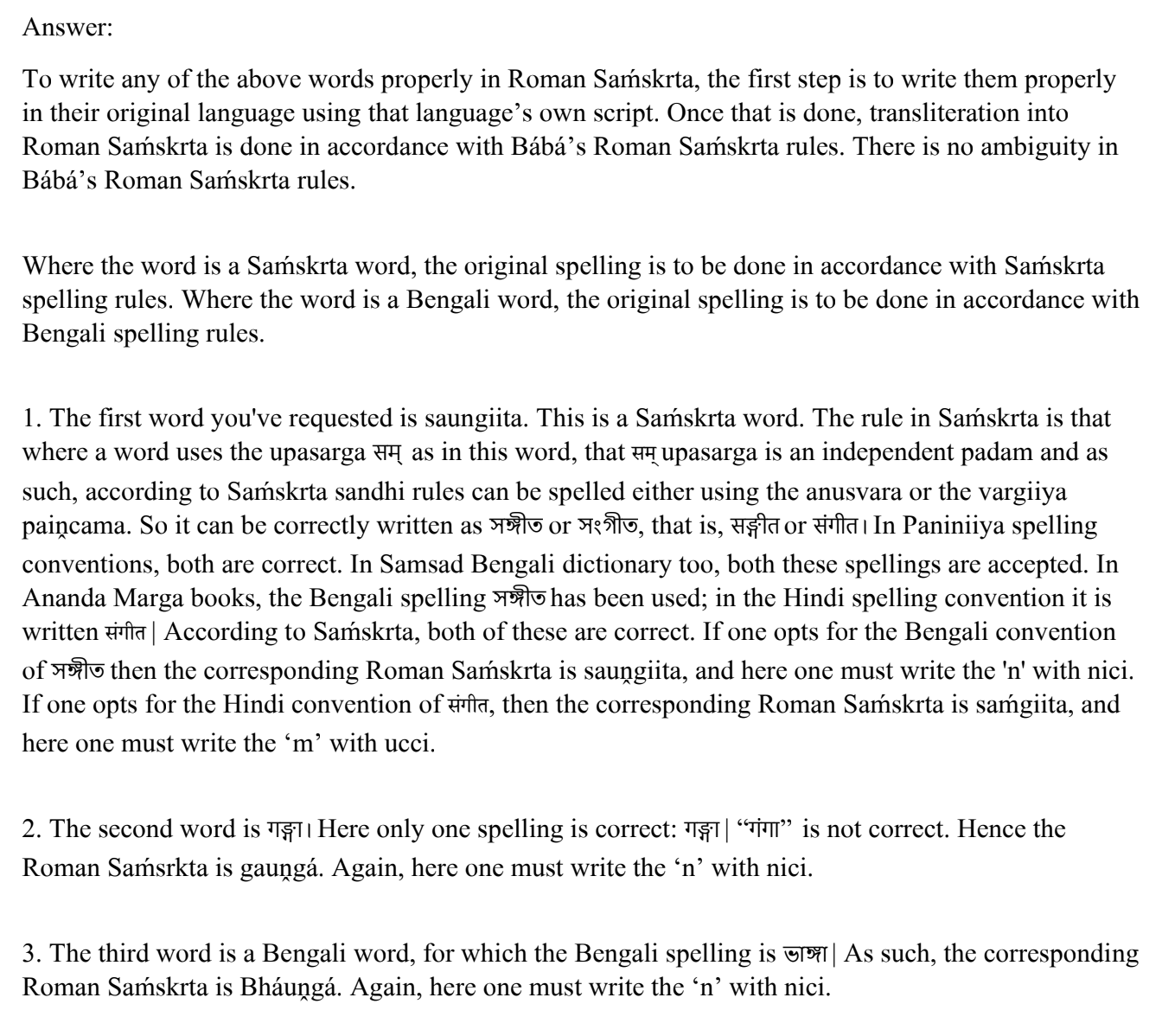
Question: At present, there is not a consensus within our AM community about how to properly write in Roman Saḿskrta words that combine (or utilize the conjunct for) UN’A + GA. Specifically, what is the proper spelling of the following terms: 

1. Saungiita, or Sam'giita, or San'giita
2. Gaunga', or Gam'ga', or Ganga'
3. Bha'n'ga', or Bha'un'ga' or Bha'm'ga


Conclusion: Sadguru Baba’s scientific system of Roman Saḿskrta is crystal clear. It works with diamond-like precision in each and every case. The only reason why certain intellectuals in AM cannot agree on the proper way to write a given word in Roman Saḿskrta is because they themselves are not aware about Baba’s guideline. So the current confusion is solely due to human error and ignorance - not any other reason. Baba’s system of Roman Saḿskrta provides perfect clarity. The more one learns Baba’s system, the less confusion there will be. So we should take it upon ourselves to study and learn Baba’s teachings on Saḿskrta and Roman Saḿskrta. This especially applies to those working in Publications etc. 


== Section: Important Teaching ==

AM marriage system: no same sex


In His below teaching, Baba is discussing the history of marriage and guides us that marital relations are between a male and a female. Baba does not mention any other type of arrangement, such as relations between the same sex, either female and female or male and male. Thus, no Ananda Margii should get swept up in the wave of same sex marriage that is happening in the west. Every Ananda Marga should hold firm to Guru’s teachings and adhere to the dharmic tenet that marriage is between a man and a woman.

Ananda Marga ideology states, “To slay the disarmed, to slaughter women, children or old people, to murder those who had surrendered or to kill those running away for their lives from a fight went against the grain of kśatriya conscience. In essence, the valour of the kśatriyas was instrumental in their surpassing the animal stratum as they learnt to understand human values. It was this sense of values that raised conjugal and domestic life to human standard to a great extent. Instead of conjugal relations being limited to the status of enjoyer and the enjoyed, they began to contain a sense of duty. With the establishment of conjugal relationships a sense of duty awakened in the father towards his children. Consequently, as soon as the responsibilities of mothers lessened to some extent, women became dependent on men for their food and clothes, particularly during the period of pregnancy and during the post-delivery period. As a result, married couples, though belonging to the same group, began to emerge in previously male-centred households. As families were male-centred, male-dominated groups became evident and clan mothers lost their previous authority.” (1)

Reference
1. Human Society - 2, Kśatriya Age


== Section: Important Teaching ==

How religions rely on blind faith

Ananda Marga ideology guides us, "Most religions demand blind faith rather than rationality from their followers. “Don't argue,” they proclaim. “Accept the teachings of the scriptures for they are the direct word of God.” The cunning intellectuals of the past imposed the importance of blind faith on the minds of their gullible followers. They told them to obey the teachings, rational or irrational, otherwise there would be no respite from the endless suffering of human life, no other path to take them to the eternal bliss of heaven.”

“In most cases religions took advantage of human weaknesses, crippled the people's rationality, and sapped their strength, thus facilitating their exploitation by the religious traders. When the vitality and  strength of the masses remains unexpressed, the exploiters will be able to exploit them in the economic and other spheres of life for a long time with relative ease. In the annals of human history it can be seen in all ages that the various exploiters were the patrons and the preachers of religion.”

Ananda Marga ideology guides us, “Dharma is altogether different from religion for it teaches human beings to advance while mercilessly smashing all obstacles that thwart human progress. Its inherent qualities are subtle analysis, ideological strength and the brilliance of valour. That's why the vested interests cannot tolerate it and use all their strength and machinery to oppose it. They claim they are protecting religion. The greater the conflict between person and person, between community and community, between state and state, the greater is their advantage. But when many people form a collective mind through sincere sacrifice and ardent practice while advancing towards the realization of oneness with the Supreme, it will be difficult to continue exploiting people on any pretext."

Reference
1. Ananda Marga Ideology and Way of Life - 7, Form and Formless


== Section 3: Links ==

Dogma of Father's Day 15 June
Father's Day: invention of materialism
Mother's Day: why dogmatic 
Postings to Read
Deriving joy from cruel dealings
Ista & courage
Analogy: what is the news
AM welcomes all types


SUBJECTS TOPICS