Search This Blog

Tuesday, September 21, 2021

Main myths in AMPS + 2 more

Baba

Main myths of AMPS

Note: This letter is only for those who have reverence for Sadguru Baba Shrii Shrii Anandamurti ji and try to follow His Ananda Marga ideology.

Namaskar,

Enclosed is a list of some common myths propagated these days in our AMPS.

Baba, Lord Shrii Shrii Anandamurtiji, started Ananda Marga Pracaraka Samgha to eradicate all sorts of dogma and establish dharma. But, unfortunately, after 1990, many so-called purodhas and in-charges infused and inculcated many dogmas. Due to this, AMPS is becoming a pool of dogma.
https://anandamarganewsbulletin.blogspot.com/

Why they want to impose dogmas


The question arises: Why have they imposed these dogmas?

History bears testimony that most of the religions have injected their own dogmas and by this way they have profited and thrived. They befool their followers, earn a lot of money, and garner respect. Basically, the public has become prone to dogma. So those coming into Ananda Marga Pracaraka Samgha from these religions have already been groomed to follow dogma. So they readily accept new dogmas. Thus for those Dadas who are imposing and enforcing these days, this is the easiest way to get respect and money.

In contrast, following dharma is not easy; one must sacrifice a lot. So all groups want to inculcate their own dogmas and rule accordingly. Because then they will be able to reap the rewards.
https://anandamarganewsbulletin.blogspot.com/

Filth in vogue in your unit or coming soon


If you are an active margii you may be aware about most of these dogmas and myths. Bear in mind that in certain areas, some of these myths are more prevalent, and in other regions less so. Wherever any of these myths are not yet commonly accepted, various interest groups are working hard to infuse them. The following are happening in your unit, or they will be happening soon, if precautionary measures are not taken. Those who oppose them get sidelined.

Prevailing myths & their rebuttals


Myth #1: One must do caran sparsha mudra / touching the feet of a Wt even if their conduct is bad and you do not have respect for that worker. Yet Guru’s teaching from Caryacarya states otherwise.

Rebuttal #1: In Caryacarya part 1 - chapter 7 it states that, “Never do carańa sparsha prańáma to people whom you do not regard, whoever they may be.” (1)


Myth #2: Importance is given to the post. So regardless of their conduct, give salute by touching the feet of one’s higher authority - even if their actions are dirty and reprehensible. Do not care about a worker's conduct, just salute them. See the below for dharmic response / rebuttal of this myth.

Rebuttal #2: In Caryacarya part 1 - chapter 7 it states that, “Never do carańa sparsha prańáma to people whom you do not regard, whoever they may be.” (2)
In numerous discourses, Baba has placed great emphasis on how Wts must maintain dharmic conduct. “Persons who teach such well-regulated behaviour to others by their own conduct are called ácáryas...an ácárya or ácáryá should always instruct by his or her exemplary actions and words.” (3)


Myth #3: All avadhutas are spiritually elevated. They are above all conduct rules; so do not compare or judge them by whether they follow certain rules or not. They are far above that level, just salute them by touching their feet. See below for dharmic explanation / rebuttal of this myth.

Rebuttal #3: In Caryacarya part 1 - chapter 7 it states that, “Never do carańa sparsha prańáma to people whom you do not regard, whoever they may be.” (4)
https://anandamarganewsbulletin.blogspot.com/


Prevailing myths & their rebuttals (cont)

Myth #4: Vishesh yogis & purodhas are spiritually elevated. They are above all conduct rules so do not compare or judge them by whether they follow certain rules or not. They are far above that level, just salute them by touching their feet. Here is the dharmic explanation / rebuttal of this myth.

Rebuttal #4: In Caryacarya part 1 - chapter 7 it states that, “Never do carańa sparsha prańáma to people whom you do not regard, whoever they may be.” (5)
In numerous discourses, Baba has placed great emphasis on how Wts must maintain dharmic conduct. “Persons who teach such well-regulated behaviour to others by their own conduct are called ácáryas...an ácárya or ácáryá should always instruct by his or her exemplary actions and words.” (6)


Myth #5: To get Baba's blessing one must visit one of their designated tiirtha, i.e. so-called holy land sites. To attain moksa one must go to Kolkata (Tiljala) or Jamalpur - only. See here below Sadguru Baba’s rebuttal of the tiirtha dogma.

Rebuttal #5: Ananda Marga philosophy says, "How strange! All countries have been created by the Supreme Consciousness, so all countries are equal. The universal concept of dharma that God is all-pervasive-- this essence of dharma has been forgotten. Ultimately dharma has been reduced to a geo-sentiment centering around Benares [Kolkata, Jamalpur etc]." (7)


Myth #6: Margiis and junior Wts must salute those holding higher posts.

Rebuttal #6: WT conduct Rule: “Workers should have the dignity of the labor and not the dignity of the post.” (8)

Conclusion


These are a few of the myths or dogmas which must be eradicated from our AMPS. These are not Baba's teachings, but rather dogmas imposed by others. By understanding the rebuttal to all these myths and by making others aware of the solution, then through mass awakening and moral vigour these myths will be eradicated from our AMPS. By this way we can build up a truly dharmic society based on Guru's teachings.
https://anandamarganewsbulletin.blogspot.com/

Namaskar,
in Him,
Ekbuddhi Deva

References
1. Ananda Vacanamrtam - 31 , Conduct of an Acarya
2. Caryacarya, “Methods of Salutation”
3. Caryacarya, “Methods of Salutation”
4. Caryacarya, “Methods of Salutation”
5. Caryacarya, “Methods of Salutation”
6. Ananda Vacanamrtam - 31 , Conduct of an Acarya
7. Neo-Humanism, Geo-Sentiment (Discourse 3)
8. 37 Workers Rules, Point #33


*        *        *

The below sections are entirely different topics, unrelated to the above material.
They stand on their own as points of interest.

*        *        *

== Section 2: Important Teaching ==

How dogma of preordained used


Prout philosophy states, “Whatever dignity a person possesses as a human being in either the Kśatriya Age or the Vipra Age is dealt its heaviest blow in the Vaeshya Age. In the Vaeshya Age a person's dignity is measured in terms of money. The repercussions of this defective evaluation of human beings are not confined only to the realm of dignity; they have far-reaching effects in all spheres of society.” (1)

Prout philosophy states, “In the Vaeshya Age this religious exploitation is more psychic than physical, because the vaeshyas use the vipras to try to spread intellectual propaganda among the masses to prevent them from finding any philosophical justification for their suppressed grievances against the vaeshya structure. This intellectual propaganda aims to convince people that they are the victims of circumstance. It argues, “Everything is destiny. Everything is preordained.” Such doctrines help the vaeshyas to perpetuate their structure. They destroy the personal force of people and make them the playthings of fate. People accept the idea that everything is preordained, and support the status quo.” (2)

References
1. Human Society - 2, The Vaeshya Age
2. Human Society - 2, The Vaeshya Age


== Section : Important Teaching ==

Essential difference: sadhakas vs non-sadhakas

Ananda Marga ideology guides us, “Take the case of the precious metal gold. Whenever you say “gold” you refer to gold in general, the gold of the universe. To be of some practical use, the gold will have to be brought within the limitation of a certain form, such as a gold necklace, a gold bangle, or gold tiara. Women may get a certain pleasure by wearing these gold ornaments, but for the goldsmith has no practical use for them as ornaments. He is only concerned about one thing – gold. Likewise, due to the influence of the static principle, an infinite number of names and forms have emerged out of Parama Puruśa, the Singular Entity. Most people enjoy using these finite names and forms, but to practical spiritual aspirants they have no special importance. Sádhakas are only interested in the original substance and not its finite forms. Thus, their only object of ideation is Parama Puruśa. They only accept Parama Puruśa, the Singular Entity, as the goal of their lives, just as the goldsmith is only interested in the gold and not its different forms.”

“How can one shake off the influence of static inertness? How can one get freedom from the bondages of names and forms? Just as the goldsmith uses a hammer and process of melting (in fire) to extract the real gold from the various ornaments, similarly a practical spiritual aspirant will have to break the bondages of names and forms in this expressed world through the cultivation of knowledge (which is mutative), devotion (which is sentient). By virtue of the heat of the fire of sádhaná and the strength derived from sustained intuitional practice, a sádhaka can overcome the static inertness, the apparent cause behind the quinquelemental universe. Life and the world will become effulgent with the resultant unfoldment of latent consciousness.” (1)

Reference
1. Ananda Marga Ideology & Way of Life, part 7, Form and Formless


== Section 3: Links ==

Sunday, September 19, 2021

Sign of pseudo-margii + 4 more

Baba
Sign of pseudo-margii 

Namaskar,

As you know, the various ceremonies given by Sadguru Baba in Caryacarya are to be performed in a certain way to preserve the sanctity of the function and prevent Hindu rituals or any religious dogma from entering into Ananda Marga Pracaraka Samgha. One key point about the shráddha ceremony is that a photo of the deceased should not be on display during this shráddha function. And here is why.

In our Ananda Marga funeral / shráddha ceremony, Parama Purusa is the focal point, not the deceased. Putting a photo of the deceased on display creates more pain for those in mourning, and it is against Caryacarya. In addition, margiis are coerced to worship the deceased; the photo of the deceased has been imposed on them as they do sadhana and puja. It is akin to punishing participants and forcing them to do something against their will by compelling them to commit adharmic acts.
https://anandamargauniversal.blogspot.com/

Nowhere is it written in Caryacarya that a photo of the deceased should be put on display. So what was recently done during the shraddha ceremony is against Caryacarya. The irony is that sincere Ananda Margiis are keen to follow Sixteen Points and abide by Caryacarya during their lifetime. But then, at the time of their death, there is a blatant breach of Caryacarya. Because their photo is put on display at the shráddha ceremony, and that is wrong. The photo should not be on display during the shráddha ceremony, let alone be placed on the puja table in front of Sadguru Baba’s pratikrti [photo].

Look what happened here


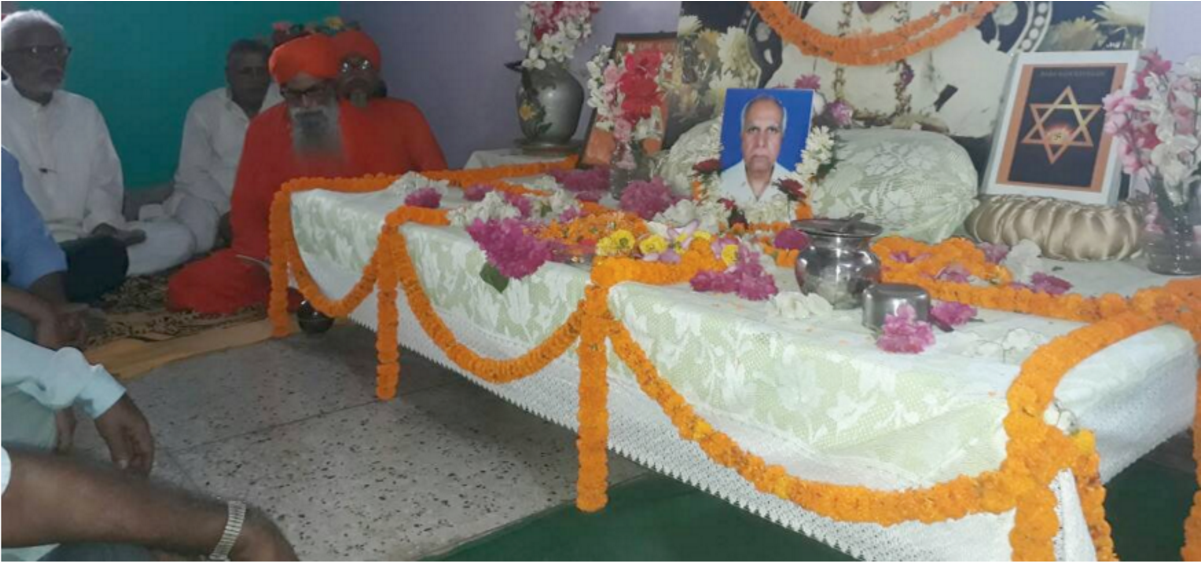
It is not written anywhere in Caryacarya that a photo of the deceased should be put on display. But unfortunately, some fall prey to the dogma of putting a photo of the departed during the death / shráddha ceremony. Below you will find the deceased margii’s photo on the puja table directly in front of Sadguru Baba’s photo. The photo is in the bottom center of the below image. And directly above it is the bottom 90% of Baba’s photo. So they fell prey to dogma by putting a photo of the deceased on display. Now see below. 


Here it should be perfectly clear: Nowhere is it written in Caryacarya that a photo of the deceased should be put on display. But unfortunately, at the shraddha ceremony,  a photo of the deceased was placed directly on the puja table, in front of Sadguru Baba’s photo. This is a direct contravention of Sadguru’s guideline in Caryacarya. Sadly they fell prey to the religious dogma of putting a photo of the departed during the death / shráddha ceremony.  See above.
https://anandamargauniversal.blogspot.com/

Conclusion


#1: In our Ananda Marga funeral / shráddha ceremony, Parama Purusa is the focal point, not the deceased.
#2: Putting a photo of the deceased on display creates more pain for those in mourning.
#3: Placing a photo of the deceased at the shraddha ceremony etc is against Caryacarya.
#4: In addition, by placing a photo margiis are coerced to worship the deceased; the photo of the deceased has been imposed on them as they do sadhana and puja.
#5: It is akin to punishing participants by forcing them to do something against their will by compelling them to commit adharmic acts.

So in the above scene, they are going against Caryacarya and the ethic of Ananda Marga philosophy by putting the photo of the deceased on display during the shráddha ceremony.

In Him,
Yogesh

~ In-depth study ~

Defeats the purpose of AM shra'ddha

Our Ananda Marga is the path of bliss - everything is related with attaining bliss. So nothing should be done that exacerbates one’s grieving and sorrow. Because the memory of their loss is raw, and if you remind the family of the deceased by having a photo on display, then the whole scene is more emotional. That defeats the purpose of AM shráddha because AM shráddha is one to calm the mourners. So that photo should not be on display. Rather the mind should be diverted in another direction - towards Parama Purusa.

In Caryacarya, it is clearly outlined how the shráddha ceremony is focused on Parama Purusa. The mantra directly addresses Him:

“O Supreme Father, the incorporeal soul of our dearest Shrii / Shriimatii (Mr./Ms.) . . . . . . . is far, far beyond this mortal world today. O Supreme Being, may his/her immortal soul attain higher and higher manifestation.” (1)

Putting the photo of the deceased only serves to remind the grieving family members of their loss. It keeps the painful memory of their departed loved one fresh in mind, exacerbating their pain. That defeats the purpose of AM shráddha because the AM shráddha is for calming and giving closure to the mourners. So the use of a photo of the deceased should be avoided. It brings the memory of the deceased back into this mortal world when the reality is the deceased is already far beyond this transitory world. That is why the entire shráddha ceremony is focused on Parama Purusa - not the deceased. After all we cannot do anything for the deceased, and placing their photo only multiplies the grief of the surviving family members. That’s why putting the photo on display defeats the purpose of AM shráddha ceremony.
https://anandamargauniversal.blogspot.com/

Ananda Marga Caryacarya states, “The departed soul does not get any advantage from the shráddha ceremony [memorial ceremony]. It is only meant for the psychic satisfaction of the person performing it.” (2)

Hence, the shráddha ceremony is only done to comfort and console the surviving family members. And not having the photo of the deceased at the shráddha ceremony is for the benefit and welfare of the family.

In our Ananda Marga funeral / shráddha ceremony, Parama Purusa is the focal point, not the deceased. Putting a photo of the deceased on display creates more pain for those in mourning, and it is against Caryacarya. In addition, margiis are coerced to worship the deceased; the photo of the deceased has been imposed on them as they do sadhana and puja. It is akin to punishing participants and forcing them to do something against their will by compelling them to commit adharmic acts.

Dwelling on the past: serious flaw in general society

Ananda Marga is unique. In the general society there are so many negative trends. When a close person dies, then the family members often get depressed for long periods. Sometimes even the surviving spouse will quickly die or become ill and slip into death. But Baba does not want this. Dwelling on the past is not condoned in Ananda Marga yet that is a serious flaw in the general society. Yet we have to bear in mind that humans are not monkeys who will carry their deceased family members in their arms for days on end.

Finally, any Ananda Margii who died will become one with Parama Purusa. So dwelling in the past is not good. By all of the above it is quite evident that there is no scope to display the photo of the deceased at the shráddha ceremony.

To achieve this proper planning is needed. This topic should be raised, explained, and decided when all family members are alive and well. Everyone should clearly understand ahead of time that the photo of the deceased will not be put on display at the time of shráddha. Trying to address this sensitive matter when already someone has died and emotions are raw will be very difficult. Those who are grief-stricken by the death and loss of their loved one may not understand in that delicate hour. So best is to rationally discuss this matter well ahead of time.
https://anandamargauniversal.blogspot.com/

In our Ananda Marga funeral / shráddha ceremony, Parama Purusa is the focal point, not the deceased. Putting a photo of the deceased on display creates more pain for those in mourning, and it is against Caryacarya. In addition, margiis are coerced to worship the deceased; the photo of the deceased has been imposed on them as they do sadhana and puja. It is akin to punishing participants and forcing them to do something against their will by compelling them to commit adharmic acts.

Look what happened here


But unfortunately, some fall prey to the dogma of putting a photo of the departed during the death / shráddha ceremony. Nowhere is it written in Caryacarya that a photo of the deceased should be put on display. But look what happened here. Unfortunately, some fall prey to dogma as they put a photo of the deceased on display during his death / shráddha ceremony. 

In the Hindu tradition they put the photos of the deceased in plain view during the funeral ceremony. And that is exactly what was done here in the case of this margii sister. But in Ananda Marga funeral / shráddha ceremony, Parama Purusa is the focal point, not the deceased.

Another related point is that after the death some families even keep a photo of the deceased on their puja table at home, along with sandalwood sticks and a copy of Ananda Vacanamrtam, just like dogmatic Christians do by placing the Bible on their altar etc

In the above scene, they are going against Caryacarya and the ethic of Ananda Marga philosophy by putting the photo of the deceased on display during the shráddha ceremony. By this way, the grief-stricken family suffers even more. So this should never be done.

In His Hindi Ananda Vacanamrtam discourse about how to deal with death, Baba guides us that when the loss is raw for those mourners, then the mind should be diverted away from their loss. That is why during the mourning period, after a death, nobody should talk about or praise the deceased in front of the deceased’s family members. Because that will exacerbate the suffering in the mind of those mourners. Having the photo on display will only heighten the pain of those grieving as it will be a constant reminder of their loss.
https://anandamargauniversal.blogspot.com/

In our Ananda Marga funeral / shráddha ceremony, Parama Purusa is the focal point, not the deceased. Putting a photo of the deceased on display creates more pain for those in mourning, and it is against Caryacarya. In addition, margiis are coerced to worship the deceased; the photo of the deceased has been imposed on them as they do sadhana and puja. It is akin to punishing participants and forcing them to do something against their will by compelling them to commit adharmic acts.


Dogma: deceased will visit the house

In some religions, the mourning period and rituals related with the loss goes on for a while. Some religions have inserted the dogma that the deceased will visit the house and move around - so do not be scared by hearing him etc. Just one should leave food for them to eat and be careful not to disturb him. And this goes on for 40 days and annually thereafter. Another thing is that often they go and visit the tomb and talk to their deceased love one. By this way they request or offer something from the deceased. This dogma is very prevalent and by this entire process the priest is benefited by cash and kind. In turn, the public and family members are exploited psychically, emotionally, economically, etc. In another religion, it is told that the deceased visits the grieving family visits so certain foods should be offered in at the temple for the deceased. Plus particular religious rites are to be done on a daily basis. By all these rituals the family members are reminded again and again about their loss and life becomes miserable for them. Ananda Marga is against all these dogmas.

In our Ananda Marga funeral / shráddha ceremony, Parama Purusa is the focal point, not the deceased. Putting a photo of the deceased on display creates more pain for those in mourning, and it is against Caryacarya. In addition, margiis are coerced to worship the deceased; the photo of the deceased has been imposed on them as they do sadhana and puja. It is akin to punishing participants and forcing them to do something against their will by compelling them to commit adharmic acts.

How to convince your family not to place photo of deceased


When any near and dear one dies, then it is a very sensitive and difficult time for the family. With regards to the shráddha ceremony, the prevailing sentiment among family members is to display a photo of the deceased, because that is what they grew accustomed to from the dogmatic religions. Here then is a point by point approach for raising this matter with family members.

1. It is extremely important to educate the family beforehand about Baba's guideline that a photo of the deceased should not be on display during the shráddha ceremony. All family members should be taught this in advance, i.e. even before anyone in the family gets sick or aged etc.

2. True margiis will follow this code and will refrain from placing a photo of the deceased during the shráddha ceremony. If others do not want to abide by this guideline from Caryacarya, then tell them that you will not attend the shráddha ceremony.
https://anandamargauniversal.blogspot.com/

3. The main thing is that awareness and pracara should be done ahead of time and if people refuse to follow then their names should be circulated publicly so then out of shame they may not do that again in the future.

4. The dogma of placing the photo during the shráddha ceremony is very similar to the various kinds of dogmas of caste marriage, dowry, and multi-deity puja worship etc

5. Overall, there are various levels of margiis and those who are pashus (lower grade sadhaka) are not going to be able to follow everything perfectly.

6. Those who are divyacariis (top grade sadhakas) will follow all of Sadguru Baba’s tenets of Ananda Marga.

7. If people refuse to adhere to dharmic guidelines of not using a photo then dharmikas should not attend that shráddha ceremony. Just as if a caste marriage is going on then a true Ananda Margiis will not attend.

8. After all, Baba made the rule of not placing the photo during the shráddha ceremony  for our all-round welfare.

9. Ananda Marga is unique. In the general society there are so many negative things that happen after the death of a family member. Many families get depressed for long spells, and even the surviving spouse often quickly dies or becomes terminally ill and slips into death. However, Baba does not want this. Dwelling on the tragedies of the past is not supported in Ananda Marga whereas that is a serious flaw in the general society. Monkeys literally will carry their deceased family members in their arms for days on end, but this is not the way for human beings. For the overall upliftment of humanity, Baba has given very specific guidelines for how to carry out the shráddha ceremony. And those who are sincere Ananda Margiis will abide by those codes and teach others to do the same.

10. Any Ananda Margii who dies will become one with Parama Purusa. That is why during the shráddha ceremony, we only keep the photo of Parama Purusa on display.

In our Ananda Marga funeral / shráddha ceremony, Parama Purusa is the focal point, not the deceased. Putting a photo of the deceased on display creates more pain for those in mourning, and it is against Caryacarya. In addition, margiis are coerced to worship the deceased; the photo of the deceased has been imposed on them as they do sadhana and puja. It is akin to punishing participants and forcing them to do something against their will by compelling them to commit adharmic acts.
https://anandamargauniversal.blogspot.com/


Garlanding the deceased’s photo is against AM ideals

Offering a garland to the deceased’s photo at the shráddha ceremony goes directly contrary to Ananda Marga teachings.

    Tadekaḿ japámas tadekaḿ smarámas
    Tadekaḿ jagatsákśiirúpaḿ namámah;
    Tadekaḿ nidhánaḿ nirálambamiishaḿ
    Bhavámbodhipotaḿ sharańaḿ vrajámah.

[I will remember You only. I will contemplate on You only. I will salute You only, the Witnessing Entity of this expressed universe. You are the supreme shelter, but you require no shelter, and no authority lords over you. We take shelter in You in the form of a ship sailing on this vast universe.]

Ananda Marga ideology guides us, “If anyone's name is to be chanted in japa, it is the name of Parama Puruśa.” What is japa? A word has a particular meaning; repeating the word inwardly again and again, after having understood its meaning, is what is termed japa. As a result of the prolonged repetition of a word, whose inner meaning is clearly understood, its ideation becomes permanently imprinted on one's mind, and consequently there occurs a radical change in one's mental arena. The extroversial tendencies of the mind gradually become introverted. This is the benefit of japa. And if anyone's name is to be repeated, it is the name of the Lord.” (3)

No one should mistakenly think that by this approach we do not care about the deceased person. Here the goal is not to eliminate the memory of the deceased; this is not our way in Ananda Marga. We know well that the mourning family is not ever going to forget their loved one. The approach we are taking here – diverting the mind away from their loss – is only a temporary measure during this very delicate and sensitive period immediately after the time of death. When this loss is such a raw and painful wound for the surviving family members, best is for them to have their mind diverted away from this painful memory. It is not good for them to constantly think about the loss of their loved one, as that worsens their grief.
https://anandamargauniversal.blogspot.com/

In our Ananda Marga funeral / shráddha ceremony, Parama Purusa is the focal point, not the deceased. Putting a photo of the deceased on display creates more pain for those in mourning, and it is against Caryacarya. In addition, margiis are coerced to worship the deceased; the photo of the deceased has been imposed on them as they do sadhana and puja. It is akin to punishing participants and forcing them to do something against their will by compelling them to commit adharmic acts.


English title is wrong in Caryacarya

Unfortunately someone mistranslated chapter 31 of the English edition of Caryacarya part 1. They titled it as “Disposal of the Dead Body.” But this is wrong and inappropriate. In the Hindi and Bengali editions, that chapter is titled as Shava Satka’r, meaning ‘reverence to lifeless body.’ This projects an air of respect and sanctity. But those publishers failed to give it a comparatively respectful title in English. Instead they called it “Disposal of the Dead Body”, as if one is just getting rid of some trash, rubbish, or garbage etc. Steps should be taken to properly title chapter 31 of the English edition of Caryacarya part 1.

References
1. Caryacarya - 1, Shráddha Ceremony
2. Caryacarya - 1, Shráddha Ceremony
3. Subhasita Samgraha - 11, The Intuitional Science of Tantra


Look what happened here

It is not written anywhere in Caryacarya that a photo of the deceased should be put on display. But unfortunately, some fall prey to the dogma of putting a photo of the departed during the death / shra'ddha ceremony. Below you will find Ramlakhan ji’s photo on the puja table directly in front of Sadguru Baba’s photo. Ramlakhan ji’s photo has a blue background with a white garland. And directly behind it is the bottom half of Baba’s photo with two orange garlands. So they fell prey to dogma by putting a photo of the deceased on display. Now see below.


Here it should be perfectly clear: Nowhere is it written in Caryacarya that a photo of the deceased should be put on display. But unfortunately, at the shraddha ceremony,  Ramlakhan ji’s photo was placed directly on the puja table, in front of Sadguru Baba’s photo. This is a direct contravention of Sadguru’s guideline in Caryacarya. Sadly they fell prey to the religious dogma of putting a photo of the departed during the death / shra'ddha ceremony.  See above.


Look what happened here: drowned in dogma

But unfortunately, some fall prey to the dogma of putting a photo of the departed during the death / shra'ddha ceremony. Nowhere is it written in Caryacarya that a photo of the deceased should be put on display. But look what happened here. unfortunately, some fall prey to dogma as they put a photo of the deceased Ramlakhan ji on display during his death / shra'ddha ceremony.  See below.


Look what happened here

But unfortunately, some fall prey to the dogma of putting a photo of the departed during the death / shraddha ceremony. 


*        *        *

The below sections are entirely different topics, unrelated to the above material.
They stands on their own as points of interest.

*        *        *

== Section 2: Prabhat Samgiita ==

In one lonely place

"Eso tumi a'ma'r ghare, baso hiya'r a'sane..." (Prabhat Samgiita #0906)

Purport:

O’ Parama Purusa, please come to my humble abode and sit in the inner core of my heart. For ages and ages, I have been longing for You. My Supreme Entity, in one lonely place, in my mind I have prepared the seat of a thousand petaled lotus for You, and decorated it with the love of my heart. I have created an altar for You
and embellished it with flowers of bhakti.

O’ Supreme One, for such a long time I have been coming and going onto this dusty earth - through countless cycles of birth and death. In Your cycle of brahmacakra there is no leisure time for taking rest, i.e. no pause. Those who come one day go, and those who have gone will one day come in new life. So there is no period of repose in Your continuous cycle of srsti cakra. Always one is either coming or going.  By Your grace, in one golden dawn, my spiritual journey, my sadhana to immortality started in my mind. 

O’ Parama Purusa, while moving on the spiritual path, from time to time I go astray and lose the way. I compromise with my sadhana and 16 points. Each moment, fatigue overcomes my body and mind. So I am incapable of moving properly; that is why I go off the path. Baba, please forgive me; bless me and shower a wee-bit of Your causeless grace, and bring me back onto whenever I veer off in the wrong direction. 

Baba, please come in my heart. In my Guru cakra, I have prepared a thousand petaled lotus for You...


== Section: Important Teaching ==

Main ingredient for sweet life

Ananda Marga philosophy says, "Those who seek to attain the permanent cessation of afflictions in their lives, have no other way than to follow this path of sadhana. Imagine that a certain person had accumulated vast wealth due to his life long's diligent labor. It may be that the person, in the days of his prosperity, was a central figure in the society. But at the end of his life he may suffered a wretched existence, bemoaning his losses in the arid desert of his heart. The reason is that the person had an insatiable thirst for material objects and never tried to identify his individual flow with the cosmic flow. On the other hand, a person living in a thatched hut may not forget Parama Purus'a even in the midst of abject poverty and never deviates from the goal of his life. Such a person's life can never lose its charm. Every dust particle of this earth will seem to be as sweet as honey to him. Likewise, his existence will acquire the sweetness of honey." (1)
   
Reference
1. Ananda Marga Philosophy in a Nutshell - 4, Individual Rhythm and Universal Rhythm

== Section ==

বিশ্বব্রহ্মাণ্ডে আকাশ পাতালে এমন কোনও শক্তি নেই,
যে আনন্দমার্গকে ধ্বংস করতে পারে
 “পরমপুরুষ শক্তি দিয়েছেন, কাজে লাগাৰার জন্য | বিদ্বানের বিদ্যা, ৰলবানের ৰল, ৰুদ্ধিমানের ৰুদ্ধি, এগুলো দেওয়া হয়েছে পুংজী করে রাখৰার জন্য নয়; কাজে লাগাৰার জন্য | যে মানুষ তা লাগায় না, সে ঈশ্বরের কাছ থেকে কোনও কিছু চাইৰার অধিকার রাখে না | আর যে মানুষ অপব্যবহার করে, অপব্যবহার {করে} করার ফলে, জগতের তো ক্ষতি হয়েই, তার শক্তিও এক দিন শেষ হয়ে যায় | তোমরা চাক্ষুস্‌ দেখেছ, অতীতে কোনও একটি শক্তি, অতিদম্ভের ফলে ভেবে ছিল যে সৰ কিছু সে করতে পারে | আনন্দমার্গের উপর অকথ্য নির্য়াতন হয়েছিল | কিন্তু সেই নির্য়াতন সহ্য করেও আনন্দমার্গ মাথা তুলে দাঁড়িয়েছে | বিশ্বব্রহ্মাণ্ডে আকাশ পাতালে এমন কোনও শক্তি নেই, যে আনন্দমার্গকে ধ্বংস করতে পারে |

[“ৰাৰা, ৰাৰা, ৰাৰা !”]

কারণ আনন্দমার্গ ন্যায়-ধর্মে প্রতিষ্ঠিত | পাপ-শক্তি যদি তার সঙ্গে সংঘর্ষে লিপ্ত হয়, তো পাপশক্তি চূর্ণ-বিচূর্ণ হয়ে যাৰে | এক ফুত্কারে ফড়িয়ের  মত শেষ হয়ে যাৰে | কিন্তু ক্ষমতার মোহে, ক্ষমতার মদে মত্ত হয়ে, মানুষ এই চরম সত্যটা ভুলে যায় | তার পরে যখন শক্তিহীন হয়ে যায়, তখন আফ়সোস করে | কিন্তু তখন আর আফ়সোস করে কোনও লাভ হয় না | যা যাওয়ার তা চলেই গেছে | তোমরা জান এক জন এমনই ব্যষ্টি ছিলেন, যাঁর হাতে ছিল প্রচুর শক্তি | তা যার হাতে ছিল, অভ্রংলেহী স্পর্ধা, আস্পর্ধা, ভাবত “আমি সৰ কিছু করতে পারি” | সে জানত না, নারায়ণের একটা নাম হ’ল দর্পহারী, তিনি কারও দর্প সহ্য করেন না | কারণ দর্প পছন্দ করেন না | তাকে গুঁড়িয়ে ধুল করে দেন |”
 (1)

Reference
1. Abhi4-11 Egiye Cala'i Ma'nus'er Dharma


SUBJECTS TOPICS