Search This Blog

Tuesday, September 17, 2024

For mental health + 3 more

Baba
For mental health

Namaskar,

In this present era, we are step-by-step witnessing the spread of various mental disorders etc. This outbreak is most prevalent in those so-called first-world nations.

Around the globe, and especially in the materialistic communities, many medical professionals and psychologists are under the impression that most mental disorders fall within the realm of brain diseases. Whether one has brain cancer or clinical depression, western medical specialists are treating certain mental disorders as brain diseases, using traditional allopathic medicines. This is their standard approach.  
https://anandamargauniversal.blogspot.com/

But brain diseases and psychic diseases are not the same. Here following are some thoughts on this distinction between brain diseases and psychic diseases.


Negative thinking is the cause

So then how do psychic diseases occur? Often people harbour thoughts which are figments of their imagination or which are untrue ideas. People can think that there is a ghost in their house, or that others hate them; or that they are better than everyone else; or, people can be afraid of the dark etc. And when any of these types of ideas dominate one's thinking and flood the objectivated mind, then that results in a psychic disease.


Simple analogy: How mind thinks it sees fake ghost


In the mind, there are two chambers: The objectivated mind and the subjectivated mind. Now, suppose in real life you saw a cat walking in the grass. And then you closed your eyes and you recollected that cat. In that case, one part of the mind creates the image of the cat and another portion of the mind sees that image. So the part of the mind that took the shape of the cat is the objectivated mind, and the part of the mind that is watching that cat is the subjectivated mind.

Everyone has an objectivated mind: It is that chamber or part of the mind which contains one's object of thinking. So the first step is to look at how the objectivated mind works. If someone is thinking about the post office then the post office is in their objectivated mind. And if a frog is thinking about a mosquito then a mosquito is in its objectivated mind. So anyone's object of thinking is what comprises their objectivated mind.
https://anandamargauniversal.blogspot.com/

This objectivated mind functions in two ways. Suppose your eyes are open and you see a cat in front of you. Then when you close your eyes and see the cat in your mind, then the picture of the cat in your mental sphere is your objectivated mind. The second way the objectivated mind works is as follows. Let's say you start imagining something that does not exist - like a ghost. That ghost has no basis in reality. In truth it does not exist. Yet you start thinking that there is a spider monster in the room which has big fangs and twisted feet, and lives in the dark. This is completely imaginary, but when you start thinking of that spider monster then it takes shape in your objectivated mind. And your subjectivated mind is watching that fictitious image of the ghost.

Let’s take it a step further. Suppose you are awake and thinking that there is a spider monster in a dark room then in that awakened state you will rationalise with the help of your conscious mind that it is just a fleeting thought and you will not take it seriously. And you will not be terrified. But if that same thought occurs when you are “sleeping” then at that point the conscious mind is sleeping so without the help of your conscious mind you will think that it is real. You will see the fangs of the spider monster coming towards you. and you will be terrified. That is called a nightmare. The thought which was not so serious in the daytime due to the awakened stage of your conscious mind becomes deadly at night when you are dreaming, because the conscious mind is inactive or “sleeping.”


Mental disease of superiority complex


Here Baba explains further how such psychic diseases like superiority complexes and inferiority complexes develop.

Ananda Marga philosophy states, "A defect in the objectivated mind may also cause inferiority complex or superiority complex. When the objectivated mind becomes large enough to pamper one's ego, one develops a superiority complex. One starts considering oneself to be superior to others in points of knowledge, the capacity to act, organizational calibre and other qualities of leadership, and unnecessarily slights others. Such a person expects preferential treatment, VIP status, and unquestioning obedience. If by accident their ego is hurt even slightly, they become violently angry. This is another kind of mania." (1)

And here Baba describes another type of psychic disease. 
https://anandamargauniversal.blogspot.com/

Ananda Marga philosophy states, "Moreover, because of problems in the objectivated mind, people suffer from various psychic complexes. For example, there are those who are inclined to think that no one, neither their friends and relatives nor even their domestic animals, cares to think of them. They unnecessarily think that everyone deliberately avoids them, dislikes them, or ignores them, and therefore they become disappointed, dejected, and dispirited. Life loses all its charm and attraction for them, and they may even commit suicide. This type of mania is called melancholia." (2)


Remedies for mental diseases


There are various kinds of psychic diseases such as inferiority complex, superiority complex, phobias, manias, depression, etc.
(a) If the psychic disease is relatively mild and the brain has only been slightly affected, then it can be cured exclusively psychically, i.e. through kiirtan, sadhana, and even satsaunga etc.
(b) Whereas if the psychic disease is more severe and the brain has been affected to a high degree, then some type of physical medicine will be needed to help cure the brain of whatever chemical imbalances it has, and, side by side, treatment should also be done in the psychic plane with meditation etc.

So some psychic diseases can be treated purely in the psychic realm and some need physical medicine to complement the healing in the psychic stratum. Unfortunately now according to material science, everything is treated as a brain disease and they do not recognise the existence of psychic diseases.
https://anandamargauniversal.blogspot.com/

For that reason, if someone is suffering from even a very mild case of depression, western doctors and psychologists often prescribe some type of strong allopathic medicine for that patient. Because those doctors think the patient is suffering from a physical problem in the brain, when in fact that patient is suffering from a very slight defect in their thinking - not a defect in the biological structure of their brain. Therefore, if it is a mild case, the patient can be cured with sadhana etc. If the situation is more grave, the patient will need physical medicine to treat the brain’s illness that was caused by defective thinking; and side by side, psychic treatment like meditation is also needed to completely solve the problem. Then both mind and brain will be cured.


Mistreatment of psychic diseases in the west


Unfortunately though, in countless cases, material science addresses psychic diseases exclusively as brain diseases. That is why some doctors prescribe medications to a grieving widow or a child who is afraid or nervous. But if those cases are relatively mild, and the patient does not have a serious organic problem in the brain, then it can be addressed purely psychically.

At present, the manifestation of psychic diseases is growing exponentially due to the fast-paced, imbalanced way of life. A large percentage of the population is feeling tension and stress and harbouring defective ideas in the mind like 'I am shelterless', 'nobody loves me', 'I am inferior', 'nobody cares about me', 'people hate me', 'I am ugly', 'I am alone' etc. This type of defective thinking creates depression and other types of psychic diseases.

By this way, psychic disease has become rampant yet these patients are being treated with crude medicine. Patients are given various steroids or drugs in order to treat the problem. But if the case is moderate or mild, then the problem can be resolved in the psychic plane with meditation etc.
https://anandamargauniversal.blogspot.com/

But when the psychic disease is so severe that the patient cannot eat or sleep nor be taught or guided because they have been so severely traumatised, then medicines are needed to help cure the person. And when they have regained some ability to function on a basic level, then they can be guided in the psychic realm as well, whereby they can be taught and benefited by sadhana etc.


How to keep mind free of psychic disease


For the situation to be remedied, allopathic medical science has to accept the existence of mind and then treat ailments related with the objectivated mind as psychic diseases - not brain diseases. And the main treatment for psychic diseases is sadhana. That is beyond the arena of present day medical science. They think that belongs to theology. But Baba guides us that sadhana alone is the proper treatment for psychic diseases.

Sadguru Baba says, "Most psychic diseases, if not all, grow out of the defective control over the objectivated mind. If one is alert, any trouble can be avoided. Those who regularly practise Iishvara pran'idha'na or dhya'na (meditation) can remain free from these diseases, as their minds will remain in a balanced state. One of the numerous benefits of sa'dhana' is that it keeps the mind free from psychic disease and encourages the natural growth of the mind." (3)

The culminating idea is that we should be clear on the difference between brain disease and psychic disease and such ailments should be treated accordingly. And as Baba describes above, psychic diseases are best treated through sadhana and spiritual practice.
https://anandamargauniversal.blogspot.com/

Ananda Marga ideology states, “Now everywhere, in cent per cent of the cases, there is wastage of human psychic potentiality. The psychic potentialities of human beings are immense, but people do not utilize them because most of their valuable time is wasted in undesirable thoughts, in psychic extravaganza….This psychic extravaganza should be checked either by physical approach, or psychic approach, or by spirituo-psychic approach…From the psychic sphere also, unnecessary waves are to be removed. This will remove many burdens from the mind. “I must not bother about petty things, because that will waste my time” – people should remember this. This removal or rather withdrawal of unnecessary and undesirable thoughts emanated from the mind will help you.” (4)


Conclusion


It is our dharmic duty to propagate sadhana and proper thinking to save this situation because with the development of science, psychic diseases are spreading more and more, especially amongst our younger generations. With them it is becoming rampant. Psychic diseases are far more prevalent in areas dominated by 'modern materialistic living’.
https://anandamargauniversal.blogspot.com/

As Ananda Margiis we should be vigilant and remember that sadhana and proper thinking are the remedy for psychic diseases.

Namaskar,
in His service,
Shriideva

We should propagate sadhana in order to build up a healthy humanity. Baba has blessed us with a human framework whereby one can perfect themselves through sadhana.

Ananda Marga ideology states, "The entire universe has the grace of Brahma, but human beings enjoy greater grace. They are endowed with the privilege of practising sa'dhana'." (5)

References
1. Ananda Marga Philosophy in a Nutshell - 5, 'Faculty of Knowledge-3'
2. Ananda Marga Philosophy in a Nutshell - 5, 'Faculty of Knowledge-3'
3. Ananda Marga Philosophy in a Nutshell - 5, 'Faculty of Knowledge-3'
4. Subhasita Samgraha - 18, The Cult of Spirituality – the Cult of Pinnacled Order
5. Subhasita Samgraha - 1, The Call of the Supreme


*        *        *

The below section is an entirely different topic, unrelated to the above material.
It stands on its own merit as a point of interest and ideological awareness.

*        *        *

== Section 2: Prabhat Samgiita ==

Overflowing with optimism

"Esecho esecho tumi esecho, mamatá ujáŕ kare esecho..." (Prabhat Samgiita #1215)

Purport:

My Parama Purusa, You have blessed me and come here. With Your abundant and overflowing prema, You showered Your infinite love. It is due to Your endless affection. Baba, now You are here because of Your infinite charm and kindness towards me. Your exquisite presence has exalted everything. By Your august arrival the dry desert and dead trees have been transformed into a lush, green forest. Your smile is expressing through their happiness. This is all nothing but Your special blessing.

Parama Purusa, You have compassionately filled this earth with Your sweet flow of warmth and bhakti and placed smiles on the faces of those who were depressed and sad. Now, by Your kindness, they are radiant with joy. And to those weeping hearts that were engulfed in sorrow, suffering, and misery, You have filled their lives with sweetness and bliss. Today they are overflowing with optimism and humming in happiness. By Your tender touch, the flowers have become saturated with nectar. Your mercy knows no bounds.

Baba, in this moment, due to Your arrival the heavenly aroma of the blossoming flowers from the bountiful garden and forest is floating and permeating all around. The melodious chirping of the dancing birds is coming and filling the air with song. The full moon's soft smile is pouring its radiant light: It comes wandering in all directions. The whole universe is getting bathed in that refulgence. You have ensconced everything with Your love and inundated this entire cosmos with Your presence and divine nectar. Everything is drenched in Your bliss. 

Baba, You are ever merciful; Your grandeur cannot be explained...


== Section: Important Teaching ==

Crystal-clear notion of mission

Ananda Marga ideology says, “Human life is a mission; life itself is a mission; one’s very existence is a mission. A’tmamoks’a'rtham’ jagaddhita’ya ca: ‘Whatever one is to do, one is to do for a’tmamoks’a– for their own liberation– and for the elevation of the entire world, elevation of the entire human society’. One is to do both of these things; that is, these two things are one’s mission.” (1)

Note: By Baba’s above teaching it is clear that the AMPS organisation is not the mission. But for certain reasons, some try to misguide or take advantage of the margiis by making them think that AMPS is the mission. But that is not correct. In His above guideline, Sadguru Baba explicitly tells us what is the mission.

Reference
1. Ananda Vacanamrtam – 30, The Four Kinds of Service


== Section: Important Teaching ==

Key tip for pracara


Ananda Marga philosophy guides us, "Even in private life when a person behaves with you badly or uses harsh words, don't behave with him in the same manner. You shall explain to him his duties gently. In case, anyone has a wrong impression, you shall show him the right path without scolding (abusing) him. Make it clear to him if possible with practical demonstration how harmful may be the effect of such habits. But always keep this in mind that in such cases your behavior must be like that of a friend, and never like that of an instructor. Your only object will be to get your advice accepted by him. The idea that he is fool and you are wise is not desirable in any party." (1)

Note: In His above teaching Baba is outlining an important pracar technique. Specifically, when speaking with non-margiis, we should talk with them in a soft and gentle manner, using a friendly, supportive tone. By this way they will gradually learn Ananda Marga ideals. Baba also addressed non-margiis in this manner. And then with more established sadhakas - i.e. experience Ananda Margiis - Baba was more firm to best enhance their progress. 

References
1. Ta'ttvika Diipika': Dvitiiya Parva


== Section: Important Teaching ==


Find out what is needed to make a flower garland


Ananda Marga philosophy states, “Not only the gods are fond of the fragrance of flowers; devotees also want to string garlands for their beloved Iśt́a with the fragrant flowers of the devotion of their hearts. If a flower has no fragrance, it has no value for a devotee. One should remember that the fragrance of a flower and the tender sweetness of a devotional heart together make a perfect combination. What does the perfume of the flower represent? The worldly activity which a devotee does with a heart filled with love is the perfume of the flower, and the overflowing devotion for one's Iśt́a is the tender sweetness in the devotee's heart. With these two together, the devotee makes a garland. Now, if there are fragrant flowers, but there is no sweetness in the devotee's heart, then the devotee cannot make a garland for his or her Iśt́a – then there is no question of garlanding Him at all, and though the flower basket may be full of flowers, they wither with the pain of emptiness and the agony of unfulfilled yearning. Then if the Beloved does not accept the garland, what is the use of holding the basket full of flowers." (1)

Reference
1. Namah Shivaya Shantaya, Shiva in the Light of Philosophy


== Section: Important Teaching ==

Analogy of string instrument and human life


Ananda Marga philosophy states, “The common people, let alone the master artists, know that sound is not emitted if the strings are loosened too much and the soft and delicate strings snap if they are tightened too much. Human life is also like this. If one practises too much austerity (in some cases, if one makes a parade of austerity), tender human sensitivities snap and break into smithereens’ the soft, delicate parts of the mind get charred and petrified. On the other hand, if life is made akin to a loose string, the nobler yearnings of life will never be fulfilled. In other words, that kind of life degenerates into the life of an animal characterized only by bathing, eating and sleeping. Hence one must never allow the string of life to be loose. But also the string of life should not be left to snap due to excessive strain. The ideal course of life is neither left-oriented nor right-oriented. This kind of life will be conspicuous by the absence of strife, mayhem or horror of the leftists and of toleration of injustices by the rightists in their loose, careless and sloppy life. It is this ideal course that will usher in a life worth yearning for a super-human existence, divinely exquisite and shining brightly on the banner of gold.” (1)

Reference:
(1) Saḿgiita: Song, Dance and Instrumental Music, Invention of Various Musical Instruments


== Section 3: Links ==

Monday, September 16, 2024

Boosting sadhana + 4 more

Baba
Boosting sadhana

Namaskar,

Each and every sadhaka knows that sadhana itself moves in phases of pause and speed. 

Ananda Marga philosophy says, "While doing sa'dhana' in the spiritual sphere, the state of pause may come. Sometimes people say, 'How strange! A few days ago I was having excellent meditation, but these days I can't seem to concentrate at all. That's very sad.' Or at times one may say, 'The other day while meditating my body began to quiver. It was quite a pleasant experience. Why don't I get the same experience today?' This sort of blissful experience during meditation or in concentration comes within the scope of assimilation. It becomes internalized. But if it does not find any expression within the mind, you can never experience it. Maybe after a few days you may experience an even greater bliss during incantation or meditation. All this means that even in the spiritual sphere also there is pause and speed." (1)

So we should always put forth maximum effort in sadhana and never skip any lessons, then one will advance ahead on the spiritual path. The main ethic is sincerity in sadhana - if one is sincere then certainly one will advance, by His grace. 
http://anandamargauniversal.blogspot.com/


Sadhana & sadhanaunga

In our sahaja yoga system - i.e. the six lessons of sadhana - the lessons can be separated into two basic categories: sa'dhana' and sa'dhana'unga. Our iishvara pranidhana and dhya'na are the only two lessons of sadhana. Iishvara pranidhana leads to mukti and abhidhyana brings moksa, by His grace. So those are both sadhana lessons.

Whereas our other lessons - numbers 2 through 5 - are helping lessons of sadhana known as sa'dhana'unga. These include: madhuvidya, tattva dharana, pranayama, and cakra shodhana. All of these are helping lessons - i.e. sa'dhana'unga - in sadhana.

Ananda Marga ideology says, "There are certain helping sádhanás. Ásana and práńáyáma, for example, are helping items. They are not sádhaná, they are called sádhanáuṋga." (2)

All the helping lessons of sadhana, (i.e. madhuvidya, tattva dharana, pranayama, and cakra shodhana), along with other aspects of astaunga yoga like asanas, help bring the mind into a balanced state where one can do sadhana, by His grace.

Ananda Marga ideology says, “Human life is for spiritual sádhaná only. There is not, there cannot be, any other motive; there cannot be any other intention; there cannot be any other desideratum.” (3)


Steps to keep sadhana strong: third lesson 


Despite our best efforts, sometimes one may undergo periods of pause in sadhana. At that time there are certain approaches that help push sadhana back into a period of speed. One point is to practice the lesson of tattva dharana. This energizes one's being, enhances concentration, and makes the mind stable. So it is a very good lesson to do when experiencing a period of pause.
http://anandamargauniversal.blogspot.com/

Sometimes sitting for a long or even short session in viira'sana (the posture for tattva dharana) is not particularly easy. Because the toes are curled underneath and there is a lot of pressure applied to the joints of the toes. In that case, one can place some soft clothing articles or a piece of foam underneath one's feet when doing third lesson. In that way viira'sana will feel more comfortable and one will be able to remain in that position long, getting the many benefits. And, over time, doing this lesson will become physically easier and easier.


About sadhana lessons: first & sixth lesson


The point then comes that when should one do 1st lesson and when should abhidhya'na be done. Here are some basic guidelines.

1. If one is struggling in abhidhyana either because one cannot visualise one's Goal or because one is not feeling that sweet, heartfelt connection inside, then one can try switching over to iishvara pranidhana. Because iishvara pranidhana is comparatively easy.

2. It should be remembered that iishvara pranidhana itself is a lesson based on bhakti. So just after one completes the stage of cittashuddhi (the last step of one's withdrawal process) then before starting the practice of mantra japa, first one infuse a strong feeling of love for one's Goal. And then after arousing that bhakti one can then repeat their is't'a mantra. Then that mantra japa will be fruitful by His grace. Here the whole point is that one's mantra repetition should be saturated with bhakti and yearning for Him. That is one key point for iishvara pranidhana.
http://anandamargauniversal.blogspot.com/

3. After doing iishvara pranidhana and other lessons then one should do abhidhyanan and if abhidhyana is not progressing properly then go back and do other lessons and come back to abhidhyana. By this way, abhidhyana can be done more than one time during a given sadhana session.


Proceeding ahead in sadhana

4. And it is vital that a sadhaka should always be natural in their approach to sadhana and not be artificial or hypocritical. One should do as one sincerely feels.

5. For example, when a small child has a strong desire to sit on his mother's lap then that little baby is going to cry and cry until that mother lifts him onto her lap. And this is quite natural and the mother feels that she must respond to the child's cry. Because that is the child's pure and natural feeling. In contrast, if for show, or to get prestige, one just sits erect in sadhana in front of others and then at other times in his home he does not do sadhana at all, that is completely unnatural, and one will not progress. Because that is just one fake display in the name of sadhana. It is wholly bereft of sincerity; so one will just degrade.

6. And the most important point in sadhana is to directly ask help from their object of meditation, one’s dhyeya. One may repeat, 'I cannot do anything, I am helpless, so please grace me. Requesting His grace in this way will invariably help one to move forward on the path. This type of constant request is needed for getting His grace. And this type of request should be carried out with all the sweet and sincere feelings of one's heart. Only then will it be successful.
http://anandamargauniversal.blogspot.com/

Ananda Marga spiritual cult says, "They will have to approach Parama Purusa with these words: 'Parama Purusa I want to move towards You, but I do not have sufficient strength to move. Please give me strength, I want to move on'." (4)


Conclusion


Sadhana is the main thing in the life of an aspirant. And in our Ananda Marga sadhana system, that means first and sixth lessons. But to progress in iishvara pranidhana and abhidhyana, an aspirant should sincerely do all the other lessons and practice other aspects of astaunga yoga like asanas, and yama and niyama. All these endeavours are sadhanaunga and enhance sadhana. Finally, when doing first and sixth lessons, it is important to be sincere and natural and cultivate bhakti. Then one is sure to get success, by His grace.  

Namaskar,
in Him,
Ananda

In sadhana, one must follow a natural approach - especially in abhidhyana. One should approach their object of meditation, one’s dhyeya, and communicate with Him according to one's internal feeling. A sadhaka should not act in any fake or unnatural manner. Sincerity is the key for progress in abhidhyana.

There are some who may say that abhidhyana is the only lesson that one should practice - but that is not proper. Rather, all the lessons have their utility and speciality, and they all help promote deeper abhidhyana. So the way to develop a sweet and more intimate feeling in abhidhyana is by doing all the six lessons and by being sincere and true in abhidhyana.
http://anandamargauniversal.blogspot.com/

Natural flow of life: systaltic movement


All the above points are important. By His grace all these guidelines help a sadhaka in sadhana, especially if one is experiencing a period of pause. Whereas when one is in a period of speed then by His grace all the lessons are flowing naturally and one becomes completely lost in the ocean of Cosmic Bliss. 

As sadhakas, it is perfectly natural for one to go through "ups" & "downs" in our practice of meditation. At the same time we all wish that we could always be in an "up" phase. So when a "down" phase invariably comes then we should all know what it means and how to handle it.

As Baba discusses in so many discourses-- whether about sadhana, economics, education, social progress, or literature etc-- each and every movement in this universe moves along a systaltic path.

Ananda Marga ideology says, "As you know, in this universe of ours nothing moves - no force, no expression, no manifestation, moves - along a straight line. The movement is always pulsative; the movement is always of systaltic order, order of pause and start. There must be a stage of pause, and another stage just following the stage of pause - a stage of movement." (5)

So according to Ananda Marga philosophy, the "ups" & "downs" in spiritual life are natural and to be expected. And His own terminology for these "ups" & "downs" of life are known are periods of speed and periods of pause.
http://anandamargauniversal.blogspot.com/


Questions & answers on meditation


Ananda Marga philosophy says,  "Question: What is dhárańá?"

"Answer: Dhárańá is defined as: Deshabandhashcittasya dhárańá. Dhárańá literally means “locating the mind firmly in an area or region of the body”. This involves concentrating upon the respective controlling points of the fundamental factors located within the human body. That is, the mind is to be fixed on specific cakras [plexi] and engaged in Cosmic ideation.'

"Question: What is shodhana?"

"Answer: The word shodhana literally means “refinement” or “purification”. In spiritual meditation shodhana is concentration on the cakras. It is a part of Ananda Marga sádhaná which is not included in aśt́áḿga yoga [the eight-fold path of yoga]."

"Question: What is dhyána?"

"Answer: Patanjali defined dhyána as: Tatra pratyatyaekatánatá dhyánam – “Dhyána means ‘the unbroken flow of mind towards the supreme goal’.” So dhyána is meditation on the Supreme Entity so that there is an incessant upward movement of the mind towards Parama Puruśa." (6)


On dharana & dhyana


Ananda Marga philosophy states, "What is Dharana and Dhyána and what is the difference between the two?"

Ananda Marga philosophy states, "Ans. Citta has the characteristic of becoming like its object. For example, when Citta is in contact with a tree it becomes like the tree. To do this citta has to depend on external sensations which convey that shape to the citta with the help of the indriyas or organs. Citta performs two types of functions: gráhaka and vikshepaka. The gráhaka function is performed with the help of the five jiṋánendriyas or sense organs with their afferent nerves, which carry sensations of external objects to the citta; then the citta takes the form of the sensations carried by the nerves. The second function of Vikshepaka is performed with the help of the five karmendriyas or motor organs and their efferent nerves, which transform sensations into physical action."

Ananda Marga philosophy states, "Thus the citta takes the forms of the image or sensation which is carried to it with the help of the sensory nerves. The property of citta to become like its object is called dháraná which means “to hold”: the citta holds an image and becomes like that. The image is carried to the citta from external sensations, and since these sensations are not continuous, the image which is formed on the citta is also not continuous. There is always a gap between two successive images, but due to the rapid succession of the images, the gap is not perceived. It is just like the images of the cinema screen which appear to be continuous and constant; but when the film is examined it is seen that the images on the screen are formed from a succession of many different pictures. In Dhárańá, citta becomes like that with which it comes in contact in the external world through the sensations; since the sensations of the external object are not continuous, the image in the citta is also not continuous. Thus Dhárańa is not dynamic, for individual images which are formed on the citta, are all static and will not remain unless immediately followed by another image."

Ananda Marga philosophy states, "Dhyána is also a state of citta like Dhárańá, but since dhyána can never be of any external object so the citta does not have to depend on external sensations. The object in dhyána is always internal and so citta can take its form without the help of any external sensations. When there is no necessity of external sensations, there is also no gap between one sensation and another; and the form which the citta adopts in dhyána is continuous. Dhyána is thus not static but a continuous process; and this continuity cannot be broken because the citta exists in the same state and takes the same form throughout the period of dhyána. Since the form is the same throughout, no gaps exist as in dháraná, and there is no succession of individual static images either dhyána is compared to the continuity of a stream of oil which flows without any apparent movement. Taela dhárá vat ekatánatá: “Meditation or dhyána is a constant remembrance, flowing like an unbroken stream of oil from one vessel to another.”

Ananda Marga philosophy states, "The result of action in dhyána is inaction. The process of dhyána is so continuous that all capacity of action is exhausted in maintaining this continuity, and the resultant therefore is inaction. When there is a cessation of action, the mind ceases to exist, and that is called samádhi. Samádhi is also called karma samádhi – the actionless state when all karma ceases (karmanásha)."

Ananda Marga philosophy states, "There is another action – the attractive power of Parama Puruśa. This attractive power which originates from Parama Puruśa will always remain; but as the object of the attraction is the mind, and when the mind itself does not exist, this attractive power will also not exist. Dhyána, therefore results in the complete loss of action."

Ananda Marga philosophy states, "Dhárańá and Dhyána are therefore quite different from each other although both take place in the citta. Dhárańá is process of the citta taking the shape of external objects, while dhyána concerns internal objects only. Dhárańa is static, while dhyána is full of dynamic form. Dhárańá is non-continuous and momentary, while dhyána is continuous. Dhárańá may result in action, but dhyána results only in the cessation of actions. Dhárańá is purely a creation of citta and is tamoguńi or static, where as dhyána is full of dynamism and is rajoguni or mutative by nature. The resultant cessation of action in dhyána shows that its final goal is Sattvaguńii Samádhi through the principle of sattvaguńa." (7)


Dhyánakriyá is just like a thread of molasses

Ananda Marga ideology says, “The best process is Brahma Sadbháva. Second one is dháraná and dhyána. Third one is Japa-Stuti – this is adhama and múrtipujá i.e. idol worship is adhamádhama. What is the matter? In Japakriyá there is only acoustic rhythm as I have told you about acoustic rhythm Ráma, Ráma, Ráma, Ráma. But in Prańidhána this acoustic rhythm maintains parallelism with mental rhythm i.e., mentally you will be saying Ráma, Ráma, Ráma, there should be acoustic rhythm Ráma, Ráma. Ráma like this and mentally you will be thinking of Ráma also, i.e., the parallelism is to be maintained, otherwise in Japakriyá where there is no parallelism what does happen; while you are uttering the word Ráma, Ráma as you are chanting the word “Rá”, letter “Rá” you are thinking of the next letter “Ma.” Ráma! Again while uttering the letter “Ma” you are thinking of the letter “Rá”. Next “Rá”. in second stage of Japa “Rá”, In that case your Mantra will be “Mara” you are uttering the letter “Ma” and thinking of the letter “Rá”, so your Iśt́a Mantra becomes “Mara” and not “Ráma”. So it is useless to do that type Japakriyá. Unless and until there is a parallelism with mental wave it is useless and where there is parallelism between acoustic rhythm and mental rhythm it is called Prańidhána. In Ananda Marga your Iishvara Pránidhána is not japakriyá; it is called Prańidhána. Prańidhána comes within the scope of Dhyána and not within the scope of japa. Do you follow? Now the first one is Pranidhána and the second one is Anudhyána. What is Anudhyána Within the greater sphere of Dhyána there are two processes – Dhárańá and Dhyána; when you try to withhold something external within your mental world it is called Dhárańá. So in Dhárańá, there is a static force, Dhárańá is of static origin. But when something is moving and that movement has been accepted by you as it is, it is called Dhyána. So in Dhyána there is a dynamic force. Dhyánakriyá is just like a thread of molasses. When poured a thread is created; there is force, there is movement in that thread but it appears to be something static. Dhyánakriyá is like this. Do you follow? “Taela Dharavat.”” (8)


Pious persons are those who....

Ananda Marga ideology says, "The Paiṋcakośas shall have to be perfected, but how is it possible? They can be consummated only through the practice of Yama and Niyama. The Annamaya Kośa is perfected through Ásanas (physical postures). Yama and Niyama Sádhana perfect the Kámamaya Kośa. The Manomaya Kośa is perfected through Pránáyáma. Through Pratyáhára the Atimánasa Kośa is perfected. The Vijiṋánmaya Kośa is perfected through Dhárańá and the Hirańmaya Kośa through Dhyána. Only Dhyána Samádhi gives access to the soul. Pious persons are those who are earnest in their efforts to perfect the Paiṋcakośa. Human existence consists of the five kośas and spiritual practice is eightfold. This spiritual practice is Dharma. That which does not provide for the explanation of the Paiṋcakośa is not Dharma, but sectism." (9)


"I will catch hold of Him"


Ananda Marga ideology says, “In Ranchi I told [you] about dhyána and dhárańá. Parama Puruśa is your goal. You are going to Parama Puruśa. If Parama Puruśa is caught easily in your heart, then that is the will of Parama Puruśa. If Parama Puruśa runs away from you, then what should you do? If you think, “Parama Puruśa does not want me,” and you go back, then you are defeated by Parama Puruśa. But if Parama Puruśa runs away and you chase Him, if you say, “I won’t let Him go, I will not desist till I catch hold of Him,” this is abhidhyána.” (10)

References
1. Prout in a Nutshell - 7, Dynamicity and Staticity
2. Ananda Vacanamrtam - 23, How to Concentrate
3. Ananda Vacanamrtam - 23, Oṋḿkára and Iśt́a Mantra
4. Subhasita Samgraha - 18, The Path unto the Abode of Beatitude
5. Ananda Vacanamrtam - 8, The Advent of Mahásambhúti
6. Yoga Psychology, Questions and Answers on Meditation, #16 - #18
7. Tattvika Praveshika, Some Questions and Answers on Ananda Marga Philosophy, Question #8
8. Subhasita Samgraha - 18, The Stance of Salvation and How to Attain It
9. Subhasita Samgraha - 2, The Call of the Supreme
10. Ananda Vacanamrtam - 31, Abhidhyána and Árádhaná


*        *        *

The below section is an entirely different topic, unrelated to the above material.
It stands on its own merit as a point of interest and ideological awareness.

*        *        *

== Section 2: Prabhat Samgiita ==

Full surrender

"Tomárei máni káche ácho jáni,tumi ámár devatá." (Prabhat Samgiita #4235)

Purport:

Parama Purusa, I adore and cherish only You. I feel that You are remaining very close by; I depend on You as You are along with me always. You are my Devata’ – my most Adorable One - my everything. Knowingly and unknowingly, I always think and long for You. Day and night, all the 24 hours, I am always in Your shelter. My eternal Savior and granter of my life, I adore only You. I feel that You are remaining very close by - along with me always. Baba, You are my most near One.

Parama Purusa, You are within one and all: from Brahma, the creative faculty, to the smallest blade of grass. I am also part of You; I am a particle of Your grand creation. You surround me day and night, yet still I search for You and wish to tell my tales of sorrow and happiness to You. I fully surrender unto You.

Parama Purusa, You suffuse and overflow the flower blossoms with Your sweetness. I am just a small particle of that flower. Baba, please fill my mind with samvit, O' the Sweetness of the Divine world entity, I fully surrender unto You...

About Prabhat Samgiita #4235: 

Theory does not satisfy the heart of the bhakta. The bhakta always wants a personal relationship with Parama Purusa. By reading books and studying philosophy one can theoretically understand that Parama Purusa is everywhere. But for the bhakta this is not enough. The bhakta's heart always longs for a personal link and intimate communication with Him. The sadhaka wants to share their own feelings, agonies, and longing with Parama Purusa. This type of yearning for Parama Purusa marks the initial stage of bhakti. If one does not have this type of communication then bhakti has not yet started. This above Prabhat Samgiita illustrates this point.

[1] Samvit: Ananda Marga philosophy states, "Samvit means spiritual consciousness, spiritual awakening. A man engaged in bad things all of a sudden feels that “No, I shouldn’t do all these things. No, I should be a good man henceforward.” Such an idea all of a sudden comes in his mind. And this thing, this change of mental tendency, is brought about by samvit shakti of Vidyámáyá. Do you follow? This is what is called samvit shakti. “No, henceforward I must be a good man. No, henceforward I must be a spiritualist. I must not encourage any depraving idea.” Samvit shakti." (1)

Here the bhakta is requesting samvit from Parama Purusa. So in this above song, the term samvit had been used.

Reference
1. Ananda Vacanamrtam - 23, Brahma Cakra


== Section 3: Important Teaching ==

All about bananas


Ananda Marga Ideal Farming states, "Banana trees are known more for their fruits than for their fibre. Both the fruit and the flower can be eaten, and when the tree is young the inner trunk can be taken as a vegetable as well. The leaves are used for plates or for wrapping food. Sodium carbonate may be obtained from the banana tree by burning the trunk into ash, and sodium bicarbonate may be obtained by boiling the ash until the water evaporates. There are numerous products which can be made from the banana tree. The fibre is obtained from the trunk of the tree. The greater the size of a tree, the greater the quantity of fibre, but the same rule does not necessarily apply for the quantity of fruit produced by the banana tree. Not more than two offshoot saplings should be allowed to grow from one banana tree. The extra shoots should be cut. There are many varieties of banana." (1)


Reference
1. Ideal Farming - 2, Some Important Crops


== Section: Important Teaching ==

Yogic health guidelines

~ From Caryacarya - 3, General Health Rules ~ 

(1) Body and clothing must be kept neat and clean.
(2) After urinating use water or cleanse yourself by some other means.
(3) Pay attention to the regular clearing of the bowels.
(4) Do not sleep on a soft bed.
(5) When taking a bath, all parts of the body, in particular the armpits and groin, should be cleaned properly. Soap, oil, and comb should be used every day. The body hair should never be cut, especially in the armpit and pubic region.
(6) Before morning and evening sádhaná, either do vyápaka shaoca or take full bath.
(7) Before and after meals, and before sleep, do vyápaka shaoca with cold water. If it is very cold, use lukewarm water.
(8) Drink a sufficient quantity of water every day, but do not drink too much at any one time.
(9) Sleeping during the day and staying awake at night are to be avoided.
(10) All intoxicants are támasika and are to be discarded like poison.

~ From Caryacarya - 3, General Health Rules ~


== Section: News ==

Beware cheats want to empty your pocket

Namaskar, 

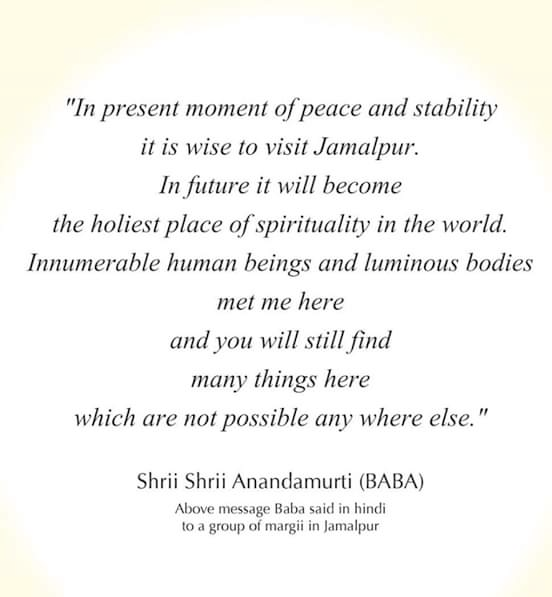
The following image is the 5th scan from Rudrananda's bogus booklet on Jamalpur, titled Ananda Sambhuti, where they are touting their project of a master unit to hoard maximum donations / dollars. Their fictitious claims on Jamalpur are completely contrary to the eternal teachings of Ananda Marga ideology. See below. 

Rudrananda is just ordering his stooges to propagate this fabricated story / false account in order to cheat margiis. But this is just a fake quote created by Rudrananda and Madhuvratananda that is getting circulated by their stooges. That they are passing around this dogmatic thing in Sadguru Baba's name is veritably shameful & sinful:


~ Fake & Fabricated Quote Propagated by Rudrananda's Stooges ~

in Him, 
Satiish


== Section: Important Teaching ==

Dangers of religious state

Ananda Marga philosophy guides us, “If a particular religion is proclaimed the state religion, those who follow other religions will not identify with the country. Consequently, the unity of the country will be undermined. If people go against this basic principle, they may be politically successful for a short time, but eventually they will inflict great harm on the country and prove to be a failure.” (1)

Reference
1. Prout in a Nutshell-16, Three Cardinal Socio-Political Principles


== Section ==

 Who should get credit - Ananda Vanii #23

"You have no right to hate even a single living creature. The best you can do is only to serve. Remember, you are to serve bearing in mind that every creature is verily the living manifestation of the Supreme Consciousness. Remember also that the credit of service is not yours; it is due to the Supreme and the Supreme alone, whose ideation has inspired you to acquire the capability of rendering service."

Note 1: The above is one of Baba’s original Ananda Vaniis. These original and true Ananda Vaniis are unique, eternal guidelines that stand as complete discourses in and of themselves. They are unlike Fake Ananda Vaniis.


== Section ==

যদি জন্তু জানবরের ধ্যান করো

তা, সৰ দেবতারই একটি না একটি বাহন আছে | তো, আজকালকার দেবতা হ’লে, jeep বাহন হত | কিন্তু, jeep jeep | হ্যাঁ | আর সে কালের দেবতা তো jeep বাহন নয় | এক-একটি জন্তু-জানবর | সুতরাং তুমি যদি জন্তু জানবরের ধ্যান করো---“যাদৃশী ভাবনা যস্য সিদ্ধির্ভবতি তাদৃশী |” যেমনটি ভাব নিয়েছ, তেমনটি গতি হৰে | কি বিপদের কথা ৰলো যে তুমি | তো, আরও বিপদের কথা মেয়েদের পক্ষে | মেয়েরা একটু সেজে-গুজে থাকতে ভালৰাসেন | তিনি যদি লক্ষ্মী পূজো করেন, লক্ষ্মীর বাহন প্যাঁচাটির মত দেখতে হয়ে যাবেন । [1]

Danger in meditating on gods and goddesses


“Each of the gods and goddesses has a particular mount, or vehicle. Had they been modern gods and goddesses, their vehicle would have been a jeep. But the ancient gods and goddesses had birds and animals as vehicles. Now if you meditate on these birds and animals, yádrshii bhávaná yasya siddhirbhavati tádrshii [As you think, so you become]. How dangerous it is! It is more dangerous for women. They generally like to remain well-dressed and well-decorated. But if they worship Lakśmii and if they become like an owl which is the mount of Lakśmii (because in meditating on Lakśmii you are meditating on owl also), then would it be good?”
 [2]


References
1. 28-Apr-1979 Ananda Vacanamrtam
2. 28-Apr-1979 Ananda Vacanamrtam


== Section 4: Links ==


SUBJECTS TOPICS