Baba
How to handle bad memories
Namaskar,
Sadguru Baba guides us that carrying old, mundane memories is a big burden. Here’s how: Suppose you want to cross the river in your boat but your vessel is completely overloaded with garbage. The journey will be difficult and it is even highly possible that your boat will sink and you will drown in the swelling river. That is why the intelligent thing to do is lighten your load from your boat. Then your journey will be smooth.
Similarly, if one is mentally overloaded up with a lifetime’s worth of old memories that person will not want to take up any new task. They will not want to learn or engage in anything new. Because they are burdened by all those memories of the past. There is no space in the mind to start anything novel. Yet when that same old person dies and is reborn as a babe, they have tremendous scope and boundless energy to explore the world and learn new things and take on risks. Because that babe is not burdened by all those past memories.
https://anandamargauniversal.blogspot.com/
Ananda Marga ideology guides us, "O sádhaka! You must forget all your past deeds, all your tales of glory or ignominy." (1)
Sadguru Baba’s teaching is that one should not indulge and waste time with memories, tales, and stories of the past. This is something we especially see when two old people sit and talk. They only talk about the past. Best is to not get caught up in that type of discussion and instead utilise the time in Hari katha.
Ananda Marga ideology guides us, "O sádhaka! You must forget all your past deeds, all your tales of glory or ignominy." (2)
When Baba has come and graciously blessed us with all the guidelines for how to lead a dharmic life and when He Himself remains in the heart always, truly we are fortunate. Baba has given the teaching how to regard and utilize history, both in collective life and individual life. By that way we can progress, and not get caught up in the dark moments of the past. At the same time, He has given scope for setting the mind on the Supreme Goal, and moving ahead in life, always thinking of Him.
Ananda Marga ideology guides us, "O sádhaka! You must forget all your past deeds, all your tales of glory or ignominy." (3)
How to lighten your burden
Ananda Marga ideology guides us, "“O mendicant, look and see. Water is entering the boat that you have boarded in the hopes of crossing to the other side of the river. So get rid of that water right away.” Sinca bhikkhu imaḿ návaḿ. If you get rid of the water your boat’s load will be lightened. Sittá te lahu messyati. A human being’s burden grows along with the past...For example, perhaps you are thinking: once you were eating rich, delicious and costly foods such as háluyápuri, murg-mashallam, namkiin poláo – this is all the burden of the past... Buddha warned his mendicants who were thirsty for liberation: O mendicants, lighten the burden that lies before you."
Yassa pure ca paccha ca majjhe ca natthi kincanam';
Akincanam' ana'da'nam' tamaham' vru'mi Bra'hman'am'.
“That person who does not carry any burden...is a true bráhmańa.” (4)
Ananda Marga ideology guides us, "O sádhaka! You must forget all your past deeds, all your tales of glory or ignominy." (5)
Conclusion
Every sadhaka should be keen not to dwell upon the past. Repeatedly thinking and pushing one’s mind back to the days and memories of old is crippling. It severely impedes one’s progress. Only, one may have a brief glance back in order to learn and avoid repeating past missteps. Beyond that, one should live in the present and be forward looking. By this way the mind will remain light and free, and one will be able to advance ahead, unburdened by those memories and tales of the past.
https://anandamargauniversal.blogspot.com/
Ananda Marga ideology guides us, "O sádhaka! You must forget all your past deeds, all your tales of glory or ignominy, from the memorable moment you start moving on the path of sádhaná or intuitional practice. Do not look back: you have eyes in the front of your head. As indispensable as it is to be cautious and careful, so that the self-created tornado propelling you forward does not dash you down to the ground to ensure your safe journey ahead, you may sometimes throw back a cursory glance and no more." (6)
Ananda Marga ideology guides us, "O sádhaka! You must forget all your past deeds, all your tales of glory or ignominy." (7)
Namaskar,
At His lotus feet,
Jaihari
~ In-depth study ~
Ananda Marga philosophy guides us, "I will call that person a Brahman whose mind does not run after any colour, who is neither obsessed by colour-laden thoughts of the past...One must free the mind from the influence of all colours." (8)
Ananda Marga ideology says, "Whatever be the consequence of your past deeds, your upliftment is guaranteed, if you have unflagging zeal to attain Brahma. Do not look back, look forward. Never take any limited material object for your worship. Accept only the loftiest entity for your contemplation. If your love for Him is genuine, you will ever remain in an Elysian exuberance. Pain will then mean nothing to you, nor will happiness either. When one’s movement is towards the Great, when one’s ardour is only for the Great, it is called Prema or Divine Love." (9)
Ananda Marga ideology guides us, "O sádhaka! You must forget all your past deeds, all your tales of glory or ignominy." (10)
Negative effect of discarding history: repeated mistakes
In India, under the teachings of Shankaracarya, history was discarded outright. There was no record kept by the people. Because of this the same mistakes and errors were repeated over and over again. And ultimately, the history of India was recorded by outsiders. This is one extreme. And the other extreme is what we see happening with the Jews where there is a perpetual manner of recounting dark episodes of history over and over again, without rest. In that case, those communities get caught up in the horrors and sufferings of the past.
https://anandamargauniversal.blogspot.com/
A delicate balance is needed where we look back approximately 1% of the time, i.e. just enough to learn and track our course. Then the remaining 99% of the time should be aimed for forward movement. This is the ideal way to use history and foster a healthy outlook. And that is neatly reflected in Baba's below teaching.
Ananda Marga philosophy says, "[That which is true] has been accepted, and the dark aspects of life have not been given any scope to flourish." (11)
Ananda Marga ideology guides us, "O sádhaka! You must forget all your past deeds, all your tales of glory or ignominy." (12)
How people suffer in personal life
While in our social life or collective life, it is important to look back and learn from history. One should be extremely careful not to drown in old memories. One should not indulge in this way; a human being should look forward. For instance, if one loses $100 or $100,000, then one should not think back again and again on this loss. In that case, life will be miserable. Yet many people fall into this thought cycle, i.e. always reliving the difficulties of the past. That is not healthy in individual life.
This happens not just with the loss of money, but with any type of painful memory or unfortunate occurrence. People churn those thoughts again and again and verily there are so many horrible memories that people harbour. This only invites more pain and compounds the difficulty.
https://anandamargauniversal.blogspot.com/
Ananda Marga ideology guides us, "O sádhaka! You must forget all your past deeds, all your tales of glory or ignominy." (13)
Deadly: reinforcing those painful memories
In the west, the primary method used in counseling, psychotherapy, and support groups is based on recollecting and reliving old habits and past harms. Whether the problem be child abuse, alcohol addiction, or any other malady or abuse, many western approaches indulge in talking about those pains, daily, weekly, monthly. They strongly identify with those past actions, thereby reinforcing those painful memories in the mind. So instead of moving beyond those tragic incidents by redirecting the mind towards a more positive or sentient engagement, those old horrors become the dominant aspect of one's present existence. This should be avoided at all costs. Key steps should be taken to break that thought cycle and redirect the mind toward sentient and psycho-spiritual pursuits.
Ananda Marga ideology guides us, "O sádhaka! You must forget all your past deeds, all your tales of glory or ignominy." (14)
References
1. Subhasita Samgraha - 4, The Chariot and the Charioteer
2. Subhasita Samgraha - 4, The Chariot and the Charioteer
3. Subhasita Samgraha - 4, The Chariot and the Charioteer
4. Ananda Vacanamrtam - 9, The Source of Internal Stamina
5. Subhasita Samgraha - 4, The Chariot and the Charioteer
6. Subhasita Samgraha - 4, The Chariot and the Charioteer
7. Subhasita Samgraha - 4, The Chariot and the Charioteer
8. Namami Krsnasundaram, Disc #24
9. Subhasita Samgraha - 4, Vibration, Form and Colour
10. Subhasita Samgraha - 4, The Chariot and the Charioteer
11. Prout in a Nutshell - 16, Our Social Treatise
12. Subhasita Samgraha - 4, The Chariot and the Charioteer
13. Subhasita Samgraha - 4, The Chariot and the Charioteer
14. Subhasita Samgraha - 4, The Chariot and the Charioteer
== Section: Hindi ==
अनशन क्यों नहीं
जेल एकमात्र ऐसी जगह है जहाँ अन्याय के खिलाफ अनशन करने की इजाजत दी जा सकती है। वह भी तब जब किसी को गिरफ्तार करके जेल में डाल दिया गया हो।
मान लीजिए जेल में रहते हुए खाद्य विषाक्तता के कारण किसी कैदी की जान को खतरा है - और जेल के सभी अधिकारी भ्रष्ट हैं; तो उस असामान्य परिस्थिति में एक ही विकल्प हो सकता है कि वह कैदी या उसके समर्थक कैदी जेल में अनशन करें।
इसतरह की परिस्थिति के अलावे किसी को भी अन्याय का विरोध करने के लिए उपवास (अनशन) का सहारा नहीं लेना चाहिए।
1. जेल की परिस्थितियाँ बहुत अलग है । समाज से अलग थलग होने के कारण जेल में विरोध करने के लिए बहुत कम उपाय है - इसलिए उस परिस्थिति में उपवास अलग बात है। यदि आप जेल की कोठरी में हैं तो आप दूसरों के साथ संवाद नहीं कर सकते हैं या लोगों को संगठित नहीं कर सकते हैं । इसलिए वहाँ अन्याय के खिलाफ विरोध के बहुत कम तरीके हैं।
2. जब बाहर यानी कि समाज मे हैं, तो जन जागृति में संलग्न होना चाहिए - यही प्राउटिष्ट विधि है । लेकिन जब जेल में एकांत कारावास होता है तो कोई सामूहिक जागरण नहीं कर सकता।
3. जब बाबा जेल में थे, तो कई बार अनशन का मुद्दा उठा । मार्गीलोग विरोध में उपवास करना चाहते थे, लेकिन बाबा ने इस प्रथा पर रोक लगा दी।
आजकल कुछ लोगों ने AMPS संस्था में एकता आदि को बढ़ावा देने के लिए उपवास किया है । हालाँकि उनका उद्देश्य बहुत अच्छा है । लेकिन उन्हें बाबा के दिशानिर्देशों के बारे में ठीक से जानकारी ले लेना चाहिए । और अनशन करने के बजाय, उन्हें प्राउट की रणनीति व शिक्षाओं के साथ खुद को जोड़ना चाहिए। तब निश्चित रूप से उन्हें सफलता मिलेगी।
== Section: Important Teaching ==
Wts & cleanliness
Pictured below our Wts are busy and involved in physical cleanliness. It would be best if they also followed “A Guide to Human Conduct” and tried to clean their mind of the gunk of groupism and come out clean as a neo-humanist. Unfortunately this is not happening. That is why we should adhere to Baba's below teaching.
Ananda Marga philosophy states, “External shaoca is an external activity and mental shaoca is an internal activity. If the impurity of selfishness, which, by entering into every cavity of the mental body, makes it weak – makes life a heavy burden – it has to be removed, it has to be burnt and melted in the fire of sádhaná. Such sádhaná is just the opposite of mean and selfish sádhaná; it is such that no impurity, no black spot, remains in the mind. The feeling of selflessness, the feeling of universalism is the only remedy to remove mental impurities.” (1)
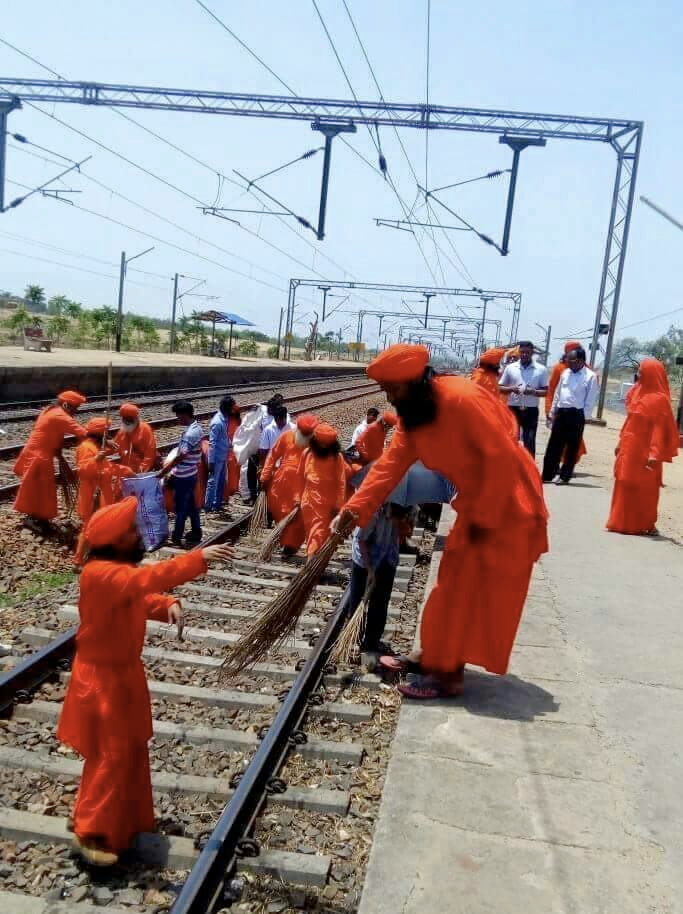
These Wts are cleaning Pundag railway station at Ananda Nagar and that is good. They should also clean the gunk of groupism from their mind.
Reference
1. Guide to Human Conduct, Shaoca
== Section: Important Teaching ==
Identifying the irredeemable debts
Ananda Marga Caryacarya states, “Four kinds of debt are irredeemable – debt to father, debt to mother, debt to ácárya, and debt to guru (divine debt)."
"(a) The only way to do service to one's father after his death is to help every male member of the universe to progress on the path of highest development."
"(b) The only way to do service to one's mother after her death is to help every female member of the universe to progress on the path of highest development."
"(c) The best service to the ácárya is to work for the comfort and benefit of one's ácárya and his/her family."
"(d) The best service to Márga Guru is to work according to His wishes. But however much service one renders, one will not redeem the four debts until Mokśa (salvation) is attained.” (1)
Reference
1. Caryacarya, Part 2, Society, Point #20
== Section: Ananda Vanii ==
They are verily the most heroic
Original Ananda Vanii states: “Those who can dedicate their all to the thought of the Great and the inspiration of the Supreme are verily the most heroic. Indeed, they are the virtuous, and they alone are capable of taking human history from darkness to light.” (Ananda Vanii #22)
Note: Sadguru Baba has assigned a number to all His original and true Ananda Vaniis. In contrast, Fake Ananda Vaniis do not have any number. By this simple formula, one can easily recognise which is a true Ananda Vanii and which is fake. For the upcoming occasion of January 1st 2017, all Ananda Marga units should use one of Baba’s original and true Ananda Vaniis, not a fake one. By this way, one will surely get His blessing.
== Section: Important Teaching ==
Link and differences between dog, wolf, and jackal
Ananda Marga Shabda Cayanika says, “A dog is a hybrid of the wolf and the vixen. In ancient times wild dogs were rather scarce, precisely for the same reason. There is hardly any dog fossil amongst the available fossils of ancient animals. Nowadays, however, wild dogs are also prevalent. These wild dogs live gregariously in jungles, and even a gigantic tiger has been seen to be flabbergasted and killed by a concerted attack of these dogs.”
“Although a dog is a hybrid of the wolf and the vixen, it must be said that there are many radical, extreme differences between a wolf and a dog. A wolf is voracious, but a dog feels satisfied with a small meal. It is difficult to tame a wolf, but a dog loves to be domesticated. A dog is extremely faithful and loyal to its master. A wolf is neither faithful nor loyal to its master. A dog is not ferocious by nature. It attacks or frightens someone as part of its duty. A wolf is ferocious by nature. It has no sense of duty. A dog would not normally kill a creature if its stomach were full. But a wolf, even when its belly is full, kills a creature. If it has no capacity to eat it, it carries the carcass to its den and eats it according to its convenience. Dogs do not generally fight with other members of the dog family. They fight with members of the feline family. But a wolf does not observe any such principle. A wolf avoids the strong and unnecessarily attacks the weak. Although there is a family resemblance between the wolf and the dog, whenever a dog is sighted the wolf attacks and kills it.”
Ananda Marga Shabda Cayanika says, “There are many differences between a jackal and a dog. A dog generally moves about during the daytime. But jackals are night prowlers by nature. A jackal moves in the daytime only when it is in danger, it has to change locations or is excessively hungry. A jackal lives in a hole, but a dog never likes to live in a hole. It prefers to live in the open. A jackal cannot be tamed; but a dog can. By virtue of being night prowlers, the jackals periodically howl in chorus to preserve their solidarity and register their presence. However, dogs do not have this habit. They bark collectively only when they have to fight an enemy as a body. Although both jackals and dogs belong to the canine family, a dog chases a jackal whenever it sees one. A jackal runs away at the sight of a dog. By nature a dog is brave and a jackal is cowardly.” (1)
Reference
1. Shabda Cayaniká Part 4: Discourse #27
== Section 3: Links ==

