Baba
Boosting sadhana
Namaskar,
Each and every sadhaka knows that sadhana itself moves in phases of pause and speed.
Ananda Marga philosophy says, "While doing sa'dhana' in the spiritual sphere, the state of pause may come. Sometimes people say, 'How strange! A few days ago I was having excellent meditation, but these days I can't seem to concentrate at all. That's very sad.' Or at times one may say, 'The other day while meditating my body began to quiver. It was quite a pleasant experience. Why don't I get the same experience today?' This sort of blissful experience during meditation or in concentration comes within the scope of assimilation. It becomes internalized. But if it does not find any expression within the mind, you can never experience it. Maybe after a few days you may experience an even greater bliss during incantation or meditation. All this means that even in the spiritual sphere also there is pause and speed." (1)
So we should always put forth maximum effort in sadhana and never skip any lessons, then one will advance ahead on the spiritual path. The main ethic is sincerity in sadhana - if one is sincere then certainly one will advance, by His grace.
http://anandamargauniversal.blogspot.com/
Sadhana & sadhanaunga
In our sahaja yoga system - i.e. the six lessons of sadhana - the lessons can be separated into two basic categories: sa'dhana' and sa'dhana'unga. Our iishvara pranidhana and dhya'na are the only two lessons of sadhana. Iishvara pranidhana leads to mukti and abhidhyana brings moksa, by His grace. So those are both sadhana lessons.
Whereas our other lessons - numbers 2 through 5 - are helping lessons of sadhana known as sa'dhana'unga. These include: madhuvidya, tattva dharana, pranayama, and cakra shodhana. All of these are helping lessons - i.e. sa'dhana'unga - in sadhana.
Ananda Marga ideology says, "There are certain helping sádhanás. Ásana and práńáyáma, for example, are helping items. They are not sádhaná, they are called sádhanáuṋga." (2)
All the helping lessons of sadhana, (i.e. madhuvidya, tattva dharana, pranayama, and cakra shodhana), along with other aspects of astaunga yoga like asanas, help bring the mind into a balanced state where one can do sadhana, by His grace.
Ananda Marga ideology says, “Human life is for spiritual sádhaná only. There is not, there cannot be, any other motive; there cannot be any other intention; there cannot be any other desideratum.” (3)
Steps to keep sadhana strong: third lesson
Despite our best efforts, sometimes one may undergo periods of pause in sadhana. At that time there are certain approaches that help push sadhana back into a period of speed. One point is to practice the lesson of tattva dharana. This energizes one's being, enhances concentration, and makes the mind stable. So it is a very good lesson to do when experiencing a period of pause.
http://anandamargauniversal.blogspot.com/
Sometimes sitting for a long or even short session in viira'sana (the posture for tattva dharana) is not particularly easy. Because the toes are curled underneath and there is a lot of pressure applied to the joints of the toes. In that case, one can place some soft clothing articles or a piece of foam underneath one's feet when doing third lesson. In that way viira'sana will feel more comfortable and one will be able to remain in that position long, getting the many benefits. And, over time, doing this lesson will become physically easier and easier.
About sadhana lessons: first & sixth lesson
The point then comes that when should one do 1st lesson and when should abhidhya'na be done. Here are some basic guidelines.
1. If one is struggling in abhidhyana either because one cannot visualise one's Goal or because one is not feeling that sweet, heartfelt connection inside, then one can try switching over to iishvara pranidhana. Because iishvara pranidhana is comparatively easy.
2. It should be remembered that iishvara pranidhana itself is a lesson based on bhakti. So just after one completes the stage of cittashuddhi (the last step of one's withdrawal process) then before starting the practice of mantra japa, first one infuse a strong feeling of love for one's Goal. And then after arousing that bhakti one can then repeat their is't'a mantra. Then that mantra japa will be fruitful by His grace. Here the whole point is that one's mantra repetition should be saturated with bhakti and yearning for Him. That is one key point for iishvara pranidhana.
http://anandamargauniversal.blogspot.com/
3. After doing iishvara pranidhana and other lessons then one should do abhidhyanan and if abhidhyana is not progressing properly then go back and do other lessons and come back to abhidhyana. By this way, abhidhyana can be done more than one time during a given sadhana session.
Proceeding ahead in sadhana
4. And it is vital that a sadhaka should always be natural in their approach to sadhana and not be artificial or hypocritical. One should do as one sincerely feels.
5. For example, when a small child has a strong desire to sit on his mother's lap then that little baby is going to cry and cry until that mother lifts him onto her lap. And this is quite natural and the mother feels that she must respond to the child's cry. Because that is the child's pure and natural feeling. In contrast, if for show, or to get prestige, one just sits erect in sadhana in front of others and then at other times in his home he does not do sadhana at all, that is completely unnatural, and one will not progress. Because that is just one fake display in the name of sadhana. It is wholly bereft of sincerity; so one will just degrade.
6. And the most important point in sadhana is to directly ask help from their object of meditation, one’s dhyeya. One may repeat, 'I cannot do anything, I am helpless, so please grace me. Requesting His grace in this way will invariably help one to move forward on the path. This type of constant request is needed for getting His grace. And this type of request should be carried out with all the sweet and sincere feelings of one's heart. Only then will it be successful.
http://anandamargauniversal.blogspot.com/
Ananda Marga spiritual cult says, "They will have to approach Parama Purusa with these words: 'Parama Purusa I want to move towards You, but I do not have sufficient strength to move. Please give me strength, I want to move on'." (4)
Conclusion
Sadhana is the main thing in the life of an aspirant. And in our Ananda Marga sadhana system, that means first and sixth lessons. But to progress in iishvara pranidhana and abhidhyana, an aspirant should sincerely do all the other lessons and practice other aspects of astaunga yoga like asanas, and yama and niyama. All these endeavours are sadhanaunga and enhance sadhana. Finally, when doing first and sixth lessons, it is important to be sincere and natural and cultivate bhakti. Then one is sure to get success, by His grace.
Namaskar,
in Him,
Ananda
In sadhana, one must follow a natural approach - especially in abhidhyana. One should approach their object of meditation, one’s dhyeya, and communicate with Him according to one's internal feeling. A sadhaka should not act in any fake or unnatural manner. Sincerity is the key for progress in abhidhyana.
There are some who may say that abhidhyana is the only lesson that one should practice - but that is not proper. Rather, all the lessons have their utility and speciality, and they all help promote deeper abhidhyana. So the way to develop a sweet and more intimate feeling in abhidhyana is by doing all the six lessons and by being sincere and true in abhidhyana.
http://anandamargauniversal.blogspot.com/
Natural flow of life: systaltic movement
All the above points are important. By His grace all these guidelines help a sadhaka in sadhana, especially if one is experiencing a period of pause. Whereas when one is in a period of speed then by His grace all the lessons are flowing naturally and one becomes completely lost in the ocean of Cosmic Bliss.
As sadhakas, it is perfectly natural for one to go through "ups" & "downs" in our practice of meditation. At the same time we all wish that we could always be in an "up" phase. So when a "down" phase invariably comes then we should all know what it means and how to handle it.
As Baba discusses in so many discourses-- whether about sadhana, economics, education, social progress, or literature etc-- each and every movement in this universe moves along a systaltic path.
Ananda Marga ideology says, "As you know, in this universe of ours nothing moves - no force, no expression, no manifestation, moves - along a straight line. The movement is always pulsative; the movement is always of systaltic order, order of pause and start. There must be a stage of pause, and another stage just following the stage of pause - a stage of movement." (5)
So according to Ananda Marga philosophy, the "ups" & "downs" in spiritual life are natural and to be expected. And His own terminology for these "ups" & "downs" of life are known are periods of speed and periods of pause.
http://anandamargauniversal.blogspot.com/
Questions & answers on meditation
Ananda Marga philosophy says, "Question: What is dhárańá?"
"Answer: Dhárańá is defined as: Deshabandhashcittasya dhárańá. Dhárańá literally means “locating the mind firmly in an area or region of the body”. This involves concentrating upon the respective controlling points of the fundamental factors located within the human body. That is, the mind is to be fixed on specific cakras [plexi] and engaged in Cosmic ideation.'
"Question: What is shodhana?"
"Answer: The word shodhana literally means “refinement” or “purification”. In spiritual meditation shodhana is concentration on the cakras. It is a part of Ananda Marga sádhaná which is not included in aśt́áḿga yoga [the eight-fold path of yoga]."
"Question: What is dhyána?"
"Answer: Patanjali defined dhyána as: Tatra pratyatyaekatánatá dhyánam – “Dhyána means ‘the unbroken flow of mind towards the supreme goal’.” So dhyána is meditation on the Supreme Entity so that there is an incessant upward movement of the mind towards Parama Puruśa." (6)
On dharana & dhyana
Ananda Marga philosophy states, "What is Dharana and Dhyána and what is the difference between the two?"
Ananda Marga philosophy states, "Ans. Citta has the characteristic of becoming like its object. For example, when Citta is in contact with a tree it becomes like the tree. To do this citta has to depend on external sensations which convey that shape to the citta with the help of the indriyas or organs. Citta performs two types of functions: gráhaka and vikshepaka. The gráhaka function is performed with the help of the five jiṋánendriyas or sense organs with their afferent nerves, which carry sensations of external objects to the citta; then the citta takes the form of the sensations carried by the nerves. The second function of Vikshepaka is performed with the help of the five karmendriyas or motor organs and their efferent nerves, which transform sensations into physical action."
Ananda Marga philosophy states, "Thus the citta takes the forms of the image or sensation which is carried to it with the help of the sensory nerves. The property of citta to become like its object is called dháraná which means “to hold”: the citta holds an image and becomes like that. The image is carried to the citta from external sensations, and since these sensations are not continuous, the image which is formed on the citta is also not continuous. There is always a gap between two successive images, but due to the rapid succession of the images, the gap is not perceived. It is just like the images of the cinema screen which appear to be continuous and constant; but when the film is examined it is seen that the images on the screen are formed from a succession of many different pictures. In Dhárańá, citta becomes like that with which it comes in contact in the external world through the sensations; since the sensations of the external object are not continuous, the image in the citta is also not continuous. Thus Dhárańa is not dynamic, for individual images which are formed on the citta, are all static and will not remain unless immediately followed by another image."
Ananda Marga philosophy states, "Dhyána is also a state of citta like Dhárańá, but since dhyána can never be of any external object so the citta does not have to depend on external sensations. The object in dhyána is always internal and so citta can take its form without the help of any external sensations. When there is no necessity of external sensations, there is also no gap between one sensation and another; and the form which the citta adopts in dhyána is continuous. Dhyána is thus not static but a continuous process; and this continuity cannot be broken because the citta exists in the same state and takes the same form throughout the period of dhyána. Since the form is the same throughout, no gaps exist as in dháraná, and there is no succession of individual static images either dhyána is compared to the continuity of a stream of oil which flows without any apparent movement. Taela dhárá vat ekatánatá: “Meditation or dhyána is a constant remembrance, flowing like an unbroken stream of oil from one vessel to another.”
Ananda Marga philosophy states, "The result of action in dhyána is inaction. The process of dhyána is so continuous that all capacity of action is exhausted in maintaining this continuity, and the resultant therefore is inaction. When there is a cessation of action, the mind ceases to exist, and that is called samádhi. Samádhi is also called karma samádhi – the actionless state when all karma ceases (karmanásha)."
Ananda Marga philosophy states, "There is another action – the attractive power of Parama Puruśa. This attractive power which originates from Parama Puruśa will always remain; but as the object of the attraction is the mind, and when the mind itself does not exist, this attractive power will also not exist. Dhyána, therefore results in the complete loss of action."
Ananda Marga philosophy states, "Dhárańá and Dhyána are therefore quite different from each other although both take place in the citta. Dhárańá is process of the citta taking the shape of external objects, while dhyána concerns internal objects only. Dhárańa is static, while dhyána is full of dynamic form. Dhárańá is non-continuous and momentary, while dhyána is continuous. Dhárańá may result in action, but dhyána results only in the cessation of actions. Dhárańá is purely a creation of citta and is tamoguńi or static, where as dhyána is full of dynamism and is rajoguni or mutative by nature. The resultant cessation of action in dhyána shows that its final goal is Sattvaguńii Samádhi through the principle of sattvaguńa." (7)
Dhyánakriyá is just like a thread of molasses
Ananda Marga ideology says, “The best process is Brahma Sadbháva. Second one is dháraná and dhyána. Third one is Japa-Stuti – this is adhama and múrtipujá i.e. idol worship is adhamádhama. What is the matter? In Japakriyá there is only acoustic rhythm as I have told you about acoustic rhythm Ráma, Ráma, Ráma, Ráma. But in Prańidhána this acoustic rhythm maintains parallelism with mental rhythm i.e., mentally you will be saying Ráma, Ráma, Ráma, there should be acoustic rhythm Ráma, Ráma. Ráma like this and mentally you will be thinking of Ráma also, i.e., the parallelism is to be maintained, otherwise in Japakriyá where there is no parallelism what does happen; while you are uttering the word Ráma, Ráma as you are chanting the word “Rá”, letter “Rá” you are thinking of the next letter “Ma.” Ráma! Again while uttering the letter “Ma” you are thinking of the letter “Rá”. Next “Rá”. in second stage of Japa “Rá”, In that case your Mantra will be “Mara” you are uttering the letter “Ma” and thinking of the letter “Rá”, so your Iśt́a Mantra becomes “Mara” and not “Ráma”. So it is useless to do that type Japakriyá. Unless and until there is a parallelism with mental wave it is useless and where there is parallelism between acoustic rhythm and mental rhythm it is called Prańidhána. In Ananda Marga your Iishvara Pránidhána is not japakriyá; it is called Prańidhána. Prańidhána comes within the scope of Dhyána and not within the scope of japa. Do you follow? Now the first one is Pranidhána and the second one is Anudhyána. What is Anudhyána Within the greater sphere of Dhyána there are two processes – Dhárańá and Dhyána; when you try to withhold something external within your mental world it is called Dhárańá. So in Dhárańá, there is a static force, Dhárańá is of static origin. But when something is moving and that movement has been accepted by you as it is, it is called Dhyána. So in Dhyána there is a dynamic force. Dhyánakriyá is just like a thread of molasses. When poured a thread is created; there is force, there is movement in that thread but it appears to be something static. Dhyánakriyá is like this. Do you follow? “Taela Dharavat.”” (8)
Pious persons are those who....
Ananda Marga ideology says, "The Paiṋcakośas shall have to be perfected, but how is it possible? They can be consummated only through the practice of Yama and Niyama. The Annamaya Kośa is perfected through Ásanas (physical postures). Yama and Niyama Sádhana perfect the Kámamaya Kośa. The Manomaya Kośa is perfected through Pránáyáma. Through Pratyáhára the Atimánasa Kośa is perfected. The Vijiṋánmaya Kośa is perfected through Dhárańá and the Hirańmaya Kośa through Dhyána. Only Dhyána Samádhi gives access to the soul. Pious persons are those who are earnest in their efforts to perfect the Paiṋcakośa. Human existence consists of the five kośas and spiritual practice is eightfold. This spiritual practice is Dharma. That which does not provide for the explanation of the Paiṋcakośa is not Dharma, but sectism." (9)
"I will catch hold of Him"
Ananda Marga ideology says, “In Ranchi I told [you] about dhyána and dhárańá. Parama Puruśa is your goal. You are going to Parama Puruśa. If Parama Puruśa is caught easily in your heart, then that is the will of Parama Puruśa. If Parama Puruśa runs away from you, then what should you do? If you think, “Parama Puruśa does not want me,” and you go back, then you are defeated by Parama Puruśa. But if Parama Puruśa runs away and you chase Him, if you say, “I won’t let Him go, I will not desist till I catch hold of Him,” this is abhidhyána.” (10)
References
1. Prout in a Nutshell - 7, Dynamicity and Staticity
2. Ananda Vacanamrtam - 23, How to Concentrate
3. Ananda Vacanamrtam - 23, Oṋḿkára and Iśt́a Mantra
4. Subhasita Samgraha - 18, The Path unto the Abode of Beatitude
5. Ananda Vacanamrtam - 8, The Advent of Mahásambhúti
6. Yoga Psychology, Questions and Answers on Meditation, #16 - #18
7. Tattvika Praveshika, Some Questions and Answers on Ananda Marga Philosophy, Question #8
8. Subhasita Samgraha - 18, The Stance of Salvation and How to Attain It
9. Subhasita Samgraha - 2, The Call of the Supreme
10. Ananda Vacanamrtam - 31, Abhidhyána and Árádhaná
* * *
The below section is an entirely different topic, unrelated to the above material.
It stands on its own merit as a point of interest and ideological awareness.
* * *
== Section 2: Prabhat Samgiita ==
Full surrender
"Tomárei máni káche ácho jáni,tumi ámár devatá." (Prabhat Samgiita #4235)
Purport:
Parama Purusa, I adore and cherish only You. I feel that You are remaining very close by; I depend on You as You are along with me always. You are my Devata’ – my most Adorable One - my everything. Knowingly and unknowingly, I always think and long for You. Day and night, all the 24 hours, I am always in Your shelter. My eternal Savior and granter of my life, I adore only You. I feel that You are remaining very close by - along with me always. Baba, You are my most near One.
Parama Purusa, You are within one and all: from Brahma, the creative faculty, to the smallest blade of grass. I am also part of You; I am a particle of Your grand creation. You surround me day and night, yet still I search for You and wish to tell my tales of sorrow and happiness to You. I fully surrender unto You.
Parama Purusa, You suffuse and overflow the flower blossoms with Your sweetness. I am just a small particle of that flower. Baba, please fill my mind with samvit, O' the Sweetness of the Divine world entity, I fully surrender unto You...
About Prabhat Samgiita #4235:
Theory does not satisfy the heart of the bhakta. The bhakta always wants a personal relationship with Parama Purusa. By reading books and studying philosophy one can theoretically understand that Parama Purusa is everywhere. But for the bhakta this is not enough. The bhakta's heart always longs for a personal link and intimate communication with Him. The sadhaka wants to share their own feelings, agonies, and longing with Parama Purusa. This type of yearning for Parama Purusa marks the initial stage of bhakti. If one does not have this type of communication then bhakti has not yet started. This above Prabhat Samgiita illustrates this point.
[1] Samvit: Ananda Marga philosophy states, "Samvit means spiritual consciousness, spiritual awakening. A man engaged in bad things all of a sudden feels that “No, I shouldn’t do all these things. No, I should be a good man henceforward.” Such an idea all of a sudden comes in his mind. And this thing, this change of mental tendency, is brought about by samvit shakti of Vidyámáyá. Do you follow? This is what is called samvit shakti. “No, henceforward I must be a good man. No, henceforward I must be a spiritualist. I must not encourage any depraving idea.” Samvit shakti." (1)
Here the bhakta is requesting samvit from Parama Purusa. So in this above song, the term samvit had been used.
Reference
1. Ananda Vacanamrtam - 23, Brahma Cakra
== Section 3: Important Teaching ==
All about bananas
Ananda Marga Ideal Farming states, "Banana trees are known more for their fruits than for their fibre. Both the fruit and the flower can be eaten, and when the tree is young the inner trunk can be taken as a vegetable as well. The leaves are used for plates or for wrapping food. Sodium carbonate may be obtained from the banana tree by burning the trunk into ash, and sodium bicarbonate may be obtained by boiling the ash until the water evaporates. There are numerous products which can be made from the banana tree. The fibre is obtained from the trunk of the tree. The greater the size of a tree, the greater the quantity of fibre, but the same rule does not necessarily apply for the quantity of fruit produced by the banana tree. Not more than two offshoot saplings should be allowed to grow from one banana tree. The extra shoots should be cut. There are many varieties of banana." (1)
Reference
1. Ideal Farming - 2, Some Important Crops
== Section: Important Teaching ==
~ From Caryacarya - 3, General Health Rules ~
(1) Body and clothing must be kept neat and clean.
(2) After urinating use water or cleanse yourself by some other means.
(3) Pay attention to the regular clearing of the bowels.
(4) Do not sleep on a soft bed.
(5) When taking a bath, all parts of the body, in particular the armpits and groin, should be cleaned properly. Soap, oil, and comb should be used every day. The body hair should never be cut, especially in the armpit and pubic region.
(6) Before morning and evening sádhaná, either do vyápaka shaoca or take full bath.
(7) Before and after meals, and before sleep, do vyápaka shaoca with cold water. If it is very cold, use lukewarm water.
(8) Drink a sufficient quantity of water every day, but do not drink too much at any one time.
(9) Sleeping during the day and staying awake at night are to be avoided.
(10) All intoxicants are támasika and are to be discarded like poison.
~ From Caryacarya - 3, General Health Rules ~
== Section: News ==
Beware cheats want to empty your pocket
Namaskar,
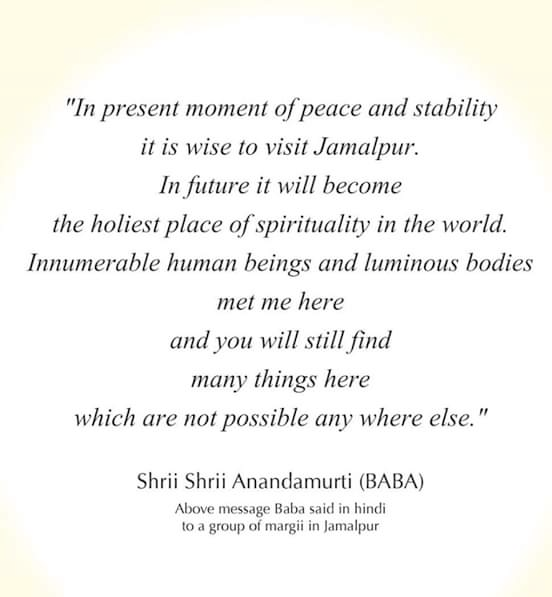
The following image is the 5th scan from Rudrananda's bogus booklet on Jamalpur, titled Ananda Sambhuti, where they are touting their project of a master unit to hoard maximum donations / dollars. Their fictitious claims on Jamalpur are completely contrary to the eternal teachings of Ananda Marga ideology. See below.
Rudrananda is just ordering his stooges to propagate this fabricated story / false account in order to cheat margiis. But this is just a fake quote created by Rudrananda and Madhuvratananda that is getting circulated by their stooges. That they are passing around this dogmatic thing in Sadguru Baba's name is veritably shameful & sinful:
in Him,
Satiish
== Section: Important Teaching ==
Dangers of religious state
Ananda Marga philosophy guides us, “If a particular religion is proclaimed the state religion, those who follow other religions will not identify with the country. Consequently, the unity of the country will be undermined. If people go against this basic principle, they may be politically successful for a short time, but eventually they will inflict great harm on the country and prove to be a failure.” (1)
Reference
1. Prout in a Nutshell-16, Three Cardinal Socio-Political Principles
== Section ==
"You have no right to hate even a single living creature. The best you can do is only to serve. Remember, you are to serve bearing in mind that every creature is verily the living manifestation of the Supreme Consciousness. Remember also that the credit of service is not yours; it is due to the Supreme and the Supreme alone, whose ideation has inspired you to acquire the capability of rendering service."
Note 1: The above is one of Baba’s original Ananda Vaniis. These original and true Ananda Vaniis are unique, eternal guidelines that stand as complete discourses in and of themselves. They are unlike Fake Ananda Vaniis.
যদি জন্তু জানবরের ধ্যান করো
তা, সৰ দেবতারই একটি না একটি বাহন আছে | তো, আজকালকার দেবতা হ’লে, jeep বাহন হত | কিন্তু, jeep jeep | হ্যাঁ | আর সে কালের দেবতা তো jeep বাহন নয় | এক-একটি জন্তু-জানবর | সুতরাং তুমি যদি জন্তু জানবরের ধ্যান করো---“যাদৃশী ভাবনা যস্য সিদ্ধির্ভবতি তাদৃশী |” যেমনটি ভাব নিয়েছ, তেমনটি গতি হৰে | কি বিপদের কথা ৰলো যে তুমি | তো, আরও বিপদের কথা মেয়েদের পক্ষে | মেয়েরা একটু সেজে-গুজে থাকতে ভালৰাসেন | তিনি যদি লক্ষ্মী পূজো করেন, লক্ষ্মীর বাহন প্যাঁচাটির মত দেখতে হয়ে যাবেন । [1]
Danger in meditating on gods and goddesses
“Each of the gods and goddesses has a particular mount, or vehicle. Had they been modern gods and goddesses, their vehicle would have been a jeep. But the ancient gods and goddesses had birds and animals as vehicles. Now if you meditate on these birds and animals, yádrshii bhávaná yasya siddhirbhavati tádrshii [As you think, so you become]. How dangerous it is! It is more dangerous for women. They generally like to remain well-dressed and well-decorated. But if they worship Lakśmii and if they become like an owl which is the mount of Lakśmii (because in meditating on Lakśmii you are meditating on owl also), then would it be good?” [2]
Who should get credit - Ananda Vanii #23
"You have no right to hate even a single living creature. The best you can do is only to serve. Remember, you are to serve bearing in mind that every creature is verily the living manifestation of the Supreme Consciousness. Remember also that the credit of service is not yours; it is due to the Supreme and the Supreme alone, whose ideation has inspired you to acquire the capability of rendering service."
Note 1: The above is one of Baba’s original Ananda Vaniis. These original and true Ananda Vaniis are unique, eternal guidelines that stand as complete discourses in and of themselves. They are unlike Fake Ananda Vaniis.
== Section ==
তা, সৰ দেবতারই একটি না একটি বাহন আছে | তো, আজকালকার দেবতা হ’লে, jeep বাহন হত | কিন্তু, jeep jeep | হ্যাঁ | আর সে কালের দেবতা তো jeep বাহন নয় | এক-একটি জন্তু-জানবর | সুতরাং তুমি যদি জন্তু জানবরের ধ্যান করো---“যাদৃশী ভাবনা যস্য সিদ্ধির্ভবতি তাদৃশী |” যেমনটি ভাব নিয়েছ, তেমনটি গতি হৰে | কি বিপদের কথা ৰলো যে তুমি | তো, আরও বিপদের কথা মেয়েদের পক্ষে | মেয়েরা একটু সেজে-গুজে থাকতে ভালৰাসেন | তিনি যদি লক্ষ্মী পূজো করেন, লক্ষ্মীর বাহন প্যাঁচাটির মত দেখতে হয়ে যাবেন । [1]
Danger in meditating on gods and goddesses
“Each of the gods and goddesses has a particular mount, or vehicle. Had they been modern gods and goddesses, their vehicle would have been a jeep. But the ancient gods and goddesses had birds and animals as vehicles. Now if you meditate on these birds and animals, yádrshii bhávaná yasya siddhirbhavati tádrshii [As you think, so you become]. How dangerous it is! It is more dangerous for women. They generally like to remain well-dressed and well-decorated. But if they worship Lakśmii and if they become like an owl which is the mount of Lakśmii (because in meditating on Lakśmii you are meditating on owl also), then would it be good?” [2]
References
1. 28-Apr-1979 Ananda Vacanamrtam
2. 28-Apr-1979 Ananda Vacanamrtam
1. 28-Apr-1979 Ananda Vacanamrtam
2. 28-Apr-1979 Ananda Vacanamrtam
== Section 4: Links ==

