Search This Blog

Saturday, July 25, 2020

Mahaprayan: Patna margii died of covid-19

Baba

Mahaprayan: Patna margii died of covid-19

Namaskar,

It is with much sadness that we share the news of the mahaprayan of Shrii Pappu ji of Patna. Pappu ji was the son of Shrii Ramashankar and his mahaprayan occurred due to complications from covid at 5:40pm.

Pappu ji was a kind-hearted soul who was keen to help and serve according to his capacity. He will be sorely missed by all those who knew him.

May we all take solace in the fact that Shrii Pappu was a bhakta of Sadguru Baba. Certainly he will attain mukti or moksa, accordingly. Baba will lovingly bestow His infinite grace.

in Him,
Caetanya Deva 

Note: Here is an alert for those cremating a dead body in India or Indian managed cremation homes around the world. Their custom is to put the fire in the mouth of the deceased to initiate the burning of the body. This is prohibited in AM as it is uncivilised. So watch out; do not allow this. If you are not careful, they will end up cremating the body in this manner. Make them aware ahead of time. 

Ananda Marga Caryacarya states, "The practice of putting fire into the mouth of the dead body is repulsive, it should not be encouraged." (Caryacarya - 1, Disposal of the Dead Body)


~ In-depth study ~

We have seen that when somebody dies then in offering their condolences people say now Mr So-and-so is sitting on Baba's lap. On other occasions when telling a Baba story people also say, "Such and such person sat on Baba's lap." But these days the trend is that "sitting on Baba's lap" is used more in connection with death. And that causes some confusion in reader's mind. To unknot the situation please read below.

Dogma: if "on Baba's lap" only used for death

Here are quoted lines from recently posted emails on various forums, wherein the writer uses the phrase - "in Baba's lap" - with the occasion of death:

- "May Parama Purusa Baba accept her in HIS divine lap"

- "We pray to Baba - please give him shelter in his lap... "

- "May his soul rest in the lap of our beloved BABA"

- "Now she is taking rest in Baba's Lap."

- "May Baba accept him in HIS divine lap....."

- "May he rest in HIS loving lap of eternity."

- "We are sure that Baba has taken him in His loving lap."

- "May his soul rest in Baba's lap forever."

- "Let her rest peacefully in Baba's Lap - which she always desired."

- "now he is in beloved Baba's lap"

- "May his soul get peaceful place in His lap"

- "He is now in Bábá's loving lap"

- "May Baba bless him with a seat in His lap."

- "May BABA accept him in HIS divine lap!"

- "May Baba take him in his eternal loving lap."

- "May his soul rest in peace taking shelter in Baba's lap."

- "Please keep him on Your lap forever."

- "We all collectively pray to Baba to take him on Baba's divine lap forever.”

All of the above lines are commonly written in eulogizing the deceased. These days mostly it is used in a eulogy and rarely used to recount one's intimate spiritual experiences - unfortunately. By this way, the phrase "in Baba's lap" is being misused and step by step the real meaning is being forgotten as now people more commonly use the phrase to eulogize those who have died, and much less so to express their inner feelings of bhakti. Unfortunately, the meaning and inner spirit of the phrase is getting lost.


Baba story: "sitting on Baba's lap"

Some time ago after dharmacakra, a senior margii was recounting his experiences of having dharma samiiksa with Baba. He said, "After being lovingly scolded by Baba for my wrongdoings, then He called me close and placed me on His lap - I remained there for some time soaking up His love - and He blessed me."

We all enjoyed hearing about his personal account with Baba during dharma samiiksa. When he finished telling his factual and historical event, there was a call for questions. Various people posed their queries. Towards the end, one new margii raised his hand and asked, "How did Baba bring you back to life?"

Everyone stared at the new margii in amazement. There was a look of astonishment all around - people were really shocked to hear him say this. The new sadhaka sensed that something was wrong He said very matter-of-factly, "I thought that sitting on Baba's Lap means that he (the margii) died - that is why I asked that question."

This was quite eye-opening for those of us in the room: Through our language and expression we had unknowingly taught someone to think that being on Baba's lap is the equivalent of death. Because it seems that nowadays people only use the phrase "Baba's lap" when a person has died, such as "Let him rest peacefully in Baba's lap", as if in order to sit on Baba’s lap one has to die. But that is false. Sincere sadhakas regularly sit on Baba’s lap in their meditation. It is His grace. It is just like a child need not die in order to sit on his father’s lap.

The idea is that this phrase - Baba's lap - has been linked with death due to extreme overuse. So for some time if sadhakas use this phrase exclusively for spiritual purposes, that will be best. The phrase, "sitting on Baba's lap", should not meet a similar fate. It should not lose its pure spiritual quality and just refer to one's death. That will be very negative.


Baba would bless bhaktas and place them on His lap

There are tens of thousands of recorded stories by sadhakas where they use the phrase, "on Baba's lap", when describing their experiences of being with Baba: He used to bless them and bring them on His lap. People should understand the deeply mystical value of this expression, and not just think that Baba's lap means death, i.e. that you can only sit on His lap at the time of death. Still today there are thousands of margiis walking this earth who sat in Baba's lap. And not only that, there are countless more sadhakas who were blessed by Baba in dreams and sadhana wherein they sat in His lap. And still today this deeply intimate experience is attainable by sadhakas, by His grace.

There are so many ways an aspirant can reach unto Baba's lap including in sadhana. That is the main idea that should be preserved. Sadhana is a spiritual practice and one can sit on Baba's lap in sadhana. We should make it cent-per-cent clear to one and all that the phrase, "sitting on Baba's lap", does not mean death.


"Mahaprayan" means death of mortals - confirm for yourself
from the Samsad Bengali-English Dictionary

Mahaprayan (Death): Many are aware that mahaprayan (death) is the common term used in India and especially in our Bengal to describe the death of any human being, even ordinary people. In that way, the obituary columns of the newspapers of Bengal regularly cite the mahaprayan (death) of various persons of society who died or passed away.

Some may get confused and wrongly think that the word 'mahaprayan' (death) is one extraordinarily term of bhakti to be used in association with Parama Purusa. But that is not at all the case. Rather to do so is only to undermine the eternal presence of Parama Purusa. That is why no bhaktas ever use the word 'mahaprayan' in reference to Lord Shiva or Lord Krsna. Because Lord Shiva and Lord Krsna exist eternally. Then there is no question of Their mahaprayan (death).

Baba is Parama Purusa so He is eternal and there is no question of His mahaprayan.

Here it should be known that the convention of an annual death day ceremony (i.e. shraddhainjali or mahaprayan) is a foundation of the Islamic tradition. Muslims are well known for this, and their approach of an annual death day ceremony was adopted by the leader of a particular group in AMPS. So no one should think that mahaprayan is some type of sacred event. It is done on the death day anniversary of Muslims.

And for those who need still more technical proof then all this can be clarified quite readily by referencing the dictionary. Specifically in the Samsad Bengali-English dictionary 3rd edition on page 848. Checking there it will be confirmed that the word 'mahaprayan' means death. Which is why it is used to refer to the passing away of even common citizens. And that is the case in this letter also. The term mahaprayan means death and this is the ideal term for this purpose.


Mahaprayan is only for humans not for Sadguru

Here it should be qualified that there is both real mahaprayan and fake mahaprayan. Real mahaprayan marks the death of any ordinary human being, just like the aforesaid news. This is the proper use of the term: To note a person's departure from this earth. That is the meaning of the mahaprayan term and that is the standard way the term is used in Indian languages.

Then there is the fake, or so-called, or dogmatic mahaprayan. That is when certain vested interests try to apply the mahaprayan term to Parama Purusa. This is grossly inappropriate because when Parama Purusa Sadguru Baba is that Divine Entity who is beginningless and endless and resides always in our heart, then it is entirely wrong to proclaim that He is gone.

That is why rational margiis are protesting; because the Oct 21st program is so-called mahaprayan. So-called means that something is fake. Parama Purusa is eternal, thus for some vested interests to declare "mahaprayan of Parama Purusa" is nothing but so-called mahaprayan.

Mahaprayan only really happens in the case of human beings, not Parama Purusa. Those doing mahaprayan for Sadguru are hypocrites. On the one side in meditation they ask His grace thinking that He is ever-present, and on the other side they think that Baba has passed away. That is their hypocrisy.


Thursday, July 23, 2020

Bengalization: English para discarded from AFPS-5


Baba


Bengalization: English para discarded from AFPS-5

Namaskar,

Bábá has given so many discourses wherein He is speaking three different languages, i.e. Hindi, English, and Bengali. While delivering those discourses, it is common for Bábá to say something in one language, and give something entirely new in the next language. So He does not necessarily express the same exact idea in each language. That’s to say, He does not merely translate from Hindi to Bengali, or English to Hindi etc, but often gives completely new and novel points in each language.

In that case, until you perfectly transcribe what Bábá said in all those three languages during a given discourse, that discourse will not be complete. Tragically, due to Bengalization, our Tiljala Publishers (TP) have largely discarded what Bábá said in the other two languages, i.e. English and Hindi. Generally, whatever Bábá spoke in the Bangla section of a given discourse is included in the published discourse. But actually that is only one third of the discourse.
https://anandamargauniversal.blogspot.com


Example of maltreatment of English sections

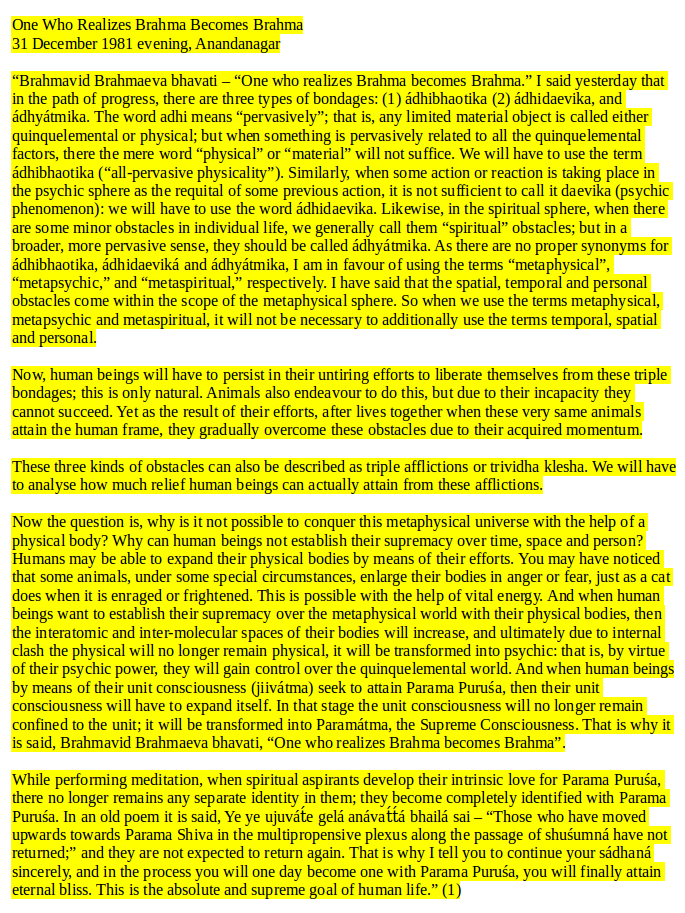
Here below is an example of a discourse published in A Few Problems Solved - 5, "One Who Realizes Brahma Becomes Brahma". (1) Bábá has given this discourse using all three languages: Bangla, Hindi, and English. Some sections Bábá spoke in Bangla, some in Hindi, and some in English. And what Baba spoke in those sections are not all the same. Each of those sections conveys unique ideas. To properly publish what Bábá has given in the discourse, it is essential to include all the material from all three languages. Short of that, the discourse will be incomplete.

Now please see for yourself, Bábá has spoken the following green para in English-- but you will not find it in the published discourse, shown below in yellow.

Bábá spoke, "When a man, when a spiritual aspirant is freed from these three types of pains, it is called ‘artham’. But, this type of liberation may or may not be of permanent nature. If it is of temporary nature, it is simply a nivrtti; that is, simply a liberation. Then, we say it is artham. And, when it is a liberation of permanent nature, emancipation of permanent nature, when it is not an ordinary emancipation, but a salvation of the zenith point of achievement, then it is called parama-artham, paramártha." (2)

Here below in yellow is the entire discourse as published by our Tiljala Publishers. In the below discourse, you will not find anywhere the above green sentences which Bábá spoke during the English segment of this very discourse. Please review the below yellow for yourself and see if you can find there the above green sentences (or even sentences expressing their meaning):


So the above yellow is the TP-published discourse, "One Who Realizes Brahma Becomes Brahma". In this entire printed discourse, the above green sentences spoken by Bábá during the discourse are not to be found. And the reason is that although the discourse was given by Bábá in three languages-- Bangla, Hindi, and English, but our Tiljala Publishers have only printed the Bangla sections. They discarded the English and Hindi sections.
https://anandamargauniversal.blogspot.com


Conclusion

This is our dharmic duty to protect our Guru's discourses. Please come forward to resolve this issue. What Guru spoke, is not reaching to you. Special interest groups are interposing themselves between you and your Guru. How long are you going to tolerate this ruination of your Guru’s teachings?

Namaskar,
Prakash
Peter Simmons

Police recover putrefied baby in the suitcase

It is like a thief who stole a box off a train. In the process of escaping with the box he was caught by the police. Upon their questioning he insisted it was his own box. The police proceeded to open the box and found the dead body of a murdered child. So now the thief has trapped himself in a murder. The police had asked him if the box was his, and he swore it was. Now he is trapped.

একটা চোর ৰাক্স চুরি করল চলা ত্রেন থেকে | পলাযনের সময পুলিসে ধোরা পড়ল | তাদের প্রশ্নের উত্তরে ৰোলল এই ৰাক্স তো আমার | পুলিশ ৰাক্সটা খুলে দেখল একটি খুন করা ছোট শিশুর লাশ ভিতোরে আছে | পুলিস ওকে জিজ্ঞাস করেছিল এই ৰাক্সটা কি তোমারে ? আরে ও ৰোলেছিল হ্যাঁ | এখন ও ফাঁদে পড়ল |

This is the situation of H group. With eyes closed, they are printing all the books of B group. When will they wake up, no one knows. But one thing is true. These people are taking upon themselves full responsibility for the mistakes of the B group Publishers by putting their own name on the same publications. In a way they are involving themselves in the same sin. Otherwise, why haven’t they or why don’t they transcribe the discourse from the original discourse and print it anew on their own?

Having claimed credit as the publisher, they are now getting caught red-handed as the creators of distortion-filled discourses.
https://anandamargauniversal.blogspot.com


References
1. Printed by Tiljala Publishers, "One Who Realizes Brahma Becomes Brahma", Electronic Edition 2009 and A Few Problems Solved, part 5.
2. As-Is version, "One Who Realizes Brahma Becomes Brahma," MGD 31 December 1980 Ananda Nagar.


*        *        *

The below sections are entirely different topics, unrelated to the above material.
They stand on their own as points of interest.

*        *        *

== Section 2: Prabhat Samgiita ==

We do not differentiate between high and low

"Tomákei bhálobási ámrá, tomár pathe cali tomár kathá boli..." (Prabhat Samgiita #3821)

Purport:

Parama Purusa, You are our everything, our Heart of hearts. We love only You. We are moving ceaselessly along Your effulgent path and treading on that very path which You have graciously shown to us. O' All-Pervading One, day and night we sing Your boundless glories and dance according to Your sweet rhythms. We always propagate Your grand ideals. You have created us: We are Your thought projection as well as Your progeny. Baba, You are our Father - Our Ista. We love only You.

Supreme Entity, we love one and all equally; everyone's existence is treasured. We do not differentiate between high and low, small and big, rich and poor, touchable and untouchable, sinner and virtuous, literate and illiterate etc. All are kith and kin - all are family members and part of that indivisible humanity. We are all bound together by Your immortal love. With Your infinite compassion, You always draw us near with Your beacon call, which pulls our heart close to You. We hear Your sound and move towards You. You are the Goal. Our each and every action and deed is aimed toward Your divine stance - toward reaching up to You. You are our Aim and the Polestar of our life.  

My Parama Purusa Baba, You have blessed us with the ideals of neo-humanism. First, You have granted us individual freedom; second, You have infused us with universal spirit; and third, You have spiritualised our minds with the dhyana of the Supreme One. With these three attributions one other quality unfolds: We wage a relentless fight against all the evils and sin. And by Your grace victory is sure. Baba, by these four noble qualities of neo-humanism - individual freedom, universal spirit, dhyana of the Omnipotent entity, and the fight against evil forces - we have created a potent, bitter medicine that cures all sorts of ailments like dogma, infighting, and narrow-mindedness. O' Ever gracious Entity, With this approach we have made this dusty earth into a golden paradise, by Your causeless blessing.

Baba, we all love only You; You are our Goal. O' our most Adored One...


Note about Prabhat Samgiita #3821

[1] "vyaśt́i...amara'r": In the third and final stanza of the above song, Ananda Marga philosophy presents 4 special principles that are part and parcel of our neo-humanistic philosophy: (a) individual freedom, (b) universal spirit, (c) dhyana of the Supreme Entity, (d) the fight against injustices and sin. All four are needed to create a golden paradise on this earth and build a society in the real sense of the term.

Spirituality is an essential aspect of neo-humanism. Without proper dhyana, individual freedom can be twisted to exploit the masses. Such is the case in capitalism since it is devoid of a spiritual approach. People just equate individual freedom with selfish pleasure and degrading activities. Communism does not allow for individual freedom nor does it recognise spirituality: Both are missing. For this reason, collective interest and a loving society could not be attained in communism. So it is more murderous than capitalism. Comparatively speaking, communists are worse than capitalists.

Then in the dogma-centered philosophy such as in the various religions, individual freedom and perfect spirituality are missing. The religions are ritualistic and dogma-based. There is no true feeling of universal love. That is why even followers of the same religion can kill each other - what to speak of harming members of other religions. History has witnessed this again and again. So the religious society is also defective.

Ananda Marga philosophy guides us that in an ideal society all 4 principles are needed: (a) individual freedom, (b) universal spirit, (c) dhyana of the Supreme Entity, and (d) the fight against injustices and sin. Failing that, this world cannot become a golden paradise. In the absence of any of these aforementioned principles, groupism and factionalism will erupt.

So our neo-humanistic approach is wholly revolutionary. In this God-centered approach, individual freedom is used for virtuous deeds which bring collective welfare, and all the while there is a pactless fight against all injustices. This is the speciality of our neo-humanism and this is the grand ideal that is being propagated in this above song.

In our present day AMPS, these qualities are missing: (a) individual freedom, (b) universal spirit, (c) dhyana of the Supreme Entity, and (d) the fight against injustices.


== Section 3: Links ==
Recent postings
Other topics of interest

SUBJECTS TOPICS