Baba
Namaskar,
Some margiis think the vegetarian diet is similar to Ananda Margii sattvika diet. Their thinking is not appropriate. One should know that in the vegetarian diet contains a number of the foods that are harmful.
For example:
(a) vegetarians eat onions, mushrooms, and garlic - all of which are támasika.
(b) vegetarians eat red lentils, white eggplant, leeks, scallions, violet carrots, and mustard leaves - all of which are támasika.
(c) vegetarians might take various intoxicating weeds such as marijuana, hashish, cacao, and other types of highly intoxicating herbs.
(d) alcohol (red wine and beer etc) also comes under the aegis of a vegetarian diet.
That's why vegetarian food is defective; so we must not sing the chorus of vegetarianism.
https://anandamargauniversal.blogspot.com
We should not gloat over vegetarianism
In Ananda Marga teachings, Sadguru Baba has divided food according to its effect on the mind. This is an important and subtle division. According to the Ananda Marga philosophy of food, there are three groups: sáttvika, rájasika, and támasika. Whereas in the general vegetarian food there is no such division. That's why it is flawed. Because all vegetable matter does not have an equal effect on the mind.
And human beings are mental beings: our existence is dominated by the mind. For example, if someone mocks you day in day out and tries to demean you, and then one day invites you for a feast on their birthday, you will not go. But in this very situation, dogs will go. So this is the difference. So we are mind-oriented beings and since food affects the mind we should only take those foods which benefit the mind, not harm it.
Yet the basic vegetarian diet contains many harmful elements and ingredients, as noted above. So we should not gloat over vegetarianism.
The overall idea is that one should not take food which is harmful to the mind. That is, one should not consume támasika food. Ananda Margiis are sentient not just vegetarians.
https://anandamargauniversal.blogspot.com
Really great?
Unfortunately, these below images were propagated by a few margiis on social media with high regard and extreme reverence that these famous people were vegetarian.
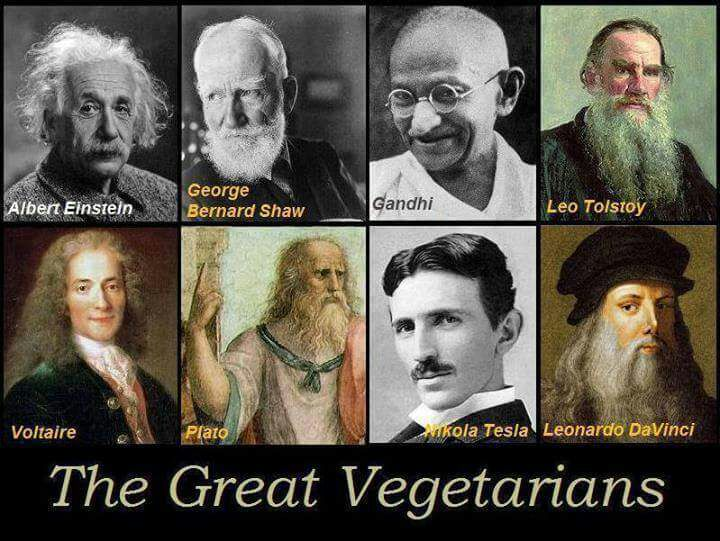
There is no doubt that vegetarianism is one step ahead of today’s materialistic standard, beyond garbage i.e. meat, fish, and eggs. But in vegetarianism there is nothing to gloat about. It is full of negative substances such as onion, garlic, mushrooms, white brinjal, red lentils, and so many other things like red puin, snake gourd, and colombi grass. And the most harmful items are marijuana, cocoa, alcohol, opium, and other intoxicants. Yet these all come within the purview of a vegetarian diet. So if someone says he is vegetarian, it is still possible that he is consuming all the above mentioned garbage.
https://anandamargauniversal.blogspot.com
Conclusion
The slogan of Ananda Marga is that human beings are mind dominated. Due to that, sentient food is the only food for human consumption. Ananda Margiis should not sing the glories of vegetarianism. Rather we should sing the glories of a sentient diet.
Namaskar,
Prema Kumar
(Peter Gruber)
~ In-depth study ~
Onion came from decomposed beef
Ananda Marga philosophy states, “By gradual transformation their mind-stuff reaches a stage where they cannot be called human beings. Who can say that the fire-burnt cane has been transformed into the plantain tree, and the decomposed beef has been transformed into onion through natural changes, and that the rice-water has produced tańd́uleraka leaves? Likewise, no one will be able to recognize you as a human being in your degenerated condition.” (1)
Sentient diet, sentient mind
Ananda Marga philosophy states:
References
1. Subhasita Samgraha - 1, Spiritual Practice and the Cosmic Science (Sádhaná and Madhuvidyá)
2. Yoga Psychology, Food, Cells, Physical and Mental Development
Frail mind Wts
Namaskar,
Whatever may be the reason, but there are many Wts who have captured a significant post in AMPS, yet they have a very weak mind. And this is due to neglect of sadhana. Here is further evidence of this: In reportings, RDS, and IRSS meetings etc, these Wts argue on meaningless points, and in knee-jerk reaction yell, threaten, verbally abuse, and even worse; they may try to physically attack their subordinates. And while doing so, their face becomes red, their hands tremble, and their blood pressure goes up, and from their mouth spews extremely dirty language.
This type of scene is not hidden in their inner chamber only. Near Ananda Marga jagritis where non-Margiis are living, they know very well. Because they see and hear this type of filth often. This is unfortunate, but it is happening. And the reason is, lack of sadhana. You can also see practically; put some cameras around your nearby Ananda Marga jagrti.
Conclusion
Those who are weak cannot control their organs. Whatever emotion arises gets executed by the organs, and later on that person repents when they reflect on and analyse the situation. With respect to ideal sadhakas, their organs are controlled by their mind. When the mind approves, their organs will act, otherwise not.
Namaskar,
In Him
Anandasagar
Baba says, "यह बात सोचनी है कि---"जितना जो कुछ भी word मेरे मुँह से निकल रहा है, वह परमपुरुष का मन्त्र है |" तब क्या होगा ? मनुष्य कुभाषा से मुँह को अपवित्र नहीं करेंगे, शरमाएँगे | मुँह से गाली निकालना उनके लिए सम्भव नहीं होगा | इसलिए मैंने कहा कि....गाली मत दो | उससे तुम्हारा मुँह अपवित्र हो जाएगा |" ["मन पर नियन्त्रण कैसे", V28-04, V32-05, V24-09, GD 3 January, 1971 Patna]
Recent postings
Other topics of interest
Vegetarianism not so great?
Namaskar,
Some margiis think the vegetarian diet is similar to Ananda Margii sattvika diet. Their thinking is not appropriate. One should know that in the vegetarian diet contains a number of the foods that are harmful.
For example:
(a) vegetarians eat onions, mushrooms, and garlic - all of which are támasika.
(b) vegetarians eat red lentils, white eggplant, leeks, scallions, violet carrots, and mustard leaves - all of which are támasika.
(c) vegetarians might take various intoxicating weeds such as marijuana, hashish, cacao, and other types of highly intoxicating herbs.
(d) alcohol (red wine and beer etc) also comes under the aegis of a vegetarian diet.
That's why vegetarian food is defective; so we must not sing the chorus of vegetarianism.
https://anandamargauniversal.blogspot.com
We should not gloat over vegetarianism
In Ananda Marga teachings, Sadguru Baba has divided food according to its effect on the mind. This is an important and subtle division. According to the Ananda Marga philosophy of food, there are three groups: sáttvika, rájasika, and támasika. Whereas in the general vegetarian food there is no such division. That's why it is flawed. Because all vegetable matter does not have an equal effect on the mind.
And human beings are mental beings: our existence is dominated by the mind. For example, if someone mocks you day in day out and tries to demean you, and then one day invites you for a feast on their birthday, you will not go. But in this very situation, dogs will go. So this is the difference. So we are mind-oriented beings and since food affects the mind we should only take those foods which benefit the mind, not harm it.
Yet the basic vegetarian diet contains many harmful elements and ingredients, as noted above. So we should not gloat over vegetarianism.
The overall idea is that one should not take food which is harmful to the mind. That is, one should not consume támasika food. Ananda Margiis are sentient not just vegetarians.
https://anandamargauniversal.blogspot.com
Really great?
Unfortunately, these below images were propagated by a few margiis on social media with high regard and extreme reverence that these famous people were vegetarian.
There is no doubt that vegetarianism is one step ahead of today’s materialistic standard, beyond garbage i.e. meat, fish, and eggs. But in vegetarianism there is nothing to gloat about. It is full of negative substances such as onion, garlic, mushrooms, white brinjal, red lentils, and so many other things like red puin, snake gourd, and colombi grass. And the most harmful items are marijuana, cocoa, alcohol, opium, and other intoxicants. Yet these all come within the purview of a vegetarian diet. So if someone says he is vegetarian, it is still possible that he is consuming all the above mentioned garbage.
https://anandamargauniversal.blogspot.com
Conclusion
The slogan of Ananda Marga is that human beings are mind dominated. Due to that, sentient food is the only food for human consumption. Ananda Margiis should not sing the glories of vegetarianism. Rather we should sing the glories of a sentient diet.
Namaskar,
Prema Kumar
(Peter Gruber)
~ In-depth study ~
Onion came from decomposed beef
Ananda Marga philosophy states, “By gradual transformation their mind-stuff reaches a stage where they cannot be called human beings. Who can say that the fire-burnt cane has been transformed into the plantain tree, and the decomposed beef has been transformed into onion through natural changes, and that the rice-water has produced tańd́uleraka leaves? Likewise, no one will be able to recognize you as a human being in your degenerated condition.” (1)
Sentient diet, sentient mind
Ananda Marga philosophy states:
Sincere spiritual aspirants must follow the dictum: Áhárashuddhao sattvashudhih [“A sentient diet produces a sentient body”]. Only food which is helpful in keeping the body and mind sentient should be eaten.
Every object of the world is dominated by one of the three principles – sentient, mutative, and static. Food is no exception, and according to its intrinsic nature, is divided into the same three categories.
Sentient food: Food which produces sentient cells and is thus conducive to physical and mental well-being is sentient. Examples of sentient food are rice, wheat, barley, all kinds of pulses, fruit, milk and milk products.
Mutative food: Food which is good for the body and may or may not be good for the mind, but certainly not harmful for the mind, is mutative.
Static food: Food which is harmful for the mind and may or may not be good for the body is static. Onion, garlic, wine, stale and rotten food, meat of large animals such as cows and buffaloes, fish, eggs, etc., are static.
Very often people eat food without knowing its intrinsic qualities. For example, the milk of a cow which has just given birth. Or white eggplant, khesárii pulse [horse gram], red puni [Basella rubra Linn.], or mustard leaves, all of which often grew out of rotten matter.
In order to have a balanced mind and to progress spiritually, human beings will have to pay attention to the qualities of the food they eat. The idea that “I will just do my sádhaná and eat any food, proper or improper” will not do. (2)
References
1. Subhasita Samgraha - 1, Spiritual Practice and the Cosmic Science (Sádhaná and Madhuvidyá)
2. Yoga Psychology, Food, Cells, Physical and Mental Development
* * *
The below sections are entirely different topics, unrelated to the above material.
They stands on their own as points of interest.
* * *
== Section 2: Important Teaching ==
The below sections are entirely different topics, unrelated to the above material.
They stands on their own as points of interest.
* * *
== Section 2: Important Teaching ==
Frail mind Wts
Namaskar,
Whatever may be the reason, but there are many Wts who have captured a significant post in AMPS, yet they have a very weak mind. And this is due to neglect of sadhana. Here is further evidence of this: In reportings, RDS, and IRSS meetings etc, these Wts argue on meaningless points, and in knee-jerk reaction yell, threaten, verbally abuse, and even worse; they may try to physically attack their subordinates. And while doing so, their face becomes red, their hands tremble, and their blood pressure goes up, and from their mouth spews extremely dirty language.
This type of scene is not hidden in their inner chamber only. Near Ananda Marga jagritis where non-Margiis are living, they know very well. Because they see and hear this type of filth often. This is unfortunate, but it is happening. And the reason is, lack of sadhana. You can also see practically; put some cameras around your nearby Ananda Marga jagrti.
Conclusion
Those who are weak cannot control their organs. Whatever emotion arises gets executed by the organs, and later on that person repents when they reflect on and analyse the situation. With respect to ideal sadhakas, their organs are controlled by their mind. When the mind approves, their organs will act, otherwise not.
Namaskar,
In Him
Anandasagar
Baba says, "यह बात सोचनी है कि---"जितना जो कुछ भी word मेरे मुँह से निकल रहा है, वह परमपुरुष का मन्त्र है |" तब क्या होगा ? मनुष्य कुभाषा से मुँह को अपवित्र नहीं करेंगे, शरमाएँगे | मुँह से गाली निकालना उनके लिए सम्भव नहीं होगा | इसलिए मैंने कहा कि....गाली मत दो | उससे तुम्हारा मुँह अपवित्र हो जाएगा |" ["मन पर नियन्त्रण कैसे", V28-04, V32-05, V24-09, GD 3 January, 1971 Patna]
== Section 3: Links ==
Recent postings
Other topics of interest

