Baba
Blessing mudras
Namaskar,
Human beings have been seeking a’nandam since their creation. Over the ages, so many rishis and munis have intuitively received various guidelines from Parama Purusa in their meditation. However, perfect knowledge only comes to humans when Parama Purusa comes in the form of Mahasambhuti and guides humanity. So we are fortunate that we have Baba’s teachings to move on the path of divinity. And, He has blessed us with two mudras – varabhaya mudra and janusparasha mudra – by which to meditate. And both have their special utility and value and propel humans along the path of bliss.
https://anandamargauniversal.blogspot.com/
Two special mudras
Indeed, it is Baba’s great blessing that He has graciously given two mudras for doing dhyana. And both have their special quality and margiis can use either one. The two mudras referred to here are: varabhaya mudra and janusparsha mudra. Those doing sahaja yoga – the standard six lessons of Ananda Marga sadhana – use varabhaya mudra when doing dhyana. 'Vara' means 'blessing', and 'abhaya' means 'fearlessness' - the blessing of fearlessness.
And those people who are suited to sadharana yoga, according to Baba’s recommended guidelines, will do their dhyana using janusparsha mudra. Specifically, ‘janu’ means ‘knee’ and ‘sparsh’ means ‘touch’. As we know, both these mudras are infused with Baba’s special grace and blessing. Yet from a practitioner’s standpoint, for some it is comparatively easier to visualize janusparsha mudra than varabhaya mudra. And for others, varabhaya mudra is more appropriate.
If any person is not adjusted well with sahaja yoga – for reasons such as age, busyness of schedule, or physical handicap etc, or if sahaja yoga is temporarily beyond their reach – then they can ask their acarya for sadharana yoga, in which case they will do dhyana using janusparsha mudra.
Ananda Marga philosophy states, "Sádhárańa Yoga: It is meant for all. Those having some more time at their disposal and having glandular defects shall learn Sahaja Yoga. Those affording still more time can take training in Visheśa Yoga." (1)
An excellent transition point
It is important to know however that in certain cases the various practices of sadharana yoga serve as a great transition point for transforming non-margiis into margiis. For example, in Baba’s system, if at the time of initiation one is overly busy in their job, or if they do not have a place to live, or if they are quite sick etc, then one can begin with sadharana yoga.
https://anandamargauniversal.blogspot.com/
In this materialistic era where scores of people are not habituated to a spiritual way of living, then it is only practical to think that many will first need the ways of sadharana yoga – in which case they can do their dhyana using janusparsha mudra. It is the standard system for the acarya to review the background of each of their diiksa bhaiis (initiated persons) and decide which system of meditation is best for them. That is the duty of the acarya.
Conclusion
The spiritual meaning of both these mudras is highly significant in the individual life of every sadhaka and also in every aspect of collective life. By this way people progress, by His grace.
https://anandamargauniversal.blogspot.com/
Ananda Marga Caryacarya states, “Utilizing the vibrations created for eternal time by Shrii Shrii Anandamurtiji through januspharsha and varabhaya mudras, take yourself and the entire universe ahead along the path of welfare. Omn Shanti!” (2)
Namaskar,
at His lotus feet,
Ananda
Society is diverse
Animals come on this earth and are bound in their base propensities, just driven by instinct and the laws of nature. Beyond that they cannot do anything. Humans have come for something more, for something infinite: To get a’nandam, bliss. Without feeling drenched in that eternal bliss, human beings will never be satisfied. And that bliss cannot be gotten without attaining Parama Purusa – without getting Him. So in essence, knowingly or unknowingly, everyone wants Him; because all want bliss, or a’nandam.
We live in a colourful world: There are so many different types of people, each with their unique set of samskaras, each with their own mental make-up. Baba has given something for all: Na’ma mantra, sadharana yoga, sahaja yoga, kapalik sadhana, and vishesh yoga etc. Which one is higher and which one is lower, that is insignificant. Because all the lessons are important and success depends upon which sadhana is most suited to a particular individual, and Guru’s grace.
https://anandamargauniversal.blogspot.com/
We should always keep in mind that even with na’ma mantra meditation one can get the highest realisation, if earnestly practiced with bhakti and sincerity. The overarching idea is that we can expect innumerable types of people – of various mental standards – to approach Ananda Marga. Many of whom may be unable to follow 16 Points due to their own physical shortcomings, or life circumstances. Yet in each and every case, Baba has given a level of practice specially suited for them.
Various levels of Ananda Marga practices
As noted, there are various levels of our Ananda Marga yoga / sadhana system: There is na’ma mantra meditation, sadharana yoga sadhana, sahaja yoga, kapalik sadhana, and vishesha yoga, madhur sadhana etc. So when any new person approaches Ananda Marga, we are to evaluate and see which level of practice is most appropriate for them.
For instance, if a new person comes to us who is particularly obese and long-habituated to eating meat etc, then we are to guide that person towards sadharana yoga. Because they cannot do difficult asanas – or any asanas – and their body is not ready to follow 16 Points in full. In that case then, according to Baba’s system, they are to receive sadharana yoga meditation and start doing dharma sadhana. Sadharana yoga does not offer all the six lessons which comprise sahaja yoga, but rather offers specific lessons that are suitable to the practitioner.
In His guidelines to acaryas, Baba clearly outlines who shall receive sadharana yoga meditation: Aged or elderly persons, diseased persons, physically handicapped individuals, those with no place or time to do sadhana, those who work 24 / 7 in their job or service, those recommended by Baba for sadharana yoga. So if one is eating meat and cannot sit in padmasana or siddhasana or for any of the above reasons, then sadharana yoga is the perfect way for them to begin.
https://anandamargauniversal.blogspot.com/
And certainly – as that new person becomes more suited to a sentient way of living – we can prepare them for entry into the more involved practices of sahaja yoga, such as when their situation changes or when they regain their health etc. Here the point is that regardless of anyone’s background, Sadguru Baba has given a way for each and every person to enter into the tantric cult of Ananda Marga sadhana.
~ In-depth study ~
Microvita are radiated through these two mudrás
Ananda Marga philosophy states, "Suppose the Sadguru is saying something, and the deaf or dumb man wants to hear it but cannot. If one concentrates the mind on varábhaya mudrá, there will be the direct effect of positive microvita on the auricular or other nerve cells and also on the controlling cells, and it may be that all of a sudden he may get back the power of hearing. One should look towards these two mudrás and not to anything else. Microvita are radiated through these two mudrás. This is the inner secret."
Ananda Marga philosophy states, "This is supernatural, but not illogical. Certainly it is supernatural because it does not come within the scope of natural phenomena." (3)
Mudra used in Gurusakásha
And varabhaya mudra is an essential element of our daily practice of Guru sakash.
Another use of varabhaya mudra: Curing disease
When sadhakas are suffering from various kinds of diseases they are unable to do social service etc. And proper meditation has a distinct effect on one’s health. Just as eating sentient food positively affects your entire personality and helps keep the body healthy, similarly meditation helps in curing certain diseases. And when the disease is cured and the body is healthy one will be able to serve the society in a better way.
https://anandamargauniversal.blogspot.com/
Ananda Marga philosophy states, "If a person contracts a disease caused by negative microvita after initiation, does dhyána perfectly and follows certain food restrictions, the disease will be completely cured. Dhyána attracts many positive microvita. Negative microvita can only be controlled by positive microvita. The positive microvita eat the negative microvita and this is the reason why the disease is cured. For example, if a person is suffering from jaundice, a disease caused by negative microvita, and if dhyána is practised perfectly, the disease will be cured very quickly. In the case of cancer, say stomach cancer, certain food restrictions will have to be strictly followed. When pain starts in the stomach one should sit for dhyána, but just prior to this one should take some juice from a sweet tasting, not a sour tasting fruit. After performing dhyána, one should take another drink which is different from the first drink. The patient should also avoid any food which causes gas in the stomach, such as pappad, cauliflower, cabbage, turnip, etc." (4)
Ananda Marga philosophy states,"If a person contracts a disease caused by negative microvita before initiation and does dhyána sincerely after initiation, the disease will not spread but be contained. However, for different types of diseases one has to follow different food restrictions and practice dhyána at specific times." (5)
References
1. Táttvika Diipiká (Paiṋcama Parva)
2. Caryacarya – 1, ‘Concluding Words’
3. Questions and Answers on Microvita – Excerpt D
4. Questions and Answers on Microvita – Excerpt C
5. Questions and Answers on Microvita – Excerpt C
* * *
The below sections are entirely different topics, unrelated to the above material.
They stand on their own as points of interest.
* * *
== Section 2: Prabhat Samgiita ==
Your august presence
Note: Only those bhaktas who have a deep feeling of bhakti in their heart can understand this song in the depths of their core.
"Tumi esecho man je keŕe cho, bhuláye diyecho shatek jválá..." (Prabhat Samgiita #0200)
Purport:
My Parama Purusa, Baba, You have come to me, and by seeing Your unending charm I am so much captivated. My mind is no longer my own. You have stolen it as I cannot think of anything other than You. You made me forget countless burning pains and all sorts of suffering and trauma which I had undergone. Now I am floating in Your infinite bliss. All the 24 hours, in the panorama of ideation, varieties of loving thoughts and feelings about Your various liilas float in my mind. In the flow of Your conation, day and night, with heavenly melody You have woven a garland of songs.
Baba, due to Your august presence and spiritual touch, the flaming fire of the meteor and lightning have turned into cool, fragrant sandalwood paste. My life was like a burning desert. The thirst that I had due to the extreme heat has been satiated. It has lost its way under Your cool green shade. Who knows where it has gone - disappeared forever. It was Your exquisite mercy. Today all my suffering and torments turned into a basket of flower bouquets and garlands. It is Your grace. You are bliss personified. You transform my life from severe suffering to unending joy.
Now quietly looking within, and meditating and thinking / contemplating about You, this much I understood and accepted that You love me wholeheartedly. Your care has no parallel. Nobody has bestowed such compassion on me as You have…
Note: Only those bhaktas who have a deep feeling of bhakti in their heart can understand this song in the depths of their core.
"Tumi esecho man je keŕe cho, bhuláye diyecho shatek jválá..." (Prabhat Samgiita #0200)
Purport:
My Parama Purusa, Baba, You have come to me, and by seeing Your unending charm I am so much captivated. My mind is no longer my own. You have stolen it as I cannot think of anything other than You. You made me forget countless burning pains and all sorts of suffering and trauma which I had undergone. Now I am floating in Your infinite bliss. All the 24 hours, in the panorama of ideation, varieties of loving thoughts and feelings about Your various liilas float in my mind. In the flow of Your conation, day and night, with heavenly melody You have woven a garland of songs.
Baba, due to Your august presence and spiritual touch, the flaming fire of the meteor and lightning have turned into cool, fragrant sandalwood paste. My life was like a burning desert. The thirst that I had due to the extreme heat has been satiated. It has lost its way under Your cool green shade. Who knows where it has gone - disappeared forever. It was Your exquisite mercy. Today all my suffering and torments turned into a basket of flower bouquets and garlands. It is Your grace. You are bliss personified. You transform my life from severe suffering to unending joy.
Now quietly looking within, and meditating and thinking / contemplating about You, this much I understood and accepted that You love me wholeheartedly. Your care has no parallel. Nobody has bestowed such compassion on me as You have…
== Section 2: Important Teaching ==
Very unhealthy competition
Namaskar,
Ananda Marga ideology says, “You know there are different divisions in propensities." (1)
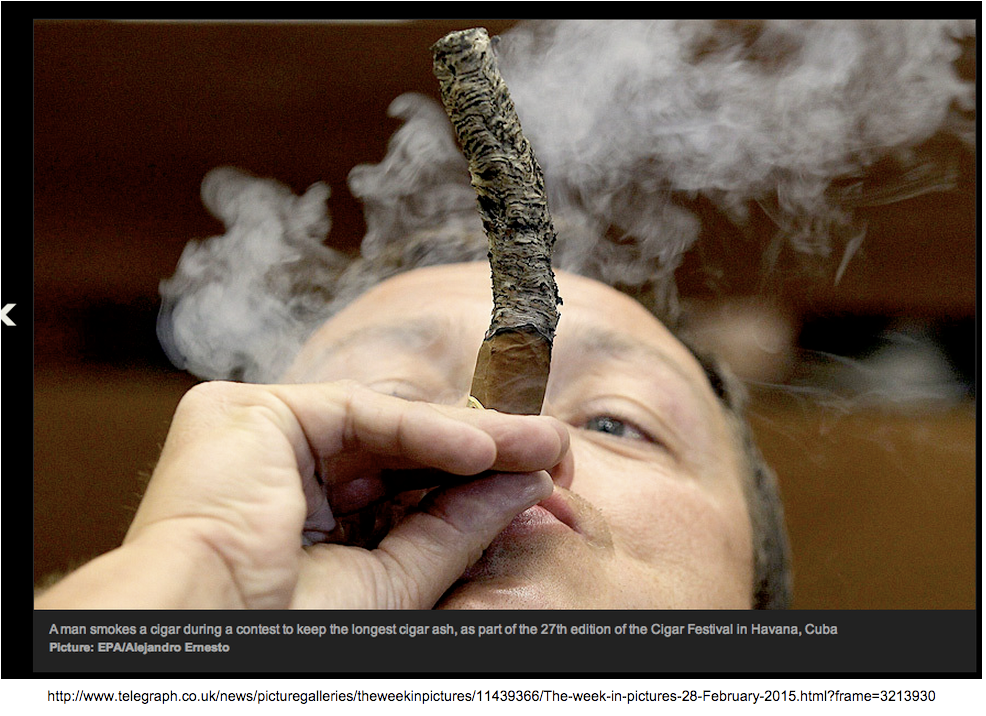
Above, a cigar ash competition is going on. For more on this, please see note 1.
Humans beings have so many propensities (i.e. mental occupations)—up to 1000 vrttis. And these can be broadly divided into four categories.
http://anandamargauniversal.blogspot.com/
Suffering is in the beginning and also in the end
#1 Kliśt́á vrtti (beginning suffering, end suffering): Those who choose to move on the path of kliśt́á vrtti engage in endeavours which are uncomfortable and painful from the very beginning up to the very end, and the end result is also bad.
Ananda Marga ideology says, “The propensities that become the cause of pain in the beginning and also in the end are called Kliśt́á. Suppose, for instance, someone is travelling without a ticket. There is a heavy rush in the train. Naturally he will have to undergo suffering and inconvenience. If the checking staff come, another misery befalls. So here the pain is in the beginning and also in the end. This action of his is Kliśt́á-vrtti.” (1)
Some squish themselves and battle the crowds to visit a holy land and then get trampled to death in a stampede. Likewise, suppose a thief was undergoing hardship walking in a hailstorm and then got arrested by the police. In both of these instances the beginning and end is bad—problematic. So these are related with kliśt́á vrtti.
Happy in beginning but suffering in end
#2 Akliśt́á Kliśt́á vrtti (beginning pleasure, end suffering): Those who choose to move on the path of akliśt́á kliśt́á vrtti, engage in actions which start out as pleasant and joyful, but yield very bad results. There are many activities and works that fall in this category.
For example, if one is eating rasagolla (sweets) in their house but then later on they suffer from constipation, gas, and bloating. That act started out as enjoyable but concluded as something painful. Also smoking and drinking etc come in this category. So these are related with akliśt́á kliśt́á vrtti.
http://anandamargauniversal.blogspot.com/
Same is the case with those who enjoy dancing and partying all night, and then have to suffer the ill effects of fatigue and nausea the next day. So these are related with akliśt́á kliśt́á vrtti.
Suffering in beginning but happy in end
#3 Kliśt́á Akliśt́á vrtti (beginning suffering, end pleasure): Those who choose to move on the path of kliśt́á akliśt́á vrtti, engage in actions which start out as uncomfortable or painful, but yield very positive and beneficial results.
For instance, eating bitter foods like neem leaves may not be a pleasant experience but the overall effect is very good as the blood, gums, liver, and kidneys are greatly benefited. Similarly, studying hard for an examination is not easy and may likely involve discomfort and even suffering. But in the end, getting success in the exam is a very positive outcome. So these are related with kliśt́á akliśt́á vrtti.
Happy in beginning & bliss in end
#4 Akliśt́á vrtti (beginning pleasure, end pleasure): Those who choose to move on the path of akliśt́á vrtti engage in actions which are blissful right from the start, and yield blissful results. Which endeavour is like that? Sadhana or intuitional practice. Sadhana with bhakti is very soothing and filled with anandam. It starts blissfully, continues blissfully, and concludes blissfully; and the final outcome is also blissful. So these are related with akliśt́á vrtti.
http://anandamargauniversal.blogspot.com/
Most often, human beings involve in such types of works and hobbies which fall in the first three groups. And due to this they suffer a lot of pain in their life. But those who are fortunate utilize their human potentiality to pursue dharmic engagements that fall in this fourth category. They learn sadhana, practice it, and see everything as Brahma. By that way, they always do good things and make their lives happy through spiritual practice. If worldly works are done while ensconced in brahmacarya, then that makes even worldly works blissful. But the main thing is to keep a sadhana oriented life—that is the best utilization.
Conclusion
For Parama Purusa everything is blissful beginning to end. Humans have all four of these types of vrttis or mental occupations. But Parama Purusa only has one. For Him everything is blissful from beginning to end. If one does sadhana, that comes in the category of aklista vrtti because the beginning, middle and end—everything is blissful. By doing sadhana life becomes full of anandam.
In Him,
Dharmadeva
Note 1: About the above photo
The person in the above photo falls in the first category—kliśt́á. That man chose to involve in a cigar smoking competition. A contestant participates in the longest ash competition during the annual cigar festival in Havana, so he is forced to inhale a lot of smoke. Due to the pressure of this competition, contestants push the limits. This man is uncomfortable smoking that cigar, but he is doing it in hopes of getting victory. The goal is to generate the longest ash in the shortest time, without letting the ash break and fall down. But the end result of such a competition is lung cancer. So that activity is problematic from beginning to end. This is the worst category. So many human engagements fall in this category, unfortunately.
http://anandamargauniversal.blogspot.com/
Those who misuse their bodies in the actions of categories 1-3, they directly degenerate to animal life after their demise. No one should misuse their body by work which is illustrated in these first three categories.
Reference
1. Subhasita Samgraha - 19, Salvation and Devotion
== Section: Important Teaching ==
Insight into dreams
Ananda Marga philosophy states, “I said a little while ago that dreaming means thinking or recollecting during sleep. Now the first question that arises is this: Why do people not always think or recollect during sleep? During the wakeful state, people are always thinking or recollecting. Even when people meditate in the wakeful state, they are thinking of, or recollecting, Supreme Consciousness. In the waking state, the mind never remains inactive. Then why does it not always dream during sleep? The answer is, the sleeping state means a state of rest for the mind. But if, before or at the time of sleep, one is tormented with deep sorrow, or becomes overjoyed with extreme happiness, or is afflicted with a serious disease, or is brooding over imaginary pains and pleasures – then during sleep if the gases in the body rise and create vibrations in the nerve cells, one starts thinking and recollecting. That is why people do not always dream during every sleep. (1)
Reference
1. Namah Shiváya Shántáya, Disc: 16
== Section: Important Teaching ==
Surgery is an ancient practice
Ananda Marga philosophy says, "There is a very interesting example of surgery. The cousin of Krsna (the son of the sister of Lord Krsna's father) was Jarasandha, the king of Magadha, with his capital at Rajgir. At the time of the birth of Jarasandha, the child bad to be cut out of the womb. People saw this child and threw it in the cremation ground. Then there came a very famous non-Aryan (raksasii) lady doctor known as Jara. She stitched the child in a proper surgical operation and saved it. Since the lady Jara joined (sandhi) the pieces of the child's body, the name of the child became Jarasandha. This proves that the people were well acquainted with surgery." (1)
Reference
1. Discourses of the Mahabharata, The Medical Science of the Age
== Section: Ananda Vanii ==
To please Parama Puruśa the real devotion
Original Ananda Vanii states: "Knowing oneself is the real knowledge; serving all with the ideation of Náráyańa, the real action, and the vow to please Parama Puruśa the real devotion." (Ananda Vanii #25)
Note: Sadguru Baba has assigned a number to all His original and true Ananda Vaniis. In contrast, Fake Ananda Vaniis do not have any number. By this simple formula, one can easily recognise which is a true Ananda Vanii and which is fake. For the upcoming occasion of January 1st 2017, all Ananda Marga units should use one of Baba’s original and true Ananda Vaniis, not a fake one. By this way, one will surely get His blessing.
== Section 3: Links ==
Festival - Niilkantha Divas - 12 Feb 2024
Recent postings
Other topics of interest

