Baba
Origin story for children
Namaskar,This is a vital topic: How to teach our margii children and other young ones about our Ananda Marga theory of creation - i.e. how this grand universe has come into existence. At some point, invariably questions arise in the minds of our youths - in the minds of our children: They wonder, 'who am I', 'where have I come from', 'what is this universe' etc. And our Ananda Marga creation theory answers all these doubts and queries in a very comprehensive and compelling way.
https://anandamargauniversal.blogspot.com/
They have come from the hospital?
The question arises: When and how should we guide our children about our Ananda Marga creation theory. Should we wait until our children reach a certain age when they can understand philosophy, grasp abstruse concepts of "Idea & Ideology", and comprehend challenging topics like jadasphota, shambhuliunga, sadrsha parin'a'ma etc? Otherwise, when and how should we approach this topic with our kids.
After all, this is an everyday reality for most of us: What is the best way to guide our children. Inevitably, either on the home-front, in school, or on the internet, this important topic of creation will be raised. And if we do not give a reply - or if our reply is not satisfactory to their ears - then our children will get the 'lesson' elsewhere. If we don't teach our children from where they have come, then they are bound to learn from the general society that human beings are just bones, flesh, and blood - nothing more. They have come from the hospital.
https://anandamargauniversal.blogspot.com/
Existence starts from ova & spermatozoa?
Commonly in materialism, people view life in a very mundane way where they think that existence starts from the ova and spermatozoa. But this is just a very superficial approach. We know that according to Ananda Marga philosophy each life is a part-life of a greater series of lives wherein the very source is Parama Purusa. We have all come from Him - that same Divine source - and we are all returning unto Him. So our connection is far deeper than how materialists view the world.
The existence of the human body starts from the ova and spermatozoa but not the human mind. And the human mind is the main thing of the human personality. Before they reach puberty, kids do not like logic and reasoning; they enjoy grand stories and imaginative tales. Every parent and educator must keep this in mind when sharing the theory of creation with young kids.
https://anandamargauniversal.blogspot.com/
The content of this letter is based on Baba's original Hindi discourse delivered in one general darshan in Patna (1965) where He explained Ananda Marga creation theory in a very easy-to-understand language.
Story starts here
The following is based on Sadguru’s special guideline from His Patna discourse (Ananda Vacanamrtam (Pure) part 36, Hindi Edn, chapter 7, Cause of Creation).
In
the very beginning, Parama Purusa was all alone. There was no one with
whom He could play. He was not surrounded by anything or anyone. There
was darkness all around; indeed the absence of anything means there was
just a vast dark void emanating in all directions from the nucleus of
His mind. According to Ananda Marga philosophy, black means no colour,
i.e. the complete absence of any colour.
When we are completely isolated and have no company, no playmates, and no one to talk to, and are all alone in the house, then we will become very, very lonely. Such was the condition of Parama Purusa. To remove that loneliness, He decided to create something - someone - with whom He could love and play.
It is just like if there are children in the house, then that household becomes colourful and vibrant. Those children will laugh and they will cry; they will sing and they will dance. And sometimes a child also comes with a problem or needs help in some way; and, on other occasions a young one cries out loudly and says, “Dad, I want this, or Mom I need that.”
https://anandamargauniversal.blogspot.com/
Having children brings warmth, joy, and, most importantly, it transforms life itself into an intimate family experience where there is lots of sharing, caring, and companionship. In which case, one will no longer be alone or feel lonely.
In the very beginning, Parama Purusa was all alone. There was no one with whom He could play. To break the monotony, Parama Purusa had to create something - someone with whom to play. But to create anything, materials are needed. It is just like if anyone wants to make some toys, then some material is needed such as clay, plastic, rubber, wood - something is needed from which to make those toys.
Similarly, Parama Purusa needed something with which to make His creation; some ingredients were needed to make something - to make one universe. Yet there was nothing around - only there was Parama Purusa and nothing else. Besides Him, there was no one; He was all alone. Then how could He create anything? Besides Him, there was nothing. So then what to do?
In that case, He had to use part of His own mind. To create something, Parama Purusa kept away some portion of His own mind from His nucleus: He put that portion of His mind away at a distance. Without putting away part of His mind, material could not be created.
When we are completely isolated and have no company, no playmates, and no one to talk to, and are all alone in the house, then we will become very, very lonely. Such was the condition of Parama Purusa. To remove that loneliness, He decided to create something - someone - with whom He could love and play.
It is just like if there are children in the house, then that household becomes colourful and vibrant. Those children will laugh and they will cry; they will sing and they will dance. And sometimes a child also comes with a problem or needs help in some way; and, on other occasions a young one cries out loudly and says, “Dad, I want this, or Mom I need that.”
https://anandamargauniversal.blogspot.com/
Having children brings warmth, joy, and, most importantly, it transforms life itself into an intimate family experience where there is lots of sharing, caring, and companionship. In which case, one will no longer be alone or feel lonely.
In the very beginning, Parama Purusa was all alone. There was no one with whom He could play. To break the monotony, Parama Purusa had to create something - someone with whom to play. But to create anything, materials are needed. It is just like if anyone wants to make some toys, then some material is needed such as clay, plastic, rubber, wood - something is needed from which to make those toys.
Similarly, Parama Purusa needed something with which to make His creation; some ingredients were needed to make something - to make one universe. Yet there was nothing around - only there was Parama Purusa and nothing else. Besides Him, there was no one; He was all alone. Then how could He create anything? Besides Him, there was nothing. So then what to do?
In that case, He had to use part of His own mind. To create something, Parama Purusa kept away some portion of His own mind from His nucleus: He put that portion of His mind away at a distance. Without putting away part of His mind, material could not be created.
The above is based on Sadguru’s special guideline from His Patna discourse (Ananda Vacanamrtam (Pure) part 36, Hindi Edn, chapter 7, Cause of Creation).
Story of srsti: create various tattvas
One might then ask, 'Why did He have to put part of His mind away?' 'Why did He have to set it aside.’ 'What was the need to do that?' The answer is that if He did not put some portion of His mind away from His nucleus, then it could not have become made into material - it would just remain unexpressed as pure consciousness. Yet some type of material was needed in order to create something tangible with which He could play.
https://anandamargauniversal.blogspot.com/
For this reason Parama Purusa had to set aside some part of His mind away from His nucleus. Otherwise, it would be impossible to make any toys - jiivas and inanimate objects etc - i.e. any of the creation. So He put aside part of His mind away from His nucleus,and it was transformed into material: The specialty of this process is that the further away Parama Purusa put away His mind from His nucleus, the more dense it became.
Accordingly, that portion of His mind that He placed just a short distance away from His nucleus was comparatively less dense, and it became the ethereal factor. And that part of His mind that was put a little further away from His nucleus was more dense so it became the aerial factor. And that portion of His mind that was even further away became the luminous factor - as it was more dense. And when He put His mind still further away it became more dense and was the liquid factor. Until finally He put some portion of His mind very far away from His nucleus, and that became the solid factor. And this is the most dense factor - the reason being that it is furthest away from Parama Purusa. And this entire process of making material is known as: saincara.
So His process of saincara is the process of making the material. And in this process of saincara, He creates the painca bhutas, or 5 fundamental factors: ethereal, aerial, luminous, liquid, and solid. And why does He do this? Why did He embark on this process of saincara? To prepare material to create His toys, i.e. living and non-living beings.
Pratisaincara: living beings to play with
After so many inanimate objects were created by placing some part of His mind away from His nucleus is called saincara, then came the task of bringing those things back close to Him. For that to occur, unit mind was created. This is the transition point - the turning point. The process of going away from His nucleus, is known as saincara. And when things are at the farthest point away from Him then they are in a solid, inanimate state.
This then is the juncture point, whereby finally unit mind is created and the cycle of creation is drawn back towards Him on an entirely new path. So instead, they evolve more and return back in a whole new way.
https://anandamargauniversal.blogspot.com/
Here, in this process, in this elliptical cycle, first plants were created. Then material was used to create something more evolved than plants. In that way, bugs and insects were created - i.e. creatures that have a very basic mind. And then those beings that were a little more developed wanted to come closer and closer to Him. So using greater materials, Parama Purusa created more evolved animals like mice, rodents, etc. He then created more developed animals like goats and sheep - and then still more developed such as dogs and monkeys etc.
The formula is that the more developed beings wanted to come closer to Parama Purusa. Until He finally created some entities that were very developed that wanted to come still more close to Him, and those are known as human beings. And the human mind is more developed and more evolved so they wanted to come very close to Parama Purusa - until one day, those sadhakas were so close that they actually became one with Him. And this entire process of returning back to Him is known as pratisaincara.
In this manner, by this dual approach of saincara and pratisaincara, Parama Purusa formed an entire universe and He began to slowly fill that universe with innumerable things: forests, rivers, mountains, planets, stars, plants, animals, human beings - so many things & so many beings..
Conclusion
So by this whole picture, by this whole scene of saincara and pratisaincara, it is easily understood that all are part and parcel of Him. Everything and everyone - inanimate objects, flora, fauna, developed creatures, and human beings - is the expression of Parama Purusa. We are all part of that same universal cosmic family. All have been created by Him. He loves all; He is everyone's Creator; He is the Supreme Father. All have come from Him.
Knowingly or unknowingly, all love Parama Purusa as He is the source and all desire to return back to Him - all want to reach Him, just like a small infant has a deep desire to cling tightly to its mother. Similarly all humans love Parama Purusa and desire to be with Him, since He is the Divine Father and all are part of His mind - all are His children.
https://anandamargauniversal.blogspot.com/
And this love which humans have for Him is not unilateral. As much as you love Him and long to be with Him, in an even deeper & greater way He loves you and longs to be close to you. Thousands and millions of times more, Parama Purusa loves you. After all you are part of His mind. That is why He is called your greater 'I' - and this greater 'I" is one for everybody.
So the whole scene is quite an intimate affair. We are all part of Him and long for Him and Parama Purusa feels us to be His very own and constantly showers His infinite love on us.
at His feet,
Karunamay
~ In-depth study ~
To remove this loneliness He created many
Ananda Marga ideology states, "Parama Puruśa was all alone in this universe at the dawn of creation. A person who is alone in a town, in a house or in a room feels so lonely. He or she is mad with loneliness. Likewise Parama Puruśa was all alone in this universe and there was nothing else in existence. How painful it was! He had the power to see but there was nothing, no world, to be seen because objects were not created. He had the power to hear, to catch, to taste but there was neither sound, nor any external object to be caught nor any food or drink to be tasted. There were none whom He could chide or punish. When there are devotees in this world and they are found at fault, then He gets an opportunity to chide and punish them. When there is nobody, He is all alone. To remove this loneliness, He created many out of One. He manifested Himself in many objects. Even then He remains One but He manifests in so many objects of the world. This is His liila - His one part is playing with His other part." (1)
No one can imagine what a terrible situation it was!
Ananda Marga ideology states, "“My Lord was alone. You know how troublesome it is to be all alone. Anyone who is forced to remain alone for …... years together will either die or become mad. In the same way my Lord was all alone when there was no universe, no expression – only a state of complete vacuity. No one can imagine what a terrible situation it was! Hence, to break the monotony, to remove the dullness of loneliness, He started to create the universe to play with His own children.” There is no other reply besides this. Thus the Supreme Cognitive entity became metamorphosed into many-the One Universal Father, the One Supreme Progenitor, continuing His divine sport with His innumerable children." (2)
Ananda Marga ideology states, "When there was no universe, our Lord was all alone. If any person had been in His place, he would have become mad. So our Lord was all alone and He did not like this solitude. He had the power to see, but He could not see because there was nothing to see. He had the power to hear, but there was nothing to hear. He had the power to reprimand, but there was no one to reprimand. That caused Him a great deal of inconvenience. To free Himself from inconvenience our Lord became many from One. This is the cause of creation." (3)
The whole import of this discussion is 'why' & 'how' Parama Purusa created this vast cosmic universal family.
https://anandamargauniversal.blogspot.com/
References
1. Ananda Vacanamrtam - 5, It Is Wise to Be a Devotee
2. Subhasita Samgraha - 11, Supramundane Heritage and Supramundane Desideratum
3. Supreme Expression - 1, Ideology, Goal and Devotion
== Section: Important Teaching ==
Unification of religions: Baba is against
Some still get confused and think they should unite with the dogmatic religions. However, Baba strictly opposes this approach.
Ananda Marga philosophy guides us, “Q. 49. How far is the unification of all religions possible?”
“Ans.: – To seek infinite bliss is the only dharma of humanity. Humanity has but one dharma. Thus, the question of the unification of religions does not arise. The apparent dissimilarity between various religions arising due to differences in their ritualistic practices is not a spiritual difference. Whenever rituals dominate and efforts to attain bliss are feeble, whatever that may be, it is not spirituality.” (1)
The below meeting was held on Friday (06 Jan 2023) in Uttar Pradesh for the unification of all religions. The second from the right in the first row is Rudrananda. Sadly, along with other issues, Dada R is of the belief that joining with the dogmatic religions will be fruitful. But this is just his misunderstanding….(continued below)
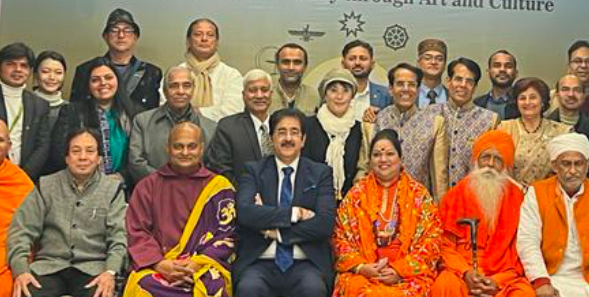
Reference
1. Tattva Kaomudii Part 1, Questions and Answers on Ananda Marga Philosophy, #49
== Section: Important Teaching ==
Remarkable benefits of dhyana
Ananda Marga philosophy teaches us, “Question: If the medicine or mother tincture required for homoeopathic medicine is prepared in a sentient environment which contains positive microvita, will the medicine prepared from that medium or mother tincture have more effect than ordinary medicine available in the market?”
“Answer: There is no doubt that the medicine prepared in a sentient environment by sentient people, from a medium or mother tincture which is also prepared in a sentient environment, will attract more positive microvita than ordinary medicines, so it will have a much greater effect in curing a patient.”
“If a person contracts a disease caused by negative microvita before initiation and does dhyána sincerely after initiation, the disease will not spread but be contained. However, for different types of diseases one has to follow different food restrictions and practice dhyána at specific times.”
“If a person contracts a disease caused by negative microvita after initiation, does dhyána perfectly and follows certain food restrictions, the disease will be completely cured. Dhyána attracts many positive microvita. Negative microvita can only be controlled by positive microvita. The positive microvita eat the negative microvita and this is the reason why the disease is cured. For example, if a person is suffering from jaundice, a disease caused by negative microvita, and if dhyána is practised perfectly, the disease will be cured very quickly. In the case of cancer, say stomach cancer, certain food restrictions will have to be strictly followed. When pain starts in the stomach one should sit for dhyána, but just prior to this one should take some juice from a sweet tasting, not a sour tasting fruit. After performing dhyána, one should take another drink which is different from the first drink. The patient should also avoid any food which causes gas in the stomach, such as pappad, cauliflower, cabbage, turnip, etc.” (1)
Reference:
1. Microvita in a Nutshell, Questions and Answers on Microvita – Excerpt C
== Section: Important Teaching ==
The excellence of bodhi jiṋána
Prout philosophy states, “The approach of PROUT is subjective approach through objective adjustment. This presupposes a connecting link between intuition and intellect. This connecting link or touching point is called “Bodhi Jiṋána”. With the help of Bodhi Jiṋána, intuitional knowledge can be utilized for solving mundane problems. Thus PROUT is a Bodhi Jiṋána.”
“Logic is a psychic survey. Such a survey may or may not be correct, therefore it is futile to follow logic blindly. The result of your psychic survey is called your rationality. This psychic survey, embedded in relativity, may or may not be correct. Intuitional vision is the best logic. Intuitional vision should be your guiding ideology. For example, it is an axiomatic truth that everything has come from the Cosmic Father and everything will merge in Him, but this truth is beyond the scope of intellectual logic.” (1)
Reference
1. Prout in a Nutshell - 15, Talks on Prout
== Section: Ananda Vanii ==
March ahead on the road of human welfare
Original Ananda Vanii states: “The very import of the history of human welfare is the history of struggle and strife. Even the sweet gospels of peace could not be preached in an environment of peace and composure. Devils did not allow the apostle of peace to work peacefully – that is why I say that peace is the outcome of fight. This endeavour at the well-being of the human race concerns everyone – it is yours, mine and ours. We may afford to ignore our rights, but we must not forget our responsibilities. Forgetting the responsibility implies the humiliation of the human race. In order to march ahead on the road of human welfare, we will have to strengthen ourselves in all the arena of life. The complete seeds of welfare in all the spheres – physical, mental, moral, social and spiritual – are embedded in the sixteen points. Hence be firm on the sixteen points.” (Ananda Vanii # )
Note: Sadguru Baba has assigned a number to all His original and true Ananda Vaniis. In contrast, Fake Ananda Vaniis do not have any number. By this simple formula, one can easily recognise which is a true Ananda Vanii and which is fake. For the upcoming occasion of January 1st 2017, all Ananda Marga units should use one of Baba’s original and true Ananda Vaniis, not a fake one. By this way, one will surely get His blessing.
== Section 3: Links ==
Festival: Shravanii Purnima - 19 Aug 2024
Recent Postings
Other topics of interest