Search This Blog

Monday, December 6, 2021

Contando el número de culturas

 Baba

Contando el número de culturas

Namaskar,

Todos somos humanos, unidos por la fraternidad cósmica. Dondequiera que los seres humanos nazcan y se críen, adoptan variaciones locales que varían de un lugar a otro. Entonces, hay variaciones locales, pero en esencia, los humanos no son diferentes entre sí. La cultura humana es una.

En un resumen en español de A Few Problems Solved - 6, “The Interplay of Culture and Civilization” , Baba nos dice : La cultura humana es, por lo tanto, una e indivisible. El uso de expresiones tales como decir: Cultura Hindú, Cultura Musulmana, Cultura India o la Cultura Europea, es absurdo. Quienes sostienen estas ideas partidistas no son simpatizantes de la humanidad.


Todos los seres humanos somos uno: (a) todos saludan, (b) todos expresan felicidad, (c) todos tienen algo que valoran o consideran un ideal, (d) las personas comparten y sirven comida juntas, y (e) muchas prácticas similares pueden incluirse en esta lista.
https://anandamargauniversal.blogspot.com/

Independientemente de su casta, idioma, raza o área geográfica, nivel de educación, etc., todos tienen estas cualidades comunes. Es por eso que la cultura inherentemente humana es una. A simple vista, parece que la gente vive de diferentes maneras y tiene una cultura diferente, pero estas son variaciones locales que llamamos demi-cultura. La conclusión es que fundamentalmente los seres humanos somos uno y hay varias diferencias locales y esas diferencias no son culturales sino demi-cultura.

En un resumen en español de Prout Nutshell - 15, “Talks on Prout” , Baba nos dice : Según PROUT, toda la sociedad tiene la misma cultura. Hay variaciones locales en el modo o estado de la expresión cultural, pero la expresión es universal. Mientras todos comen, algunos comen con la mano, otros con un palo y todavía otros con cuchara. La danza india se basa en el mudrá o las posturas de danza, y la danza europea se basa en el ritmo, pero no representan dos culturas diferentes. (resumen en español)


Caminata de campo con Baba


Aquí está mi relato personal de aquella vez en la caminata de campo con Parama Purusa Baba donde habló sobre diferentes expresiones culturales. Por Su gracia, estuve en Su divina compañía para una caminata de campo (8 de mayo de 1979) en Fiesch durante Su gira por el sector de Berlín en 1979. Y en esa gira, Baba usó el término demi-cultura. Para su referencia, he adjuntado partes de ese campo que se encuentran más abajo en este correo electrónico/artículo.

Los diferentes modos de expresión no son culturas diferentes


Todos los sadhakas son conscientes de Su directriz de que la cultura humana es una y que las llamadas guerras culturales, la desconfianza y los enfrentamientos entre áreas geográficas dejarán de existir cuando la gente acepte nuestra cultura humana como una.

En estos días, lo que la gente considera comúnmente como cultura o culturas separadas, en realidad no son más que diferentes modos de expresión, no diferentes culturas. La cultura humana es una y Baba eligió el término demi-cultura o modo de expresión para representar las diferentes formas en que las personas expresan nuestra cultura humana singular.
https://anandamargauniversal.blogspot.com/


Paseo de Baba en Fiesch: cultura y demi-cultura

Como se mencionó anteriormente, en una caminata de campo en Fiesch, Parama Purusa Baba habló lo siguiente sobre cultura y demi-cultura:

 En un resumen en español de Baba's Field Walk in Fiesch, “May 8, 1979” Baba dijo: "Verás, he dicho que la cultura humana es una. Solo que hay diferentes modos de expresión. Ahora, podemos decir demi-cultura, con respecto a esos modos de expresión. Hubo durante la Edad Media, tres diferentes demi-culturas en Europa. Una prusiana, otra latánica y la tercera ibérica. “Ibérica” significa España, Portugal y Vasco ... " (resumen en español)

Luego, un margii, que no comprendía completamente las enseñanzas de Baba, se tomó un momento para hablar.

Margii: Aunque en la antigüedad solo existía una cultura humana.


Baba luego corrige el margii

En un resumen en español de Baba's Field Walk in Fiesch, “May 8, 1979” Baba: "Incluso ahora, la cultura humana es una. Hay diferencias locales en comer y bailar. [Pero] eso no hace que sean diferentes culturas". (resumen en español)

En su enseñanza anterior, Parama Purusa Baba está afirmando claramente que la cultura humana ha sido y sigue siendo una. Solo podemos decir que los modos de expresión, o demi-culturas, varían. Esas variaciones reflejan las diversas formas en que la gente come y baila, etc. Ese es el uso que hace Baba del término demi-cultura.

Es nuestro deber utilizar estos términos, demi-cultura y modos de expresión, en nuestro día a día. Debemos utilizar la terminología de demi-cultura dada por Baba en nuestra: escritura, arte, literatura, charlas, conferencias, presentaciones, historias, dramas y más. Gradualmente, de esta manera, se propagarán las enseñanzas de Baba sobre cultura y demi-cultura. El concepto de que la cultura humana es una es una idea completamente nueva. Tenemos que ayudar a entender y enseñar a otros mediante nuestro uso diario práctico del término demi-cultura.
https://anandamargauniversal.blogspot.com/


La cultura es una y representa diversas expresiones humanas

(A) Aquí Parama Purusa Baba plantea el punto de que la cultura representa una amplia gama de expresiones humanas.

En un resumen en español de Prout Nutshell - 15, “Talks on Prout” , Baba nos dice : Es [cultura] el nombre colectivo para diferentes expresiones de la vida. La gente come, disfruta de la hospitalidad, ríe en algunas ocasiones y derrama lágrimas en otras, y por lo tanto expresa la vida a través de diversas acciones. El nombre colectivo de todos estas acciones es cultura. (resumen en español)

(B) A continuación, Baba enfatiza aún más cómo la cultura humana es internamente una con muchas variaciones externas. Como simpatizantes de la humanidad, debemos unirnos siempre en torno a los puntos en común. Eso hará que la sociedad sea saludable. Aquellos que destacan las diferencias entre los seres humanos dañan a la sociedad.

En un resumen en español de Prout Nutshell - 15, “Talks on Prout” , Baba nos dice : Hay ciertas variaciones locales prima vista, pero no hay diferencia en el flujo cultural subterráneo de la sociedad humana. La diferencia es externa y no interna. La cultura es una para el mundo entero. Factores comunes para la humanidad entera (es decir, la cultura en el verdadero sentido del término) siempre debe ser alentada, pero las diferencias que se ven a primera vista nunca deben alentarse. Quienes fomentan estas diferencias ayudan a las tendencias separatistas que ponen en peligro el progreso humano. Para establecer una perspectiva cultural cosmopolita, tenemos que eliminar las diferencias a primera vista mediante el matrimonio y otras combinaciones socioeconómicas. (resumen en español)

En un resumen en español de A Few Problems Solved Part 6, “The Interplay of Culture and Civilization” , Baba nos dice : Las expresiones humanas son multilaterales. (resumen en español)


La cultura es una, las costumbres locales es lo varía

(C) A continuación, Parama Purusa Baba diferencia entre costumbres y cultura. Las costumbres son muchas, mientras que la cultura humana es una.
https://anandamargauniversal.blogspot.com/

En un resumen en español de Prout Nutshell - 15, “Talks on Prout” , Baba nos dice Las variaciones locales disminuirán si hay una mezcla estrecha entre diferentes grupos de personas, porque esto creará costumbres comunes. En Nepal hay una mezcla de costumbres hindúes y budistas. En Bengala hay una mezcla de arios y costumbres dravídicas. Estas variaciones locales se denominan costumbres. Por lo tanto, los modos de expresión locales que llevan las especialidades locales o grupales son costumbres, pero la expresión en sí es cultura. Por lo tanto, es un error reajustar las fronteras sobre la base del idioma y la cultura . (resumen en español)


El acto de saludar en sí mismo es la cultura humana

Como todos sabemos, cuando las personas se encuentran, se saludan. Esta práctica de que los humanos se saludan cuando se encuentran es omnipresente. Sucede en todas partes. Una persona en las colinas de Corea del Norte saluda a su amigo; y una persona de un valle de California saluda a su amigo. En ambos casos, de alguna manera saludan a sus pares. Esta es una práctica común. Esta es la cultura. Y está en todas partes, es por eso que la cultura es una.

Ciertamente, las personas de diferentes países pueden expresar sus saludos de manera diferente, pero esas diferentes formas de saludar no representan culturas diferentes, sino más bien demi-cultura.

Por ejemplo, en Ananda Marga hacemos namaskar o pranam; en algunos países, las personas se inclinan unas a otras; en otros países la gente agita la mano y saluda; en algunos lugares la gente dice shalom; en otras tierras la gente se abraza o besa; y muchos también recurren al apretón de manos. Por lo tanto, hay muchas formas en que las personas se saludan. Pero estos diversos tipos de saludos no representan culturas diferentes. El acto de saludar es en sí mismo cultura humana y singular; y las diversas formas en que se realizan los saludos es la demicultura.

Por tanto, la cultura es el acto de saludar, independientemente de cómo se haga. En este punto, todos los seres humanos comparten un hilo conductor; todos se saludan. La práctica de saludar a un amigo o vecino, etc., es compartida por todos los pueblos de todas las tierras. El mismo acto de saludar a otra persona es en sí mismo nuestra cultura humana. Por tanto, la cultura humana es singular, no muchas.
https://anandamargauniversal.blogspot.com/

Algunos pueden intentar bifurcar la sociedad dividiendo a las personas en esta cultura o en esa cultura. Pero en verdad hay un hilo conductor que todos comparten. El saludo es uno de esos puntos en común. Una vez más, puede haber varias formas de saludar a un amigo, pero en realidad las personas de todos los lugares están haciendo lo mismo, es decir, saludar.

Debe quedar muy claro que el saludo en sí mismo es cultura, mientras que la forma en que las personas se saludan es una expresión cultural o demi-cultural. La demi-cultura puede ser numerosa, pero la cultura es una. Por eso la cultura humana no son muchas sino una, como se ha explicado en los párrafos anteriores. Aquí todos tenemos que recordar que internamente los humanos somos uno y la cultura humana es singular en número; sólo externamente hay una multitud de expresiones y variaciones culturales.


Conclusión

Algunas personas piensan que "nuestra cultura es xyz y su cultura es abc, entonces somos diferentes". Aquellos que piensan así sufren un grave malentendido. Esta carta tiene como objetivo aclarar esas nociones erróneas y explica cómo frases como decir: la Cultura Estadounidense, la Cultura Japonesa y la Cultura India, etc., son un mal uso del término cultura. Más bien debería decirse demi-cultura India, demi-cultura americana, etc. Este debería ser nuestro enfoque porque la cultura humana en sí misma es una; mientras que la demi-cultura representa las variaciones locales.

Por lo general, la gente piensa que hay tantas culturas: africana, occidental, nativa americana, china, rusa, india, etc. De hecho, en las últimas dos décadas, se han utilizado varios términos como multicultural, pluralidad de culturas, bi-cultural, pluralismo cultural, etc. La gente piensa que los humanos difieren según su propia "cultura separada". Por lo tanto, a menudo se piensa que hay muchas culturas diferentes en este planeta.
https://anandamargauniversal.blogspot.com/

En ese caso, la gente considera que los demás son diferentes. Su objetivo es tolerar las diferencias, pero en última instancia sienten que "esas personas no son como yo, son extranjeras, podemos vivir juntos tolerando las diferencias, pero su cultura es diferente a la mía".

Según las enseñanzas de Baba, esto no es correcto ni debería ser nuestra perspectiva. Debemos abrazar a todos y cada uno como propios y cultivar sentimientos de amor y cordialidad, no pensar en que debe haber tolerancia. La cultura humana es una, no muchas. Esta carta es un esfuerzo por comprender mejor las sublimes enseñanzas de Baba sobre la cultura y obtener claridad sobre por qué la cultura humana es una.

Namaskar,
En él,
Prabha
(Patricia)

En un resumen en español de Prout in a Nutshell - 4, “Ism and Human Progress” , Baba nos dice : Aunque según la lógica perfecta, la cultura de toda la humanidad es una e indivisible, los exponentes de los ismos no comprenden esto. Prefieren afirmar que los diferentes conjuntos de escritura y lenguaje, comportamiento y hábito, y las variaciones locales en la expresión, son en realidad lo que constituyen a la cultura humana . (resumen en español)


~ Estudio en profundidad ~

Ananda Marga quiere unir a todos y formar una sociedad humana. Este es uno de nuestros principales enfoques: Unir a todos los seres humanos.

La cultura humana es, por definición, una. Es singular. Como Ananda Margiis, propagamos esta verdad, es decir, que la cultura humana es una, para producir una sociedad humana. Codo a codo, debemos presentarle a la gente expresiones culturales más refinadas y sensibles.

Cuando la gente empiece a pensar que la cultura humana es una, será muy fácil unir a todos los humanos. Entonces la paz puede traerse a esta tierra. La desunión invita a la violencia. Las personas dividen a la humanidad sobre la base de varias plataformas, incluida la cultura. De esa manera surgen tantos problemas. Propagar la verdad de que la cultura humana es una es la manera en la podemos unir a la humanidad y traer la paz.
https://anandamargauniversal.blogspot.com

Dogma: dividir a la humanidad en diferentes culturas


En la actualidad, debido a la falta de comprensión, la gente piensa de manera analítica (divisiva). Dividen nuestra cultura humana singular en muchas. Y todavía esto está sucediendo.

En un resumen en español de A Few Problems Solved part 7, “Renaissance in All the Strata of Life” , Baba nos dice: Los dogmas se han arraigado en la mente humana. La gente no puede deshacerse de estas ideas falsas porque se han inyectado en sus mentes desde la infancia. Como resultado, una sociedad humana se divide en diferentes naciones, y una nación está dividida en diferentes religiones; las religiones también tienen diferentes castas, y las castas también tienen diferentes subcastas: ¿qué tipo de situación es esta? Solo hemos aprendido cómo dividir y subdividir a la humanidad, y nunca aprendimos cómo unir a la gente. todo se debe a las enseñanzas defectuosas de los dogmas . (resumen en español)

De hecho, en este punto de la cultura, las personas continúan dividiendo a la humanidad hasta tal punto que finalmente todas y cada una de las personas llevan su propia cultura separada. Esto no es más que el camino del análisis (división y faccionalismo) mientras que el nuestro es ese camino de síntesis (unidad).

Por ejemplo, algunos piensan que existe tanto la cultura occidental como la oriental. Y por su camino de análisis, dividen la cultura occidental en partes como la cultura europea y la cultura estadounidense. Y dividen aún más la cultura estadounidense en muchas partes: Cultura Italoamericana, Cultura Nativa Americana, Cultura Chino-Americana, Cultura Afroamericana, Cultura mexicoamericana, Cultura Cuatemalteca Americana, Cultura Filipina Americana, Cultura Japonesa Americana, Cultura Greco-Americana etc.
https://anandamargauniversal.blogspot.com/

Si continuamos enumerando todas estas divisiones, entonces podría haber varios cientos de clasificaciones. Porque personas de todo el mundo están en Estados Unidos y llevan su propia etiqueta demi-cultural. De la misma forma, este tipo de análisis (división) se puede realizar en todos y cada uno de los terrenos. Trágicamente, a través de este enfoque, hay una ola gigantesca de diferenciación y desconfianza. Independientemente del modo de expresión o demi-cultura de uno, la cultura humana es una.

- Here is a link to the original English posting: Counting the number of cultures

- Here are more Spanish postings

Sunday, December 5, 2021

Example of harmful sadhana + 4 more

Baba

Example of harmful sadhana

Namaskar,

Here we take a look at various yoga postures that are extremely detrimental to one’s health. The aim is to prevent and save practitioners from falling prey to harmful and painful approaches, and help seekers proceed along the proper path that will enable them to become one with Parama Purusa.
http://anandamargauniversal.blogspot.com/


Suffering by a fire

Unfortunately in the first photo, the fake yogi is standing on his head and surrounding himself by fire in hopes that by this way he is pleasing God. But actually his actions undermine his intended goal. That fake yogi cannot please God in this way, no more than a child who pricks himself with a sharp object in order to get his mother’s attention can please his mother. By seeing this, the mother will be distraught that her child engaged in this self-inflicted harm. And the same is the case with the dogmatic practitioner who tortures himself in hopes of pleasing God. The Supreme Entity will not be pleased, but rather sad. All in all, it is most unfortunate that this fellow became misguided and is now intentionally subjecting himself to such tortures. This dogmatic yogi is actually trying to do something good, but his approach is 100% faulty. 

In the second photo, the misguided yogi has also placed fire all around himself in the extreme summer heat of the mid-day sun and he has even put fire on top of his head. Sadly, this ignorant yogi also thinks he is pleasing God. Here again it is incumbent upon us to bring such persons onto the path of Ananda Marga at the very outset of their journey and save them from needlessly undergoing so much self-imposed torture. We have to help them progress and properly guide them from a very early age so they can avert such torment and smoothly enter onto the path of Ananda Marga sadhana. When a dogmatic practitioner tortures himself in hopes of pleasing God, then the Supreme Entity will not be pleased, but rather sad.
http://anandamargauniversal.blogspot.com/

And a similar scene is taking place in the third photo where the confused yogi is surrendering himself to the fire as a way to please God. It is unfortunate to see a human being passing their life in this way. As disciples of Shrii Shrii Anandamurti ji we have to help such persons. Clearly they have tremendous potential and stamina and it is our fault that to date we could not help them channelise that psychic force into progressing along the path of true spirituality and serving others in a meaningful way. Here is the irony: When a dogmatic practitioner tortures himself in hopes of pleasing God, then the Supreme Entity will not be pleased, but rather sad. 

In contrast, those practitioners of yoga in the west do headstands for their physical health and beauty. So their whole intention and motivation is different from the "sadhus" featured below. But according to Ananda Marga philosophy, such types of poses are harmful to the body and mind; they are not beneficial. See how this yogi is torturing himself in order to please God, yet in all such cases the Supreme Entity will not be pleased, but will instead feel hurt. 


~ Confused yogiis ~

Sadly, these yogiis are harming themselves in hopes of pleasing God. The Supreme Entity / God will not be pleased by seeing this, but will rather feel sad.


What is the meaning of tapah

The dharmic teaching of tapah is to please Parama Purusa by sacrificing for the betterment and service of others. And Baba has given clear guidelines about this. But unfortunately we could not propagate His guidelines to the entire society. That is why we see that even after ages and ages, still today there are countless fake “rishis” and confused yogis who could not get the right teaching on tapah (penance).
http://anandamargauniversal.blogspot.com/

Ananda Marga ideology says, "The ancient "sages" used to practice penance by sitting near a firepit with their legs up and their hands down. What value does this type of penance have? Not much. To continue to perform penance like this is certainly not the highest fulfilment of life. Human beings have come onto this earth to do something good, some thing which will be of some benefit for the society for at least some period of time." (1)

In His above teaching, Baba disapproves of those who intentionally harm themselves in the name of tapah in hope of acquiring virtue. As Ananda Margiis we have to redouble our efforts and help save these misguided yogis. We have to steer them in the right direction.

Harming themselves unfortunately, not doing tapah


For more about this, here below are some examples about what some ignorant yogis do as tapah. It is unfortunate that they were misled and indoctrinated in this way. They want to do something good, but lacking Sadguru's teachings they went astray. It is our duty to bring them onto the path; clearly, their endeavours do not represent true tapah. Instead, in the name of tapah, sadly these misguided yogis are wasting their time, destroying their bodies, and misusing their potential. Due to their dogmatic approach, they engage in all kinds of torturous activities in order to gain virtue and please God. But their approach will not work. In true tapah, one sacrifices for the welfare of others - keeping cosmic ideation. The scenes described and depicted below are dogma, sadly enough.

What is happening in the below photos


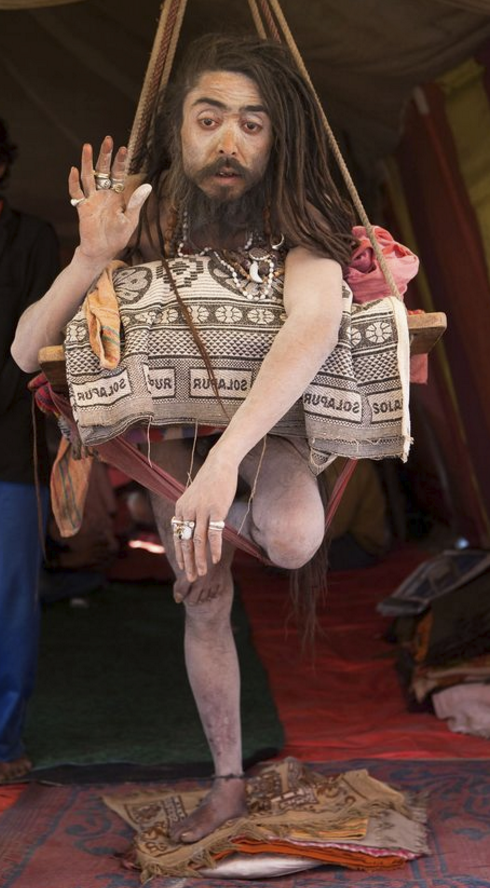
Here in this next photo below, one confused yogi has embarked on the difficult and tortuous proposition of remaining standing for 12 years in a row on one leg. This is a special type of ordeal where one can never sit or lie down. Always one must be standing on either the right or left leg, while the opposite leg is tied up. Then a swing is used so the yogi can lean on something. Because he has to remain standing all the time. That means when he sleeps, eats, defecates etc, he will always be on one foot or the other. And this is all done to please God by their suffering (tapasya). Tragically, in attempting to do this those fake yogis often suffer terrible maladies and may even lose their entire leg.  This is the effect of dogma. Still, for those who are able to endure it for 12 years, they  are verily worshipped as a divine being. Upon completion a grand ceremony is done complete with yajina and the burning of ghee etc. And for miles and miles in all directions the people will worship that yogi as a second god. The masses think that whatever that fake yogi says will become true - and they shower that yogi with huge respect and gifts etc. So the below ignorant yogi is trying to do this for 12 years straight and he has his hand in a blessing posture. See how this yogi is torturing himself in order to please God, yet in all such cases the Supreme Entity will not be pleased, but will instead feel sad.
http://anandamargauniversal.blogspot.com/


~ Fake yogi ~

According to Ananda Marga philosophy, all such attempts by misguided yogis to please God by needlessly torturing themselves hold no value. And Baba has come onto this earth to guide them also. So we should do extensive pracara amongst such yogis. They deserve to know that the real tapasya comes when one sacrifices for the welfare of others with the idea of serving the Supreme. For instance, if a sadhaka is a firefighter and goes into burning buildings - risking his life - in order to save innocent people and that sadhaka views those people as the expression of Parama Purusa, then they doing real tapah / tapasya. And there are many other cases in the life of a sadhaka where they sacrifice their personal comfort and money, or undergo hardship in order to help others. And that is true tapah and part of bhagavad dharma. Whereas, sadly what these ignorant yogis are doing is improper, as they are inflicting harm upon themselves in hope of acquiring virtue and pleasing God.

In this following photo, the confused yogi is kneeling on the ball of his right foot and balancing himself in this awkward position for one hour or so in the morning and evening in hopes of pleasing God through this type of tapasya. All the while he is repeating some chants and mantras and undergoing pain and torment to please God.  Sadly, see how this yogi is torturing himself in order to please God, yet in all such cases the Supreme Entity will not be pleased, but will instead feel hurt. 


~ Ignorant yogi ~

Then this below photo features a fake yogi who has placed hot coals all around himself in the extreme summer heat of the midday sun, and he has even put coals on top of his head. This yogi also thinks he is pleasing God by undergoing all this self-inflicted suffering. But according to Ananda Marga philosophy, this is not tapasya - this is just dogma. The real tapasya comes when one sacrifices for the welfare of others with the idea of serving the Supreme. Sadly, this yogii is harming himself in hopes of pleasing God. The Supreme Entity will not be pleased by seeing this, but will rather feel sad.
http://anandamargauniversal.blogspot.com/


~ Misguided yogi ~

True tapah: shoulder sorrows & miseries of others


Here below are some of Baba's dharmic teachings about real tapasya from His book, "A Guide to Human Conduct", Tapah chapter.

Ananda Marga philosophy states, "Tapah means to practise penance to reach the goal." (2)

Ananda Marga philosophy states, "There must be one and only one purpose behind the practice of penance and that is to shoulder sorrows and miseries of others to make them happy, to free them from grief and to give them comforts." (3)

Ananda Marga philosophy states, "If you serve sick people who are in great pain for hours together to give them needed relief, this is tapah." (4)

Ananda Marga philosophy states, "As a rule, practice of tapah will lead to mental dilation, and this dilation will certainly help a sádhaka, to a large extent, in practising Iishvara prańidhána. The sádhakas of tapah know that the served is Brahma, their cherished goal. They are servants and the service rendered by them is their sádhaná." (5)

Ananda Marga philosophy states, "Those who look upon the served only as an expression of the Cosmos and look after their comforts selflessly develop devotion or love for the Supreme in a short time. When love is aroused, and devotional sentiment is expressed, what else remains to be achieved?" (6)

in Him,
Sunayana'

And we must do extensive pracara, and work to bring such dogmatic adherents onto the path of dharma - then they could become great assets to the society.
http://anandamargauniversal.blogspot.com/


~ In-depth study ~

Extremely difficult to remove preconceived notions

   Ananda Marga philosophy states, "Religions are based on external ritualistic observances, so they are preoccupied with physical objects. In the course of time, these physical objects become the objects of  ideation. Take the example of cows. Cows are considered sacred by Hindus because they provide milk. Now, if cows are considered sacred for this reason, then what about buffaloes which provide more milk? They should be considered more sacred than cows. The followers of religious dogma do not like to discuss such issues. As a result of ideating on religion, the human mind becomes inert. No amount of discussion or intellectual persuasion can shake that psychic inertia. From childhood, human beings are taught irrational ideas, so when they grow up it is extremely difficult to remove preconceived notions. For example, students conversant with science know that a solar or lunar eclipse is caused by scientific factors and has nothing to do with the mythological demons Ráhu and Ketu. But even then, due to their inherent reactive momenta, they go to the Ganges and take a holy bath. Is this not due to ingrained religious beliefs?"
   "...One community considers it a sin to eat beef but not goats or deer. The custom of wearing a vermilion mark on the head and forehead by Indian women is an expression of religious sentiment. The women of other countries do not follow this practice. It does not matter at all if Indian women stop using vermilion. All religions exploit people by appealing to religious sentiments." (7)


Due to religious dogma

Ananda Marga philosophy states, "Behind the origin of a religion lies the inborn fear psychology of human beings. Human beings started religious practice to appease the different natural phenomena – the hills and mountains, the rivers and oceans, the forests, thunder and lightening, the morning and evening, and so on. Such religious practice was based on the instinct for self-preservation: the only intention being to propitiate the gods and goddesses of diverse moods. Some kind of imaginary faith worked in the back of people’s minds. Such psycho-sentiments arose after human beings came in contact with the different natural phenomena. The roots of most religions lie in the worship of a particular natural phenomenon. Some religions centered around the moon, some the sun, and others a stone image. Later on people created an improvised philosophy to support the worship of that physical phenomenon. They advanced the philosophical argument that it was possible to attain the unlimited by worshipping its limited form. They declared their temples, mosques and churches made of bricks as sacred places. A strong sentiment developed for the worship of different deities. So blind were their sentiments that they refused to listen to rationality. Take the case of cows: Hindus worship cows as something holy, apparently because they give us milk. But if cows are revered as mothers for giving us milk, shouldn’t buffaloes be given a similar status? Actually, buffaloes give more milk than cows. Unfortunately, the blind religious followers refuse to listed to logic as their religious sentiment for cows has taken root deep in their minds. People are fed these ideas since childhood, so later on it becomes impossible for them to discard them. Science students understand the reason for a lunar or solar eclipse. They know that the eclipse does not occur because the sun or moon has been devoured by the mythological demons Ráhu and Ketu (Umbra and Penumbra). Yet due to the deep rooted Saḿskaras in the mind, they rush to take a holy bath in the Ganges during the eclipse. This is the result of blind faith." (8)

References
1. Subhasita Samgraha -12, How an Ideal Person Should Live
2. A Guide to Human Conduct, Tapah
3. A Guide to Human Conduct, Tapah
4. A Guide to Human Conduct, Tapah
5. A Guide to Human Conduct, Tapah
6. A Guide to Human Conduct, Tapah
7. Prout in a Nutshell - 21, How to Unite Human Society
8. A Few Problems Solved - 2, Human Society Is One and Indivisible – 2


== Section: Important Teaching ==
Technique to memorize anything

Baba's below teaching discloses the reason why our scripture has been composed in the genre of poetry: Because poetry is easy to memorise. For this reason, Baba has composed our scripture - i.e. Ananda Sutram and Prabhat Samgiita - in poetic verse.

Ananda Marga philosophy states, "In the absence of rhythm it is difficult to memorize. That is why since ancient times, for 15,000 years, the common practice has been to bring every valuable branch of knowledge within the scope of rhythm. Human beings do not easily forget rhythm. One may forget the contents of knowledge, but not the rhythm. That is why all Vedic Rks were composed in 7 meters. All literary compositions were brought within the gamut of the seven Vedic metres...as they are valuable for the memory." (1)

Set it to rhythm

If you want to learn or memorize anything, the easiest way is to set it to rhythm. One paragraph of prose is very difficult to memorise, but 1 stanza of a poem, shloka, or song is comparatively easy to memorise. Rhythm helps in memorising anything. That is why in their infancy, children are introduced to language via rhythm in nursery rhymes and songs etc. By this way they can quickly learn and advance.

In the distant past, before the invention of any script and before paper came into vogue, people used to keep everything in their mind. There were no books or other media as we see nowadays: Audio, video, writings, etc. There was nothing.

What yogis did in the past

So when there was no way to store ideas or teachings on paper or cassette, the only option was to store it all in their memory. The best technique for doing that was to create rhythmic poetry. So all those past yogis, rishis, sages, thinkers, and munis put their realizations into shloka, poem, or any kind of rhythmic expression like the vedas, purana etc. Even when script was first invented, most people did not know how to read or write, so those thinkers continued to put their teachings into poetic verse. This happened all across the globe.

This is not only for those of the past. Today also if you want to memorise anything then put it in rhythmic form. Cunning advertisers create jingles or rhymes to influence consumers, and film-makers do the same.

So to keep something readily in the mind then take help from a rhythmic flow, otherwise it will be very difficult to store that in your memory. For this reason Baba has given the key of Ananda Marga teachings - i.e. Ananda Sutram - in poetic form, and Prabhat Samgiita as well. And in virtually every discourse He has included a shloka. By that way - by memorizing one rhythmic shloka - one can get the seed idea of the entire discourse. That is how to memorize that entire discourse in key form.

In His series of discourses on the Faculty of Knowledge, Baba has given so many points about memory and rhythm.

Reference
1. Ananda Marga Philosophy in a Nutshell - 5, The Faculty of Knowledge – 4


== Section: Prabhat Samgiita ==


तुमने गूंगे लोगों को  बोलने  और बहरों को  सुनने की क्षमता दी है।

प्रभात संगीत 2201 तुमि जे एशेछो आलो साथे एनेछो, सबार  मनेर कालो दूर करेछो...

भावार्थ

हे परमपुरुष! तुम अपनी सुन्दर  आभा  के साथ आ गये हो। तुम्हारे आ जाने  से सभी के मन की कालिमा दूर हो गई हैै। तुम ने कृपा कर सब के मन से अज्ञान के गहरे  अंधेरे  और जड़ता को मिटा दिया है। हे दिव्य ! तुम कितने कृपालु हो। तुम स्थानों या  लोगों से जुडी थोथी परम्पराओं  को कोई महत्व नहीं देते और न ही संसार के  कर्मकाॅंड को। सभी प्रकार के उथलेपनऔर  लोक दिखावे  को अनदेखा कर तुम ने कृपा की वर्षा  की है। तुम अच्छे और बुरे, साधु या असाधु सब लोगों  को  एक समान  प्रेम करते हो।

हे प्रभु!  सभी जगह पाए जाने वाले  इस अन्त हीन  आकाश  में केवल तुम्हीं एकमात्र दिव्य तारे हो, जो सभी को आकर्षित करते हो। तुम्हारा मधुर  स्वर  पूरे संसार  को तुम्हारे चारों ओर नचाता रहता है। प्रत्येक व्यक्ति के मन का एकतारा तुम्हें प्रसन्न करने और संतुष्ठ करने के लिये ही बज रहा है। उसका मधुर स्वर  सभी के हृदय और मन में तुम्हें पाने की लालसा भर देता है। तुम्हारी कृपा से सब के जीवन में आशा  का संचार हो गया है।


हे परमपुरुष! नये नये रंगों और रूपों में और अधिक पास आने की कृपा करो। हे सदा नई दिखाई देने  वाली  सत्ता ! तुमने गूंगे लोगों  को  बोलने  और बहरों को  सुनने की क्षमता दी है। तुम ने सभी को परम सत्ता के  यश और कीर्ति का गायन करने की ताकत  दी  है। इस प्रकार तुम ने हर एक व्यक्ति  को आशीष दिया है।

बाबा, हे परमपुरुष! तुम्हारे बड़प्पन और सुन्दरता   की कल्पना नहीं की जा सकती  है , कृपा कर मेरे हृदय में  हमेशा  रहो । 


== Section: Important Teaching ==

Infants' connection with previous life

Ananda Marga philosophy states, "After death the disembodied mind floats in the vast space with its unexpressed saḿskáras. Later on, with the cooperation of the mutative principle, the disembodied mind finds a suitable physical base. The memory of its past life remains awake for approximately the first five years of its new life. Although the child remains in a new physical environment, mentally it continues to live the joys and sorrows of its previous life. That is why children sometimes laugh and cry in their sleep, and their mothers often think they are talking with God. In colloquial Bengali this is called deola kát́á. In actual fact this laughter and crying is nothing but the reappearance of past memories. To re-experience past events one does not need the cooperation of the old brain. The newly-born mind has not yet had time to build a close relationship with the new brain. The revival of experiences of past lives is what we call “extra-cerebral memory”, and is principally the task of the causal mind." (1)

Reference
1. Ananda Marga Philosophy in a Nutshell - 4, Cerebral and Extra-Cerebral Memory


== Section 2: Links ==


SUBJECTS TOPICS