Baba
Sign of pseudo-margii
Namaskar,
As you know, the various ceremonies given by Sadguru Baba in Caryacarya are to be performed in a certain way to preserve the sanctity of the function and prevent Hindu rituals or any religious dogma from entering into Ananda Marga Pracaraka Samgha. One key point about the shráddha ceremony is that a photo of the deceased should not be on display during this shráddha function. And here is why.
In our Ananda Marga funeral / shráddha ceremony, Parama Purusa is the focal point, not the deceased. Putting a photo of the deceased on display creates more pain for those in mourning, and it is against Caryacarya. In addition, margiis are coerced to worship the deceased; the photo of the deceased has been imposed on them as they do sadhana and puja. It is akin to punishing participants and forcing them to do something against their will by compelling them to commit adharmic acts.
https://anandamargauniversal.blogspot.com/
Nowhere is it written in Caryacarya that a photo of the deceased should be put on display. So what was recently done during the shraddha ceremony is against Caryacarya. The irony is that sincere Ananda Margiis are keen to follow Sixteen Points and abide by Caryacarya during their lifetime. But then, at the time of their death, there is a blatant breach of Caryacarya. Because their photo is put on display at the shráddha ceremony, and that is wrong. The photo should not be on display during the shráddha ceremony, let alone be placed on the puja table in front of Sadguru Baba’s pratikrti [photo].
Look what happened here
It is not written anywhere in Caryacarya that a photo of the deceased should be put on display. But unfortunately, some fall prey to the dogma of putting a photo of the departed during the death / shráddha ceremony. Below you will find the deceased margii’s photo on the puja table directly in front of Sadguru Baba’s photo. The photo is in the bottom center of the below image. And directly above it is the bottom 90% of Baba’s photo. So they fell prey to dogma by putting a photo of the deceased on display. Now see below.

Here it should be perfectly clear: Nowhere is it written in Caryacarya that a photo of the deceased should be put on display. But unfortunately, at the shraddha ceremony, a photo of the deceased was placed directly on the puja table, in front of Sadguru Baba’s photo. This is a direct contravention of Sadguru’s guideline in Caryacarya. Sadly they fell prey to the religious dogma of putting a photo of the departed during the death / shráddha ceremony. See above.
https://anandamargauniversal.blogspot.com/
Conclusion
#1: In our Ananda Marga funeral / shráddha ceremony, Parama Purusa is the focal point, not the deceased.
#2: Putting a photo of the deceased on display creates more pain for those in mourning.
#3: Placing a photo of the deceased at the shraddha ceremony etc is against Caryacarya.
#4: In addition, by placing a photo margiis are coerced to worship the deceased; the photo of the deceased has been imposed on them as they do sadhana and puja.
#5: It is akin to punishing participants by forcing them to do something against their will by compelling them to commit adharmic acts.
So in the above scene, they are going against Caryacarya and the ethic of Ananda Marga philosophy by putting the photo of the deceased on display during the shráddha ceremony.
In Him,
Yogesh
~ In-depth study ~
Defeats the purpose of AM shra'ddha
Our Ananda Marga is the path of bliss - everything is related with attaining bliss. So nothing should be done that exacerbates one’s grieving and sorrow. Because the memory of their loss is raw, and if you remind the family of the deceased by having a photo on display, then the whole scene is more emotional. That defeats the purpose of AM shráddha because AM shráddha is one to calm the mourners. So that photo should not be on display. Rather the mind should be diverted in another direction - towards Parama Purusa.
In Caryacarya, it is clearly outlined how the shráddha ceremony is focused on Parama Purusa. The mantra directly addresses Him:
“O Supreme Father, the incorporeal soul of our dearest Shrii / Shriimatii (Mr./Ms.) . . . . . . . is far, far beyond this mortal world today. O Supreme Being, may his/her immortal soul attain higher and higher manifestation.” (1)
Putting the photo of the deceased only serves to remind the grieving family members of their loss. It keeps the painful memory of their departed loved one fresh in mind, exacerbating their pain. That defeats the purpose of AM shráddha because the AM shráddha is for calming and giving closure to the mourners. So the use of a photo of the deceased should be avoided. It brings the memory of the deceased back into this mortal world when the reality is the deceased is already far beyond this transitory world. That is why the entire shráddha ceremony is focused on Parama Purusa - not the deceased. After all we cannot do anything for the deceased, and placing their photo only multiplies the grief of the surviving family members. That’s why putting the photo on display defeats the purpose of AM shráddha ceremony.
https://anandamargauniversal.blogspot.com/
Ananda Marga Caryacarya states, “The departed soul does not get any advantage from the shráddha ceremony [memorial ceremony]. It is only meant for the psychic satisfaction of the person performing it.” (2)
Hence, the shráddha ceremony is only done to comfort and console the surviving family members. And not having the photo of the deceased at the shráddha ceremony is for the benefit and welfare of the family.
In our Ananda Marga funeral / shráddha ceremony, Parama Purusa is the focal point, not the deceased. Putting a photo of the deceased on display creates more pain for those in mourning, and it is against Caryacarya. In addition, margiis are coerced to worship the deceased; the photo of the deceased has been imposed on them as they do sadhana and puja. It is akin to punishing participants and forcing them to do something against their will by compelling them to commit adharmic acts.
Dwelling on the past: serious flaw in general society
Ananda Marga is unique. In the general society there are so many negative trends. When a close person dies, then the family members often get depressed for long periods. Sometimes even the surviving spouse will quickly die or become ill and slip into death. But Baba does not want this. Dwelling on the past is not condoned in Ananda Marga yet that is a serious flaw in the general society. Yet we have to bear in mind that humans are not monkeys who will carry their deceased family members in their arms for days on end.
Finally, any Ananda Margii who died will become one with Parama Purusa. So dwelling in the past is not good. By all of the above it is quite evident that there is no scope to display the photo of the deceased at the shráddha ceremony.
To achieve this proper planning is needed. This topic should be raised, explained, and decided when all family members are alive and well. Everyone should clearly understand ahead of time that the photo of the deceased will not be put on display at the time of shráddha. Trying to address this sensitive matter when already someone has died and emotions are raw will be very difficult. Those who are grief-stricken by the death and loss of their loved one may not understand in that delicate hour. So best is to rationally discuss this matter well ahead of time.
https://anandamargauniversal.blogspot.com/
In our Ananda Marga funeral / shráddha ceremony, Parama Purusa is the focal point, not the deceased. Putting a photo of the deceased on display creates more pain for those in mourning, and it is against Caryacarya. In addition, margiis are coerced to worship the deceased; the photo of the deceased has been imposed on them as they do sadhana and puja. It is akin to punishing participants and forcing them to do something against their will by compelling them to commit adharmic acts.
Look what happened here
But unfortunately, some fall prey to the dogma of putting a photo of the departed during the death / shráddha ceremony. Nowhere is it written in Caryacarya that a photo of the deceased should be put on display. But look what happened here. Unfortunately, some fall prey to dogma as they put a photo of the deceased on display during his death / shráddha ceremony.
In the Hindu tradition they put the photos of the deceased in plain view during the funeral ceremony. And that is exactly what was done here in the case of this margii sister. But in Ananda Marga funeral / shráddha ceremony, Parama Purusa is the focal point, not the deceased.
Another related point is that after the death some families even keep a photo of the deceased on their puja table at home, along with sandalwood sticks and a copy of Ananda Vacanamrtam, just like dogmatic Christians do by placing the Bible on their altar etc
In the above scene, they are going against Caryacarya and the ethic of Ananda Marga philosophy by putting the photo of the deceased on display during the shráddha ceremony. By this way, the grief-stricken family suffers even more. So this should never be done.
In His Hindi Ananda Vacanamrtam discourse about how to deal with death, Baba guides us that when the loss is raw for those mourners, then the mind should be diverted away from their loss. That is why during the mourning period, after a death, nobody should talk about or praise the deceased in front of the deceased’s family members. Because that will exacerbate the suffering in the mind of those mourners. Having the photo on display will only heighten the pain of those grieving as it will be a constant reminder of their loss.
https://anandamargauniversal.blogspot.com/
In our Ananda Marga funeral / shráddha ceremony, Parama Purusa is the focal point, not the deceased. Putting a photo of the deceased on display creates more pain for those in mourning, and it is against Caryacarya. In addition, margiis are coerced to worship the deceased; the photo of the deceased has been imposed on them as they do sadhana and puja. It is akin to punishing participants and forcing them to do something against their will by compelling them to commit adharmic acts.
Dogma: deceased will visit the house
In some religions, the mourning period and rituals related with the loss goes on for a while. Some religions have inserted the dogma that the deceased will visit the house and move around - so do not be scared by hearing him etc. Just one should leave food for them to eat and be careful not to disturb him. And this goes on for 40 days and annually thereafter. Another thing is that often they go and visit the tomb and talk to their deceased love one. By this way they request or offer something from the deceased. This dogma is very prevalent and by this entire process the priest is benefited by cash and kind. In turn, the public and family members are exploited psychically, emotionally, economically, etc. In another religion, it is told that the deceased visits the grieving family visits so certain foods should be offered in at the temple for the deceased. Plus particular religious rites are to be done on a daily basis. By all these rituals the family members are reminded again and again about their loss and life becomes miserable for them. Ananda Marga is against all these dogmas.
In our Ananda Marga funeral / shráddha ceremony, Parama Purusa is the focal point, not the deceased. Putting a photo of the deceased on display creates more pain for those in mourning, and it is against Caryacarya. In addition, margiis are coerced to worship the deceased; the photo of the deceased has been imposed on them as they do sadhana and puja. It is akin to punishing participants and forcing them to do something against their will by compelling them to commit adharmic acts.
How to convince your family not to place photo of deceased
When any near and dear one dies, then it is a very sensitive and difficult time for the family. With regards to the shráddha ceremony, the prevailing sentiment among family members is to display a photo of the deceased, because that is what they grew accustomed to from the dogmatic religions. Here then is a point by point approach for raising this matter with family members.
1. It is extremely important to educate the family beforehand about Baba's guideline that a photo of the deceased should not be on display during the shráddha ceremony. All family members should be taught this in advance, i.e. even before anyone in the family gets sick or aged etc.
2. True margiis will follow this code and will refrain from placing a photo of the deceased during the shráddha ceremony. If others do not want to abide by this guideline from Caryacarya, then tell them that you will not attend the shráddha ceremony.
https://anandamargauniversal.blogspot.com/
3. The main thing is that awareness and pracara should be done ahead of time and if people refuse to follow then their names should be circulated publicly so then out of shame they may not do that again in the future.
4. The dogma of placing the photo during the shráddha ceremony is very similar to the various kinds of dogmas of caste marriage, dowry, and multi-deity puja worship etc
5. Overall, there are various levels of margiis and those who are pashus (lower grade sadhaka) are not going to be able to follow everything perfectly.
6. Those who are divyacariis (top grade sadhakas) will follow all of Sadguru Baba’s tenets of Ananda Marga.
7. If people refuse to adhere to dharmic guidelines of not using a photo then dharmikas should not attend that shráddha ceremony. Just as if a caste marriage is going on then a true Ananda Margiis will not attend.
8. After all, Baba made the rule of not placing the photo during the shráddha ceremony for our all-round welfare.
9. Ananda Marga is unique. In the general society there are so many negative things that happen after the death of a family member. Many families get depressed for long spells, and even the surviving spouse often quickly dies or becomes terminally ill and slips into death. However, Baba does not want this. Dwelling on the tragedies of the past is not supported in Ananda Marga whereas that is a serious flaw in the general society. Monkeys literally will carry their deceased family members in their arms for days on end, but this is not the way for human beings. For the overall upliftment of humanity, Baba has given very specific guidelines for how to carry out the shráddha ceremony. And those who are sincere Ananda Margiis will abide by those codes and teach others to do the same.
10. Any Ananda Margii who dies will become one with Parama Purusa. That is why during the shráddha ceremony, we only keep the photo of Parama Purusa on display.
In our Ananda Marga funeral / shráddha ceremony, Parama Purusa is the focal point, not the deceased. Putting a photo of the deceased on display creates more pain for those in mourning, and it is against Caryacarya. In addition, margiis are coerced to worship the deceased; the photo of the deceased has been imposed on them as they do sadhana and puja. It is akin to punishing participants and forcing them to do something against their will by compelling them to commit adharmic acts.
https://anandamargauniversal.blogspot.com/
Garlanding the deceased’s photo is against AM ideals
Offering a garland to the deceased’s photo at the shráddha ceremony goes directly contrary to Ananda Marga teachings.
Tadekaḿ japámas tadekaḿ smarámas
Tadekaḿ jagatsákśiirúpaḿ namámah;
Tadekaḿ nidhánaḿ nirálambamiishaḿ
Bhavámbodhipotaḿ sharańaḿ vrajámah.
[I will remember You only. I will contemplate on You only. I will salute You only, the Witnessing Entity of this expressed universe. You are the supreme shelter, but you require no shelter, and no authority lords over you. We take shelter in You in the form of a ship sailing on this vast universe.]
Ananda Marga ideology guides us, “If anyone's name is to be chanted in japa, it is the name of Parama Puruśa.” What is japa? A word has a particular meaning; repeating the word inwardly again and again, after having understood its meaning, is what is termed japa. As a result of the prolonged repetition of a word, whose inner meaning is clearly understood, its ideation becomes permanently imprinted on one's mind, and consequently there occurs a radical change in one's mental arena. The extroversial tendencies of the mind gradually become introverted. This is the benefit of japa. And if anyone's name is to be repeated, it is the name of the Lord.” (3)
No one should mistakenly think that by this approach we do not care about the deceased person. Here the goal is not to eliminate the memory of the deceased; this is not our way in Ananda Marga. We know well that the mourning family is not ever going to forget their loved one. The approach we are taking here – diverting the mind away from their loss – is only a temporary measure during this very delicate and sensitive period immediately after the time of death. When this loss is such a raw and painful wound for the surviving family members, best is for them to have their mind diverted away from this painful memory. It is not good for them to constantly think about the loss of their loved one, as that worsens their grief.
https://anandamargauniversal.blogspot.com/
In our Ananda Marga funeral / shráddha ceremony, Parama Purusa is the focal point, not the deceased. Putting a photo of the deceased on display creates more pain for those in mourning, and it is against Caryacarya. In addition, margiis are coerced to worship the deceased; the photo of the deceased has been imposed on them as they do sadhana and puja. It is akin to punishing participants and forcing them to do something against their will by compelling them to commit adharmic acts.
English title is wrong in Caryacarya
Unfortunately someone mistranslated chapter 31 of the English edition of Caryacarya part 1. They titled it as “Disposal of the Dead Body.” But this is wrong and inappropriate. In the Hindi and Bengali editions, that chapter is titled as Shava Satka’r, meaning ‘reverence to lifeless body.’ This projects an air of respect and sanctity. But those publishers failed to give it a comparatively respectful title in English. Instead they called it “Disposal of the Dead Body”, as if one is just getting rid of some trash, rubbish, or garbage etc. Steps should be taken to properly title chapter 31 of the English edition of Caryacarya part 1.
References
1. Caryacarya - 1, Shráddha Ceremony
2. Caryacarya - 1, Shráddha Ceremony
3. Subhasita Samgraha - 11, The Intuitional Science of Tantra

Look what happened here
It is not written anywhere in Caryacarya that a photo of the deceased should be put on display. But unfortunately, some fall prey to the dogma of putting a photo of the departed during the death / shra'ddha ceremony. Below you will find Ramlakhan ji’s photo on the puja table directly in front of Sadguru Baba’s photo. Ramlakhan ji’s photo has a blue background with a white garland. And directly behind it is the bottom half of Baba’s photo with two orange garlands. So they fell prey to dogma by putting a photo of the deceased on display. Now see below.

Here it should be perfectly clear: Nowhere is it written in Caryacarya that a photo of the deceased should be put on display. But unfortunately, at the shraddha ceremony, Ramlakhan ji’s photo was placed directly on the puja table, in front of Sadguru Baba’s photo. This is a direct contravention of Sadguru’s guideline in Caryacarya. Sadly they fell prey to the religious dogma of putting a photo of the departed during the death / shra'ddha ceremony. See above.
Look what happened here: drowned in dogma
But unfortunately, some fall prey to the dogma of putting a photo of the departed during the death / shra'ddha ceremony. Nowhere is it written in Caryacarya that a photo of the deceased should be put on display. But look what happened here. unfortunately, some fall prey to dogma as they put a photo of the deceased Ramlakhan ji on display during his death / shra'ddha ceremony. See below.

Look what happened here
But unfortunately, some fall prey to the dogma of putting a photo of the departed during the death / shraddha ceremony.

The below sections are entirely different topics, unrelated to the above material.
They stands on their own as points of interest.
* * *
Main ingredient for sweet life
Ananda Marga philosophy says, "Those who seek to attain the permanent cessation of afflictions in their lives, have no other way than to follow this path of sadhana. Imagine that a certain person had accumulated vast wealth due to his life long's diligent labor. It may be that the person, in the days of his prosperity, was a central figure in the society. But at the end of his life he may suffered a wretched existence, bemoaning his losses in the arid desert of his heart. The reason is that the person had an insatiable thirst for material objects and never tried to identify his individual flow with the cosmic flow. On the other hand, a person living in a thatched hut may not forget Parama Purus'a even in the midst of abject poverty and never deviates from the goal of his life. Such a person's life can never lose its charm. Every dust particle of this earth will seem to be as sweet as honey to him. Likewise, his existence will acquire the sweetness of honey." (1)
Reference
1. Ananda Marga Philosophy in a Nutshell - 4, Individual Rhythm and Universal Rhythm
== Section ==
বিশ্বব্রহ্মাণ্ডে আকাশ পাতালে এমন কোনও শক্তি নেই,
যে আনন্দমার্গকে ধ্বংস করতে পারে “পরমপুরুষ শক্তি দিয়েছেন, কাজে লাগাৰার জন্য | বিদ্বানের বিদ্যা, ৰলবানের ৰল, ৰুদ্ধিমানের ৰুদ্ধি, এগুলো দেওয়া হয়েছে পুংজী করে রাখৰার জন্য নয়; কাজে লাগাৰার জন্য | যে মানুষ তা লাগায় না, সে ঈশ্বরের কাছ থেকে কোনও কিছু চাইৰার অধিকার রাখে না | আর যে মানুষ অপব্যবহার করে, অপব্যবহার {করে} করার ফলে, জগতের তো ক্ষতি হয়েই, তার শক্তিও এক দিন শেষ হয়ে যায় | তোমরা চাক্ষুস্ দেখেছ, অতীতে কোনও একটি শক্তি, অতিদম্ভের ফলে ভেবে ছিল যে সৰ কিছু সে করতে পারে | আনন্দমার্গের উপর অকথ্য নির্য়াতন হয়েছিল | কিন্তু সেই নির্য়াতন সহ্য করেও আনন্দমার্গ মাথা তুলে দাঁড়িয়েছে | বিশ্বব্রহ্মাণ্ডে আকাশ পাতালে এমন কোনও শক্তি নেই, যে আনন্দমার্গকে ধ্বংস করতে পারে |
[“ৰাৰা, ৰাৰা, ৰাৰা !”]
কারণ আনন্দমার্গ ন্যায়-ধর্মে প্রতিষ্ঠিত | পাপ-শক্তি যদি তার সঙ্গে সংঘর্ষে লিপ্ত হয়, তো পাপশক্তি চূর্ণ-বিচূর্ণ হয়ে যাৰে | এক ফুত্কারে ফড়িয়ের মত শেষ হয়ে যাৰে | কিন্তু ক্ষমতার মোহে, ক্ষমতার মদে মত্ত হয়ে, মানুষ এই চরম সত্যটা ভুলে যায় | তার পরে যখন শক্তিহীন হয়ে যায়, তখন আফ়সোস করে | কিন্তু তখন আর আফ়সোস করে কোনও লাভ হয় না | যা যাওয়ার তা চলেই গেছে | তোমরা জান এক জন এমনই ব্যষ্টি ছিলেন, যাঁর হাতে ছিল প্রচুর শক্তি | তা যার হাতে ছিল, অভ্রংলেহী স্পর্ধা, আস্পর্ধা, ভাবত “আমি সৰ কিছু করতে পারি” | সে জানত না, নারায়ণের একটা নাম হ’ল দর্পহারী, তিনি কারও দর্প সহ্য করেন না | কারণ দর্প পছন্দ করেন না | তাকে গুঁড়িয়ে ধুল করে দেন |” (1)
Reference
1. Abhi4-11 Egiye Cala'i Ma'nus'er Dharma
It is not written anywhere in Caryacarya that a photo of the deceased should be put on display. But unfortunately, some fall prey to the dogma of putting a photo of the departed during the death / shra'ddha ceremony. Below you will find Ramlakhan ji’s photo on the puja table directly in front of Sadguru Baba’s photo. Ramlakhan ji’s photo has a blue background with a white garland. And directly behind it is the bottom half of Baba’s photo with two orange garlands. So they fell prey to dogma by putting a photo of the deceased on display. Now see below.

Look what happened here: drowned in dogma
But unfortunately, some fall prey to the dogma of putting a photo of the departed during the death / shra'ddha ceremony. Nowhere is it written in Caryacarya that a photo of the deceased should be put on display. But look what happened here. unfortunately, some fall prey to dogma as they put a photo of the deceased Ramlakhan ji on display during his death / shra'ddha ceremony. See below.
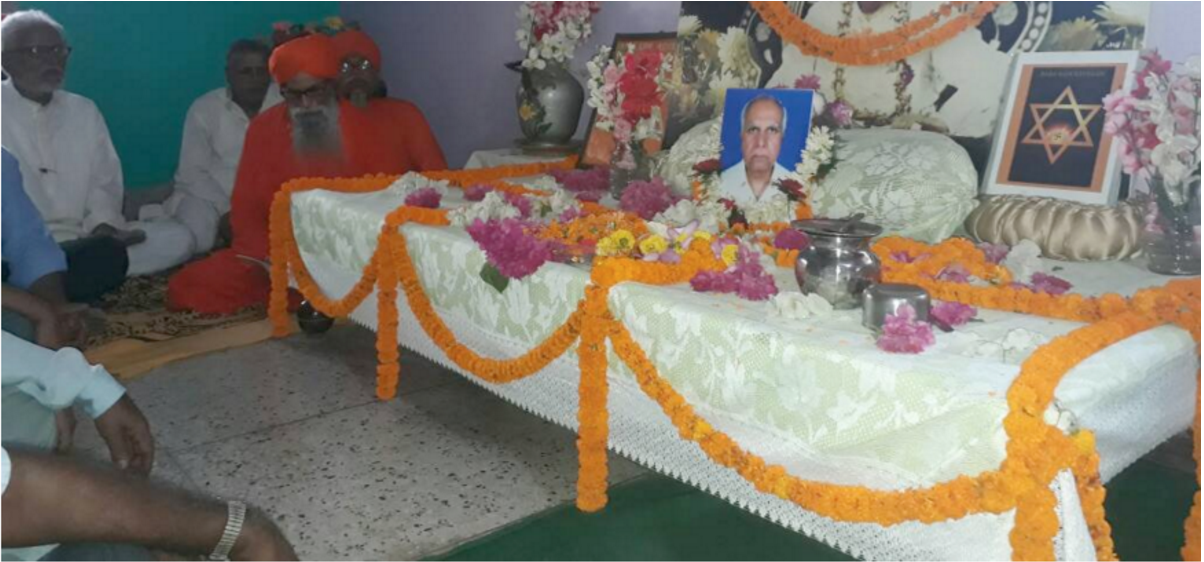
Look what happened here
But unfortunately, some fall prey to the dogma of putting a photo of the departed during the death / shraddha ceremony.

* * *
The below sections are entirely different topics, unrelated to the above material.
They stands on their own as points of interest.
* * *
== Section 2: Prabhat Samgiita ==
In one lonely place
"Eso tumi a'ma'r ghare, baso hiya'r a'sane..." (Prabhat Samgiita #0906)
Purport:
O’ Parama Purusa, please come to my humble abode and sit in the inner core of my heart. For ages and ages, I have been longing for You. My Supreme Entity, in one lonely place, in my mind I have prepared the seat of a thousand petaled lotus for You, and decorated it with the love of my heart. I have created an altar for You
and embellished it with flowers of bhakti.
O’ Supreme One, for such a long time I have been coming and going onto this dusty earth - through countless cycles of birth and death. In Your cycle of brahmacakra there is no leisure time for taking rest, i.e. no pause. Those who come one day go, and those who have gone will one day come in new life. So there is no period of repose in Your continuous cycle of srsti cakra. Always one is either coming or going. By Your grace, in one golden dawn, my spiritual journey, my sadhana to immortality started in my mind.
O’ Parama Purusa, while moving on the spiritual path, from time to time I go astray and lose the way. I compromise with my sadhana and 16 points. Each moment, fatigue overcomes my body and mind. So I am incapable of moving properly; that is why I go off the path. Baba, please forgive me; bless me and shower a wee-bit of Your causeless grace, and bring me back onto whenever I veer off in the wrong direction.
Baba, please come in my heart. In my Guru cakra, I have prepared a thousand petaled lotus for You...
== Section: Important Teaching ==
Main ingredient for sweet life
Ananda Marga philosophy says, "Those who seek to attain the permanent cessation of afflictions in their lives, have no other way than to follow this path of sadhana. Imagine that a certain person had accumulated vast wealth due to his life long's diligent labor. It may be that the person, in the days of his prosperity, was a central figure in the society. But at the end of his life he may suffered a wretched existence, bemoaning his losses in the arid desert of his heart. The reason is that the person had an insatiable thirst for material objects and never tried to identify his individual flow with the cosmic flow. On the other hand, a person living in a thatched hut may not forget Parama Purus'a even in the midst of abject poverty and never deviates from the goal of his life. Such a person's life can never lose its charm. Every dust particle of this earth will seem to be as sweet as honey to him. Likewise, his existence will acquire the sweetness of honey." (1)
Reference
1. Ananda Marga Philosophy in a Nutshell - 4, Individual Rhythm and Universal Rhythm
== Section ==
যে আনন্দমার্গকে ধ্বংস করতে পারে “পরমপুরুষ শক্তি দিয়েছেন, কাজে লাগাৰার জন্য | বিদ্বানের বিদ্যা, ৰলবানের ৰল, ৰুদ্ধিমানের ৰুদ্ধি, এগুলো দেওয়া হয়েছে পুংজী করে রাখৰার জন্য নয়; কাজে লাগাৰার জন্য | যে মানুষ তা লাগায় না, সে ঈশ্বরের কাছ থেকে কোনও কিছু চাইৰার অধিকার রাখে না | আর যে মানুষ অপব্যবহার করে, অপব্যবহার {করে} করার ফলে, জগতের তো ক্ষতি হয়েই, তার শক্তিও এক দিন শেষ হয়ে যায় | তোমরা চাক্ষুস্ দেখেছ, অতীতে কোনও একটি শক্তি, অতিদম্ভের ফলে ভেবে ছিল যে সৰ কিছু সে করতে পারে | আনন্দমার্গের উপর অকথ্য নির্য়াতন হয়েছিল | কিন্তু সেই নির্য়াতন সহ্য করেও আনন্দমার্গ মাথা তুলে দাঁড়িয়েছে | বিশ্বব্রহ্মাণ্ডে আকাশ পাতালে এমন কোনও শক্তি নেই, যে আনন্দমার্গকে ধ্বংস করতে পারে |
[“ৰাৰা, ৰাৰা, ৰাৰা !”]
কারণ আনন্দমার্গ ন্যায়-ধর্মে প্রতিষ্ঠিত | পাপ-শক্তি যদি তার সঙ্গে সংঘর্ষে লিপ্ত হয়, তো পাপশক্তি চূর্ণ-বিচূর্ণ হয়ে যাৰে | এক ফুত্কারে ফড়িয়ের মত শেষ হয়ে যাৰে | কিন্তু ক্ষমতার মোহে, ক্ষমতার মদে মত্ত হয়ে, মানুষ এই চরম সত্যটা ভুলে যায় | তার পরে যখন শক্তিহীন হয়ে যায়, তখন আফ়সোস করে | কিন্তু তখন আর আফ়সোস করে কোনও লাভ হয় না | যা যাওয়ার তা চলেই গেছে | তোমরা জান এক জন এমনই ব্যষ্টি ছিলেন, যাঁর হাতে ছিল প্রচুর শক্তি | তা যার হাতে ছিল, অভ্রংলেহী স্পর্ধা, আস্পর্ধা, ভাবত “আমি সৰ কিছু করতে পারি” | সে জানত না, নারায়ণের একটা নাম হ’ল দর্পহারী, তিনি কারও দর্প সহ্য করেন না | কারণ দর্প পছন্দ করেন না | তাকে গুঁড়িয়ে ধুল করে দেন |” (1)
Reference
1. Abhi4-11 Egiye Cala'i Ma'nus'er Dharma
== Section 3: Links ==
Recent postings
Other topics of interest

