Search This Blog

Sunday, July 7, 2019

Rare book: see the discarded section + 3 more


Baba

Rare book: see the discarded section

Namaskar, 

Recently, the topic was raised about the Ananda Marga book, “A Discussion”, which is based on the inaugural Prout conference that Baba convened from 17 - 22 Oct 1959. It is a collection of six discourses. And those six discourses were later included in the Prout in a Nutshell series and retitled as “Discourses on Prout”. So, by that way, one would think that the chapter, “Discourses on Prout” in Prout in a Nutshell (Part 4), is an exact replica of the book, “A Discussion”. But that is not the case. 

Unfortunately, there is one glaring absence that needs to be noted. On the 5th day of that inaugural Prout conference, Baba outlined the seven stages of physical revolution. That was the closing section of the discourse on 21 Oct 1959. Unfortunately, due to fear, this highly important section was discarded from the Prout in a Nutshell series chapter known as “Discourses on Prout”. 

For your records and knowledge, that missing section is presented below. The portions in the red boxes are starkly missing from the chapter, “Discourses on Prout”. 
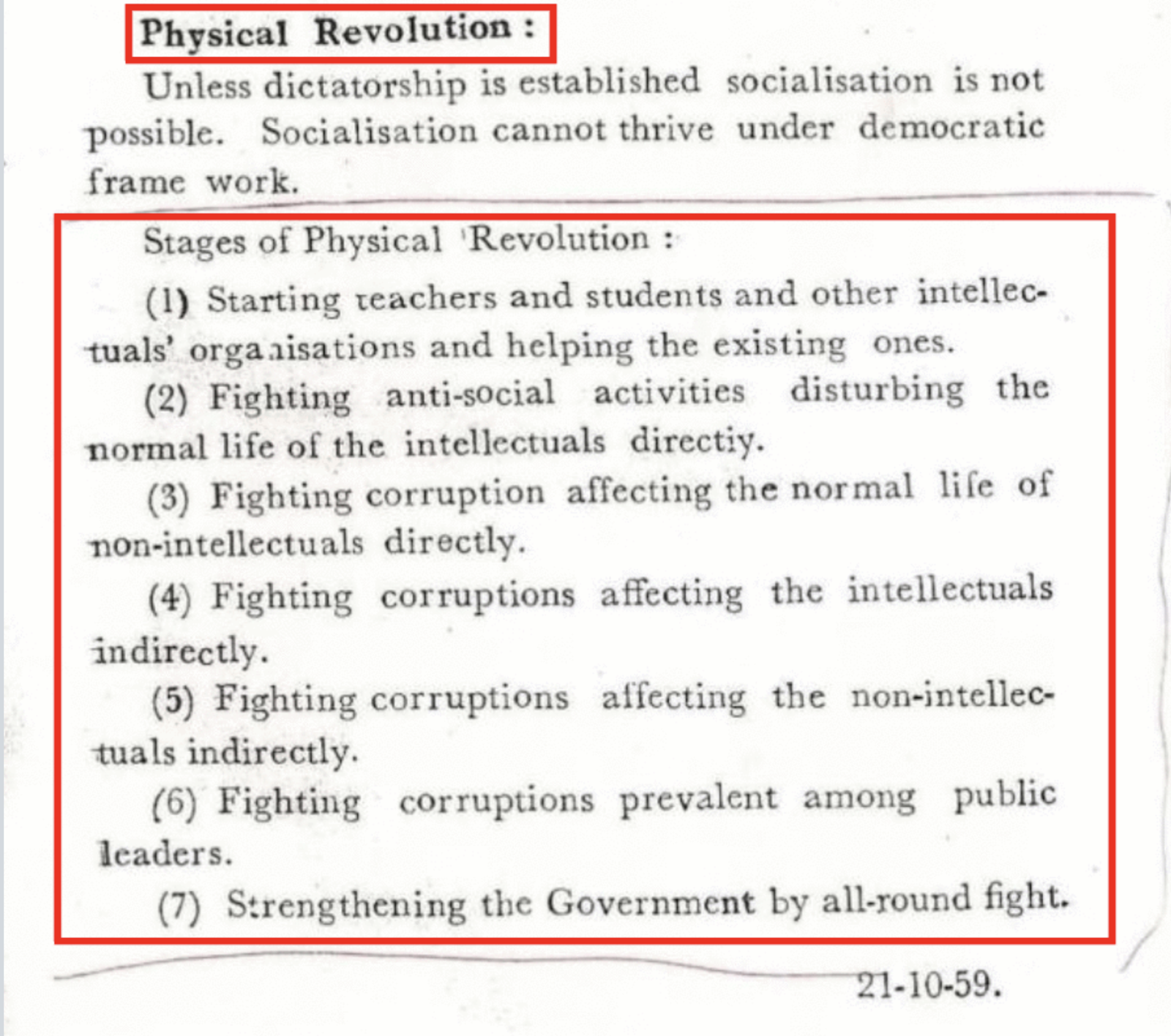


Unfortunately, due to fear, those in-charges discarded the above section - “Stages of Physical Revolution” - and never included it in the Prout in a Nutshell series, “Discourses on Prout”. Three more decades have passed and still they have not done so. Kindly add the above image to your reference library. Also find links to the scanned editions below.

In Him, 
Vijaya

Here are scanned copies of the book "A Discussion" so you can view them in their entirety. 

1st Edition (1959): https://archive.org/details/A-Discussion-English-1st-Edition

2nd Edition (1960): https://archive.org/details/adiscussionbook19602ndednscanfromxerox

- Here is a link to the initial posting on this topic: Story about rare book


*        *        *

The below sections are entirely different topics, unrelated to the above material.
They stand on their own as points of interest.

*        *        *


== Section 2: Prabhat Samgiita ==


Drum of victory resounds

“Jaya bherii báje ácambite, kár iingite bolo…” (Prabhat Samgiita #4137)

Purport:

All of a sudden, the kettle drum of victory resounds. Who gave this command - upon whose order, tell me, tell me. The voice of that Entity is heard not only in the sky and  infernal regions, but everywhere. I hear His cosmic trumpet throughout the entire atmosphere. Now, stricken with fear, where have those sinners and mahapatakiis hidden themselves? All these incidents occurred on whose watch, on whose command?

The shadow of darkness which descended and overpowered righteousness in the past, and the delusive fog of maya which covered the whole universe with selfishness and the ignorance of materialism, and the devilish teeth which were ready to swallow everything, all these things were destroyed by the fire of Kalagni the great. Each one of these incidents happened on whose lookout, under whose direction?

Now on the eastern horizon the mountain is shining. It is beautified with the truth and straightness of dharma, Prout, and neo-humanism. Who has washed it with the flame of this panoramic colour? A universal, neo-humanistic society has been formed. All these incidents happened under whose watch, upon whose command?... 


== Section 3: Important Teaching ==

India: how invading aryans subverted history


Namaskar,

Ananda Marga philosophy states, “In the Vedic era, the Aryans used to steal food grains and animals from the non-Aryans to perform their sacrifices and rituals (yajinas). In retaliation, groups of non-Aryans used to attack the Aryans to recover their possessions while they were performing their rituals. These attacks were grossly distorted in the Vedas, which gives the impression that the Aryans were good while the non-Aryans were evil. In fact, the non-Aryans were forced to attack the Aryans to recover their food to ensure their survival. Did the non-Aryans do anything bad? No, they did the right thing." (1)

In India, even today, the common public has been indoctrinated into the dogma that evil asuras were destroying the religious rituals and yajinas of aryans. They think that asuras are some type of nasty creatures that have very long teeth, dangerous claws like lions, horns on their head, and a very terrible face. That is how it is propagated in Indian mythology.

So Baba's above teaching is eye-opening. The truth about the aryans and non-aryans (i.e. the indigenous people of India) is a previously unknown aspect of history. No one was aware about this. Genealogy studies have since come to know that the so-called highest caste of Indians came from central Asia. When those aryans entered into India they treated the indigenous population as demons and created all kinds of stories and myths about them. So many false things were propagated.

Looting the food for their rituals (yajinas)


Verily those aryans created an entire mythology about such so-called asuras. The aryans claimed that demons were coming and ruining their ritualistic offerings and sacrifices of food and animals etc. But now the truth has been revealed. Those war-like aryans were looting the food of the native population and throwing that food in their sacrificial fires. In turn, the indigenous people were protesting and fighting back.

So actually, the so-called asuras were none other than the indigenous people of India. They were the original inhabitants of India, living here prior to the invasion of the aryans. Still nowadays, however they are condemned as so-called, low-caste creatures, by so-called upper-caste people. These asuras are treated unjustly and known as harijans which are regarded by upper caste people as despicable and low. But actually, these are the indigenous people of India.


Dummy purodhas exploit the masses

It is very important to accurately depict history and keep records that properly portray what transpired. Bad people always try to distort history and befool the future generations. But the truth invariably comes to the surface.

This same type of drama has unfolded in AMPS as well. Hypocrites and cheats are projecting themselves as divine; such immoralist purodhas present themselves as demigods as they exploit the mass of common margiis. Now is the crucial period - a proper historical record must be made. If we are not careful, our grand-grandsons and daughters and all future generations will be taught false things and indoctrinated into the narrow agenda of the various groups. 

in Him,
Bhaktideva

For more information about the misdeeds of immoralist purodhas, please write us. 

References
1. Prout in Nutshell - 16, Religious Dogma – Excerpt B


== Section 4: Links ==

~ Legal Notice ~
©2017 Ananda Marga Universal Forum. All rights reserved. Ananda Marga Universal Forum content is the intellectual property of Ananda Marga Universal Forum or its third party content providers. Ananda Marga Universal Forum shall not be liable for any errors or delays in content, or for any actions taken in reliance thereon. Any copying, republication or redistribution, part or full, of Ananda Marga Universal Forum content, including by framing or similar means, is against the court of law and expressly prohibited without the prior written consent of Ananda Marga Universal Forum.

This email contains four sections:
1. PS #4137: Drum of victory resounds
2. Posting: 
Rare book: see the discarded section
3. IT: India: how invading aryans subverted history
4. 
Links

Tuesday, July 2, 2019

Mahaprayan of true bhakta


Baba

Mahaprayan of true bhakta

Namaskar,

It is with much sadness that we share the news of the mahaprayan of Shrii Rakesh Ranjan of Buxar. Unfortunately, he breathed his last as his mahaprayan occurred on Tuesday, 2nd July at 11:23 pm IST at the Buxar hospital. He was bedridden for more than six months leading up to his mahaprayan. Prior he was treated at a medical center in Patna and AIIMS, Delhi. 

Shrii Ranjan was a true bhakta, born into a margii family, and dedicated to Sadguru Shrii Shrii Anandamurti ji. Verily, Ranjan ji was was ever-ready do anything and everything in service to Marga Guru. His life was fully intertwined with our Ananda Marga dharmic lifestyle. With his mahaprayan, our entire Ananda Marga society is losing a very dear brother. 

Ranjan ji was the son of Shrii Shriish Chandra, the longtime bhukti pradhan of Buxar. Ranjan and his family had numerous personal experiences with Baba. Shrii Ranjan is survived by his mother, his wife Rachana and their two children, as well as by his three brothers, Devesh ji of Mumabi, Nandan ji, and Niraj ji of Buxar.

May we all take solace in the fact that our Ranjan ji was a bhakta of Sadguru Baba. Certainly he will attain mukti or moksa, accordingly. Baba will lovingly bestow His infinite grace.

in Him, 
Dharmaviira

Note: Alert for those cremating a dead body in India or Indian managed cremation homes around the world. Their custom is to put the burning fire in the mouth of the deceased to initiate the burning of the body. This is prohibited in AM as it is uncivilised. So watch out do not allow this. If you are not careful they will end of doing it. Make them aware ahead of time. 

Ananda Marga Caryacarya states, "The practice of putting fire into the mouth of the dead body is repulsive, it should not be encouraged." (Caryacarya - 1, Disposal of the Dead Body)


~ In-depth study ~

We have seen that when somebody dies then in offering their condolences people say now Mr So-and-so is sitting on Baba's lap. On other occasions when telling a Baba story people also say, "Such and such person sat on Baba's lap." But these days the trend is that "sitting on Baba's lap" is used more in connection with death. And that causes some confusion in reader's mind. To unknot the situation please read below. 

Dogma: if "on Baba's lap" only used for death

Here are quoted lines from recently posted emails on various forums, wherein the writer uses the phrase - "in Baba's lap" - with the occasion of death:
- "May Parama Purusa Baba accept her in HIS divine lap"

- "We pray to Baba -please give him shelter in his lap... "

- "May his soul rest in the lap of our beloved BABA"

- "Now she is taking rest in Baba's Lap."

- "May Baba accept him in HIS divine lap....."

- "May he rest in HIS loving lap of eternity."

- "We are sure that Baba has taken him in His loving lap."

- "May his soul rest in Baba's lap forever."

- "Let her rest peacefully in Baba's Lap - which she always desired."

- "now he is in beloved Baba's lap"

- "May his soul get peaceful place in His lap"

- "He is now in Bábá's loving lap"

- "May Baba bless him with a seat in His lap."

- "May BABA accept him in HIS divine lap!"

- "May Baba take him in his eternal loving lap."

- "May his soul rest in peace taking shelter in Baba's lap."

- "Please keep him on Your lap forever."

- "We all collectively pray to Baba to take him on Baba's divine lap forever.”
All of the above lines are commonly written in eulogizing the deceased. These days mostly it is used in a eulogy and rarely used to recount one's intimate spiritual experiences - unfortunately. By this way, the phrase "in Baba's lap" is being misused and step by step the real meaning is being forgotten as now people more commonly use the phrase to eulogize those who have died, and much less so to express their inner feelings of bhakti. Unfortunately, the meaning and inner spirit of the phrase is getting lost.


Baba story: "sitting on Baba's lap"

Some time ago after dharmacakra, a senior margii was recounting his experiences of having dharma samiiksa with Baba. He said, "After being lovingly scolded by Baba for my wrongdoings, then He called me close and placed me on His lap - I remained there for some time soaking up His love - and He blessed me."

We all enjoyed hearing about his personal account with Baba during dharma samiiksa. When he finished telling his factual and historical event, there was a call for questions. Various people posed their queries. Towards the end, one new margii raised his hand and asked, "How did Baba bring you back to life?"

Everyone stared at the new margii in amazement. There was a look of astonishment all around - people were really shocked to hear him say this. The new sadhaka sensed that something was wrong He said very matter-of-factly, "I thought that sitting on Baba's Lap means that he (the margii) died - that is why I asked that question."

This was quite eye-opening for those of us in the room: Through our language and expression we had unknowingly taught someone to think that being on Baba's lap is the equivalent of death. Because it seems that nowadays people only use the phrase "Baba's lap" when a person has died, such as "Let him rest peacefully in Baba's lap", as if in order to sit on Baba’s lap one has to die. But that is false. Sincere sadhakas regularly sit on Baba’s lap in their meditation. It is His grace. It is just like a child need not die in order to sit on his father’s lap.

The idea is that this phrase - Baba's lap - has been linked with death due to extreme overuse. So for some time if sadhakas use this phrase exclusively for spiritual purposes, that will be best. The phrase, "sitting on Baba's lap", should not meet a similar fate. It should not lose its pure spiritual quality and just refer to one's death. That will be very negative.

Baba would bless bhaktas and place them on His lap


There are tens of thousands of recorded stories by sadhakas where they use the phrase, "on Baba's lap", when describing their experiences of being with Baba: He used to bless them and bring them on His lap. People should understand the deeply mystical value of this expression, and not just think that Baba's lap means death, i.e. that you can only sit on His lap at the time of death. Still today there are thousands of margiis walking this earth who sat in Baba's lap. And not only that, there are countless more sadhakas who were blessed by Baba in dreams and sadhana wherein they sat in His lap. And still today this deeply intimate experience is attainable by sadhakas, by His grace.

There are so many ways an aspirant can reach unto Baba's lap including in sadhana. That is the main idea that should be preserved. Sadhana is a spiritual practice and one can sit on Baba's lap in sadhana. We should make it cent-per-cent clear to one and all that the phrase, "sitting on Baba's lap", does not mean death.

"Mahaprayan" means death of mortals - confirm for yourself
from the Samsad Bengali-English Dictionary


Mahaprayan (Death): Many are aware that mahaprayan (death) is the common term used in India and especially in our Bengal to describe the death of any human being, even ordinary people. In that way, the obituary columns of the newspapers of Bengal regularly cite the mahaprayan (death) of various persons of society who died or passed away.

Some may get confused and wrongly think that the word 'mahaprayan' (death) is one extraordinarily term of bhakti to be used in association with Parama Purusa. But that is not at all the case. Rather to do so is only to undermine the eternal presence of Parama Purusa. That is why no bhaktas ever use the word 'mahaprayan' in reference to Lord Shiva or Lord Krsna. Because Lord Shiva and Lord Krsna exist eternally. Then there is no question of Their mahaprayan (death).

Baba is Parama Purusa so He is eternal and there is no question of His mahaprayan.

Here it should be known that the convention of an annual death day ceremony (i.e. shraddhainjali or mahaprayan) is a foundation of the Islamic tradition. Muslims are well known for this, and their approach of an annual death day ceremony was adopted by the leader of a particular group in AMPS. So no one should think that mahaprayan is some type of sacred event. It is done on the death day anniversary of Muslims.

And for those who need still more technical proof then all this can be clarified quite readily by referencing the dictionary. Specifically in the Samsad Bengali-English             dictionary 3rd edition on page 848. Checking there it will be confirmed that the word 'mahaprayan' means death. Which is why it is used to refer to the passing away of even common citizens. And that is the case in this letter also. The term mahaprayan means death and this is the ideal term for this purpose.

Mahaprayan is only for humans not for Sadguru


Here it should be qualified that there is both real mahaprayan and fake mahaprayan. Real mahaprayan marks the death of any ordinary human being, just like the aforesaid news. This is the proper use of the term: To note a person's departure from this earth. That is the meaning of the mahaprayan term and that is the standard way the term is used in Indian languages.

Then there is the fake, or so-called, or dogmatic mahaprayan. That is when certain vested interests try to apply the mahaprayan term to Parama Purusa. This is grossly inappropriate because when Parama Purusa Sadguru Baba is that Divine Entity who is beginningless and endless and resides always in our heart, then it is entirely wrong to proclaim that He is gone.

That is why rational margiis are protesting; because the Oct 21st program is so-called mahaprayan. So-called means that something is fake. Parama Purusa is eternal, thus for some vested interests to declare "mahaprayan of Parama Purusa" is nothing but so-called mahaprayan.

Mahaprayan only really happens in the case of human beings, not Parama Purusa. Those doing mahaprayan for Sadguru are hypocrites. On the one side in meditation they ask His grace thinking that He is ever-present, and on the other side they think that Baba has passed way. That is their hypocrisy.


Reply to: anandamargauniversal1@yogasamsthanam.net


~ Legal Notice ~
©2017 Ananda Marga Universal Forum. All rights reserved. Ananda Marga Universal Forum content is the intellectual property of Ananda Marga Universal Forum or its third party content providers. Ananda Marga Universal Forum shall not be liable for any errors or delays in content, or for any actions taken in reliance thereon. Any copying, republication or redistribution, part or full, of Ananda Marga Universal Forum content, including by framing or similar means, is against the court of law and expressly prohibited without the prior written consent of Ananda Marga Universal Forum.

SUBJECTS TOPICS