Search This Blog

Wednesday, May 15, 2019

News: AM ideals enforced by court order + 2 more


Baba

News: AM ideals enforced by court order

Namaskar, 

In our AM way of life, we do not serve or eat food at a shráddha (death) ceremony - nor at any dogmatic annual death day ceremony like mahaprayan.

Ananda Marga Caryacarya states, “Shráddhánna: Shráddhánna (food offered at a memorial service) is neither priityanna nor ápadanna, hence it is not to be taken.” (1)

And now Baba’s dharmic ideals are coming into form the general society as well. Baba has infused the vibration, and in the below article the government has made it illegal to do a mass feeding as part of a death ceremony. The punishment is 1 year in jail.  A court order has banned death day food distribution etc. 
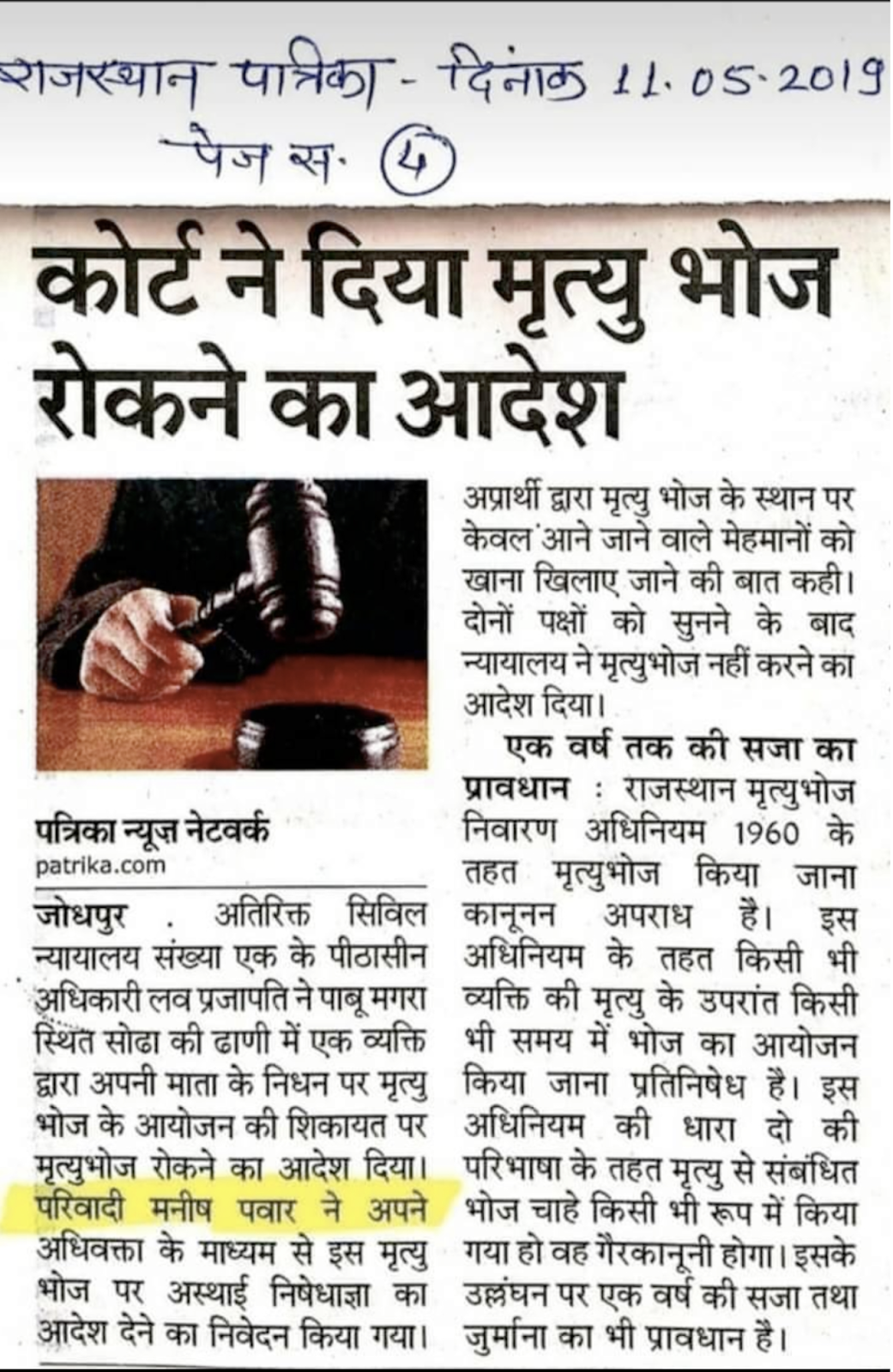


In the above below article, the government has made it illegal to do a mass feeding as part of a death ceremony. The punishment is 1 year in jail.  Verily, a court order has banned death day food distribution etc. This upholds Baba’s dharmic ideal and shows how Baba has infused the spiritual vibration to inculcate AM ideals to all corners of the earth - and beyond.

In Him,
Natavar Singh

Reference
1. Caryacarya, Part 2, Society, Point #37


== Section 2: Prabhat Samgiita ==

You took advent as Mahasambhuti

Note: Only those who sincerely practice the higher lessons of sahaja yoga meditation can understand this song in the depths of their heart.

"Yugántarer tamasá náshite, álor jhalake esechile..." (Prabhat Samgiita #4718)

Purport:

My Parama Purusa, to eliminate the darkness piled up over the ages, You came in the flow of light. In those dark days of the distant past the whole society was drowned in dogma and everyone was suffering in pain and agony. In that desperate moment, in a flash of lightning - floating in the rhythm of dance, You took advent as Mahasambhuti. You came and showered Your grace to wipe away the age-old staticity and inundate this earth with bhakti. 

Baba, Parama Purusa, before Your auspicious arrival, it was very bleak; there was no positive pulsation of life. Just there was sorrow and misery in every direction. People were depressed. The society was submerged in the murkiness of materialism and selfishness. There was greediness, infighting, and hatred all around.  Nobody had the stamina to shake the struggling humanity from its inertia. No one valiantly came forward and declared, “Arise, awake, the new dawn has come! Get rid of all dogma and follow the path of neo-humanism!” No one called out, “Always keep the great ideology in mind: True progress is only when one is advancing towards divinity, Supreme fulfillment, and the Cosmic Entity.” 

My eternal Bandhu, Your victorious chariot is fast moving forward, with its rattling sound, in the bhuloka, duloka, and triloka and throughout the infinite arena. Your exquisite vibration is reaching each and every corner of this vast cosmos. The entire universe is being transformed in all the realms: physical, psychic, and spiritual. O’ Parama Purusa, You told everyone this eternal truth, “In your frustration do not sit and cry in the depths of hell. Arise, awake, and follow the sublime path. Human life is very valuable and you must not forget that Your destination is Parama Purusa.” Baba, You bestowed this magnificent and blessing upon all.

Parama Purusa, You came and wiped away all the darkness by infusing Your endless refulgence. It is Your grace, it is Your mercy...

Note about Prabhat Samgiita #4718:

The below passage from Ananda Marga ideology following discourse expresses the conclusive idea of this Prabhat Samgiita.

Ananda Marga ideology says, "O human beings, you are fortunate. The clarion call of the Universal has reached you. Not only has the call come, but you are hearing it and it is vibrating in every cell of your body. Will you now lie in the corner of your house as an inert being and waste your time by clinging to old skeletons and bemoaning them? The Supreme Being is calling you in the  roar of the ocean, in the thunder of the clouds, in the speed of lightning, in the meteor's flaming fires. Nothing good will come from idleness. Get up and awake the clouded chivalry of your dormant youth. It may be that the path is not strewn with flowers and that inferiority complex will be attempting to hold fast your each advancing step, but even then you have to proceed onwards tearing the shroud of darkness. You will tear the thick darkness of despair as you advance in the racing chariot radiant with the Sun's brilliance towards the attainment of the Supreme state." (1)

Those same divine ideas which Sadguru has given in His various discourses are also present in Prabhat Samgiita. That means the ideas which have been given in prose have also been given in the music and poetry of Prabhat Samgiita. The main difference between Ananda Marga ideological discourses and Prabhat Samgiita is that Prabhat Samgiita is quite concentrated. Those teachings of Prabhat Samgiita are presented in a very condensed form - such as in half a line or less; whereas in Ananda Marga discourses that same idea might be explained over the course of several pages or more. That is why without proper translations and purports, Prabhat Samgiita is often unintelligible.

Reference
1. Subhasita Samgraha - 1, The Call of the Supreme


== Section 3: Links ==

Ananda Purnima - Sat 18 May 2019

Legal Notice: ©2019 Ananda Marga Universal Forum. All rights reserved. Ananda Marga Universal Forum content is the intellectual property of Ananda Marga Universal Forum or its third party content providers. Ananda Marga Universal Forum shall not be liable for any errors or delays in content, or for any actions taken in reliance thereon. Any copying, republication or redistribution, part or full, of Ananda Marga Universal Forum content, including by framing or similar means, is against the court of law and expressly prohibited without the prior written consent of Ananda Marga Universal Forum.

For posting translation / जो अंग्रेजी नहीं जानते : 
Those who face difficulty in understanding English should copy sections of the post, paste them into Google translate or any other on-line translator, choose whatever language you like, and the post will be translated then and there into your selected language. In this way you will get some approximate idea of the subject discussed. Here is the link for Google translate: https://translate.google.com.

This email contains three sections:
1. PS #4718: You took advent as Mahasambhuti
2. IT: News: AM ideals enforced by court order
3. Links


Sunday, May 12, 2019

WT of which grade bhakti: proof

Baba

WT of which grade bhakti: proof

Namaskar,

In his book, one very senior Wt Dada has written something that makes it very clear to readers what grade of sadhaka he is: top, middle, or lowest. Kindly continue reading to get the answer.

A child who has many siblings will not say, “This is our mother.” The child will use the phrase “my mother”. A child will always say, “This is my mother.” Because the child has an extremely personal relation with its mother. That child feels that, “My mother belongs to me and me only.” That is why the term "my" is used. Similarly, A-grade bhaktas cannot share Parama Purusa. They will never say,  “Amader Baba”, they will say, “Amar Baba”; ie. they will not say, “Our Baba”, they will say, “ My Baba.”
http://anandamarganewsbulletin.blogspot.com/

First grade of bhaktas & their call

The relation between Parama Purusa and the aspirant is based on bhakti. And there are various grades of bhakti. As one feels closer to Parama Purusa, it means their level of bhakti has increased. When one feels more distant from Parama Purusa, it means they have lower bhakti. Baba has clearly outlined this in His discourses. The below teaching clearly defines the highest level of bhakti.

Ananda Marga ideology states, “Bhakta’s of the highest category think, “Parama Purus'a is mine only and He belongs to no one else.” This is the sign of an excellent sa'dhaka…... “He is mine and mine alone and He does not belong to anyone else”.” (1)

Per the teachings of Ananda Marga ideology, in this top-most level of bhakti, the bhakta feels that, “Parama Purusa is mine – He only belongs to me – He is my personal property.” Certainly many on the path of Ananda Marga have this type of feeling. They have a personal relation with Parama Purusa. This is the way spiritual practice is done. There is no third entity present, only there is the bhakta and Parama Purusa. Such bhaktas say 'my God.' They never say 'our God.' Those who say “our God” are 3rd class bhaktas.
http://anandamarganewsbulletin.blogspot.com/


Slogans of various grades of bhaktas
আমাদের ৰাৰা কী জয় -- তৃতীয় শ্রেণীর স্লোগ্যান

In review there are three grades of bhaktas:
  • 3rd grade bhaktas say, “Victory to our collective Baba who belongs to all of us, and me also.”
  • 2nd grade bhaktas say, “Victory to Baba who belongs to me, as well as everybody else.”
  • 1st grade bhaktas say, “Victory to my Baba who belongs to me and only me.”
Top grade bhaktas have a personal relationship with Parama Purus'a. So 1st grade bhaktas do not raise the slogan, “A'ma'der Baba ki – Jai”, i.e. “Victory to our collective Baba.” Top grade bhaktas never say, “Our Baba”. Those who say “Our Baba” are 3rd class bhaktas. Yet, that is what one very senior Dada has done in his book; he used the phrase, “Our Baba”.


Conclusion

The slogan of 3rd class bhaktas is: A'ma'der Baba ki – jai! So first grade bhaktas do not raise the 3rd class slogan – A'ma'der Baba ki – jai! Because it is for the mindset of 3rd class bhaktas.

Namaskar,
in Him,
Madhumita' Bose

Dada is 3rd grade bhakta

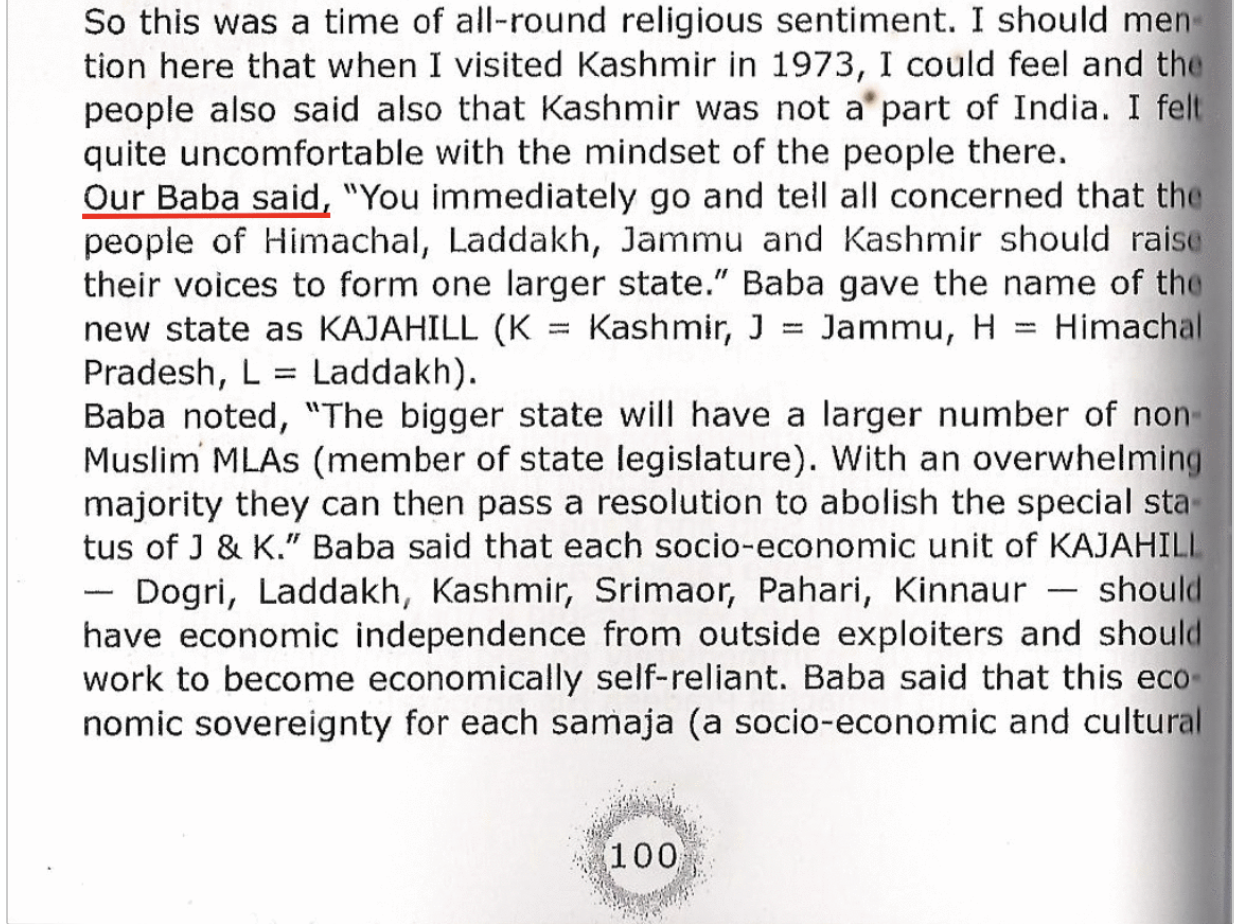
Here below, on page 100 of his book one very senior Wt  Dada writes the phrase “Our Baba”, underlined below in red. By this way, this very senior Wt Dada exposes himself as being the lowest grade type of sadhaka.


Here above, Dada Vandanananda writes the phrase “Our Baba”, underlined in red. By this way, Dada Vandanananda shows himself as being a 3rd grade sadhaka, i.e. the lowest category, unfortunately.

Ananda Marga ideology states, “Bhakta’s of the highest category think, “Parama Purus'a is mine only and He belongs to no one else.” This is the sign of an excellent sa'dhaka…... “He is mine and mine alone and He does not belong to anyone else”.” (1)

Sauch A grade  sadhaka say my Baba, they never say our Baba

Child says she is "my" mother - not she is "our" mother

Since all are familiar with teachings of Ananda Marga ideology on this subject, the overall idea can be summed up very succinctly. When one feels more close with Parama Purusa, the bhakta thinks that. “He is mine and mine alone.” They have a personal relation with Parama Purusa. It is just like a child who has many siblings never refers to his own mother, “She is our mother; rather the child only thinks, “she is my mother.” So A-grade bhaktas are immersed in the deeply personal feeling that, “Baba is mine – He belongs only to me.”
http://anandamarganewsbulletin.blogspot.com/


Key point

The main point concludes here but those who want to know more about this issue may continue reading.

Ananda Marga philosophy states, “Suppose there is a flower and there are two hundred mirrors. The reflection of the flower is in all two hundred mirrors. Will it be incorrect if each particular mirror says, “The flower is mine only”? So it is not selfishness, it is a fact, it is a crude reality, that for each and every entity, Parama Puruśa is a personal entity, Parama Puruśa is non-transferable. It is a fact, that is, Parama Puruśa is personal property. What is spiritual practice? It is the movement of the mirror towards the Nucleus, towards that flower.” (2)

So A-grade bhaktas do not raise the slogan – A'ma'der / Our Baba ki – Jai! Such bhaktas do not share Parama Purusa with anyone.


~ For in-depth reading ~

Third grade bhaktas & their slogan

In the lowest stage of bhakti, the relation with Parama Purusa is very distant - not personal nor intimate. The aspirant feels that Parama Purusa is the collective property of all. So the personal link is  essentially missing.

Ananda Marga ideology states, “The bhaktas of the lowest category think, “As Parama Purus'a belongs to all, so certainly He belongs to me as well because I am one of the multitude.” Thoughts of this type are not very congenial for one's spiritual progress.” (3)

The 3rd grade bhakta thinks, “Since Baba belongs to all, and since I am one of the masses, then He must also be mine.” This mindset is not indicative of a close, personal, intimate relation with Parama Purusa. That is why they raise a collective the slogan – A'ma'der Baba ki –Jai! Note: A'ma'der means our, ie victory to our collective Baba.

So this 3rd grade bhakti is not very conducive for spiritual progress, i.e. coming close to Him. Because such persons do not have a personal relation with Parama Purusa.
http://anandamarganewsbulletin.blogspot.com/


Levels of jai slogans

The feelings of bhakti outlined above come into form in so many aspects of our lives: In our conversations, manan (thinking of Him), and in our reflections, stories etc, including the way in which we raise the Jai slogan.

For instance, the proper way of raising the jai slogan is: Parama Pita Baba ki – Jai! In this manner, the basic spirit is Victory to Baba, my Father - and does not refer to Baba as being the collective Father of all people. For instance, a son who has many siblings never refers to his own father by saying “our father” - i.e. “the father of myself and all my siblings.” Rather that child says “my father” - as the son feels his father belongs to him alone. Similarly, in the field of bhakti, the sense is that one's mind is pointed on the Divine Father, Parama Purusa in a more personal way where the bhakta feels that, “He belongs to me and me alone.”

The possessive pronoun – my – is understood as people always think of their father as “my father”. No one thinks our father.

The overall meaning is: Victory to My (personal) Divine Father Baba. They do not raise the slogan – A'ma'der Baba ki – jai!
http://anandamargauniversal.blogspot.com


Slogans of bhaktas of the lowest category

Some wts regularly bring the slogan: A'ma'der Baba ki – jai!

A'ma'der means ‘Our collective'; Baba ki means ‘of Baba'; jai means ‘victory'.

The overall meaning is: Victory to our (collective) Baba.

The sense of the slogan - A'ma'der Baba ki – jai! - is that, “Parama Purusa belongs to all, He is the collective property of everyone and not the personal possession of a single bhakta.” The overall meaning is: Victory to our collective Baba.

In spiritual life, this type of ideation is not beneficial for A-grade bhaktas – rather it is detrimental and limiting.

The slogan – A'ma'der Baba ki – jai! – is a less personal expression and reflects 3rd grade level of bhakti, since one is thinking that Parama Purusa belongs to all.


Bhaktas of the lowest category think

Ananda Marga ideology guides us, “The bhaktas of the lowest category think, “Parama Purus'a belongs to all...Thoughts of this type are not very congenial for one's spiritual progress.” (4)

Why isn’t this congenial to one's spiritual progress? Because it does not exemplify the same type of true love like the child who says “my father”. No child refers to his father as “our father.” Rather a child feels exclusive ownership of his father and says, “my father.”

3rd class people raise the – A'ma'der Baba ki – jai! - slogan, where Parama Purusa, is shared in a collective manner. He is not one's personal property. This type of thinking is ultravarious to spiritual closeness.
http://anandamarganewsbulletin.blogspot.com/


Which one amongst these three is philosophically correct

    Ananda Marga philosophy states, “There are three categories of devotees: A, B, and C. The C category of devotees says, “Parama Puruśa is the creator of everything, He is the creator of the entire Universe, and I am also a part and parcel of this Universe, so he belongs to me also.” The B category of devotees says, “Parama Puruśa is mine, but because others are also creations of Parama Puruśa, Parama Puruśa belongs to others also.” But the first thought is that Parama Puruśa is “mine”, and the second thought is that Parama Puruśa belongs to others also. The A category of devotees says, “I am ready to share everything with others, but regarding Parama Puruśa I am selfish. Parama Puruśa belongs to me only, and to nobody else.”
    "Now let us see which one amongst these three is philosophically correct, or psychologically or scientifically correct."
   “Suppose there is a flower and there are two hundred mirrors. The reflection of the flower is in all two hundred mirrors. Will it be incorrect if each particular mirror says, “The flower is mine only”? So  it is not selfishness, it is a fact, it is a crude reality, that for each and every entity, Parama Puruśa is a personal entity, Parama Puruśa is non-transferable. It is a fact, that is, Parama Puruśa is personal property. What is spiritual practice? It is the movement of the mirror towards the Nucleus, towards that flower.” (5)

The key point is that first grade bhaktas should not blindly raise 3rd class slogan – A'ma'der Baba ki – jai! The important difference between the 2nd & 3rd grade bhaktas is this. The 2nd grade bhakta thinks that Parama Purusa is mine, and then reasons that He must belong to others as well.

And for those who wish to know even more - keep reading...

Second grade bhaktas & their slogan

And here is more about 2nd grade bhaktas.

Ananda Marga ideology states, “The second category of bhaktas...think, “Parama Purus'a is mine, and thus He must belong to others also.” That is, the bhaktas...have no hesitation in sharing Parama Purus'a with others.” (6)

Here due to a lack of closeness with Parama Purusa, the second-grade bhakta feels that Parama Purusa belongs to me, but reasons that He must belong to others also. This type of outlook only occurs when they do not have a personal relation with Parama Purusa. And in that case, they raise a collective slogan for Baba, i.e. “A'ma'der Baba ki – Jai!.”
http://anandamarganewsbulletin.blogspot.com/


Those leading this slogan are more responsible

We should clarify that this does not mean that everyone who ever raised this slogan - A'ma'der Baba ki – jai! - is a lower tier bhakta. Rather, we can say that those leading this slogan are more responsible. After all they are the ones who selected the slogan. The margiis and wts in attendance may or may not feel this way. After all, they are just responding to the call, without analysing its value.


References
1. Subhasita Samgraha -11, What Is the Way?
2. Two Hundred Mirrors, 17 May 1979 evening, Berlin
3. Subhasita Samgraha -11, What Is the Way?
4. Subhasita Samgraha -11, What Is the Way?
5. Two Hundred Mirrors, 17 May 1979 evening, Berlin
6. Subhasita Samgraha -11, What Is the Way?


== Section: Important Teaching ==

Why degrading books are best-sellers

Ananda Marga philosophy says,"These days Sáhitya Sarasvatii [the goddess of art and learning] is mortgaged to Lakśmii [the goddess of wealth], for the value of the goddess of learning now depends upon the favours of the goddess of wealth. Whatever the quality of the writing, if the publisher is well-established, the book will sell well in the market due to effective advertising. Thus the indigent sáhityika suffers humiliation as he or she cringes at the doors of reputed publishers; and publishers are quick to exploit this situation in their favour. Due to publicity stunts and propaganda, it has become impossible for the common people to know which book is good and which is not." (1)

Ananda Marga philosophy says, "There is a flagrant dearth of developed critical literature or critical magazines in every country of the world. Books sell in the market on the strength of publicity skills, or on the strength of how they excite the lower human propensities, or in some cases by their crude ability to provide entertainment for the common masses. That is why we find that books published by the authors themselves, regardless of how good they are, do not sell well in the market. On the other hand, books which excite people’s sexuality, whatever might be their content or language, sell extremely well." (1)

Ananda Marga philosophy says, "...Thus sales are not a criterion for judging the superiority of a book. It is therefore a great problem for the readers, purchasers and library directors to select books, and there will be no solution to this problem as long as high-quality critical literature and critical reviews are not available." (1)

References
1. A Few Problems Solved - 1, The Practice of Art and Literature


== Section 2: Links ==


SUBJECTS TOPICS